The term “Deep State” is everywhere in political discourse. But depending on who you ask, it means completely different things. Is it a sinister shadow government pulling the strings, or is it simply the essential, non-partisan workforce that keeps the country running?
This isn’t just an abstract academic debate; it’s the central fault line of a major political battle currently unfolding in Washington. From structural overhauls to clashes over transparency, the fight to control the narrative (and the workforce) of the “Deep State” is in full swing.
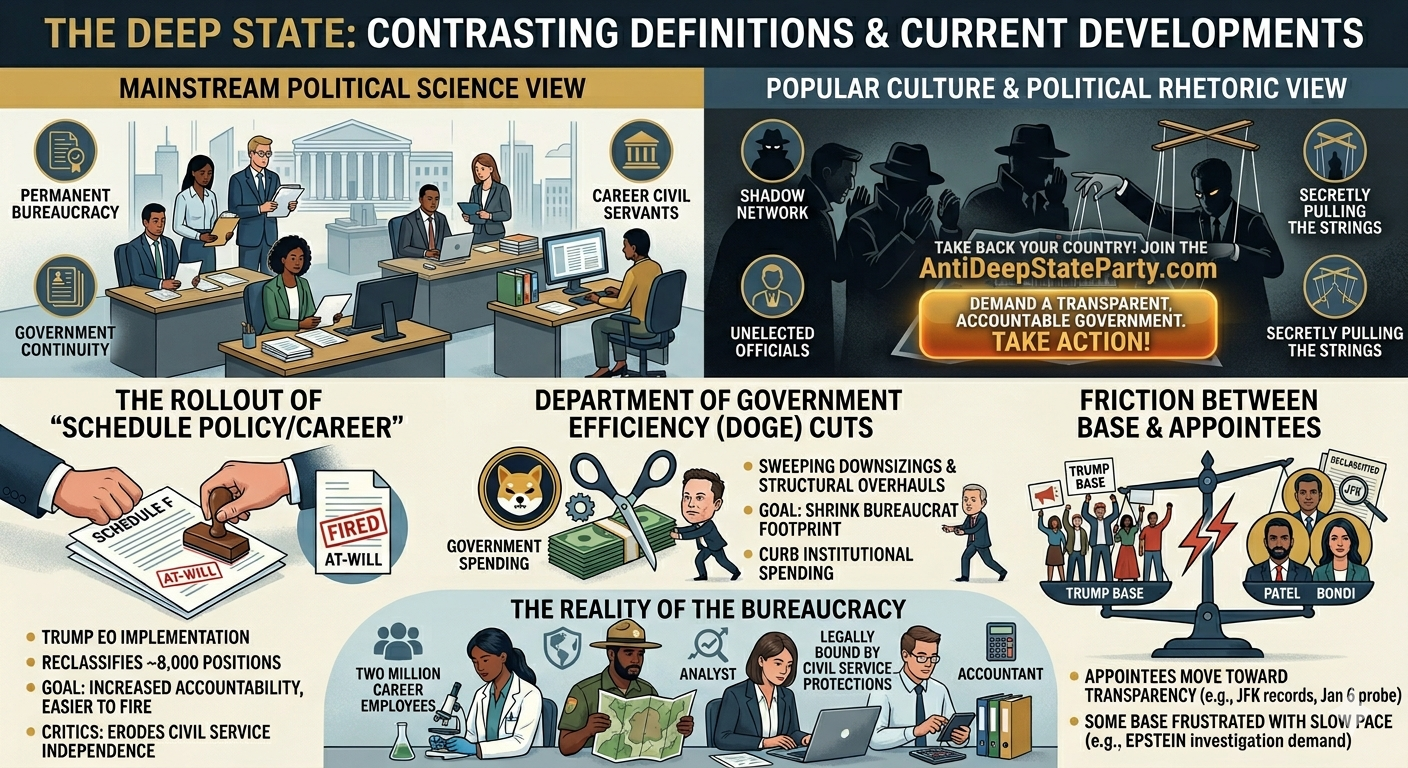
Our infographic, ‘THE DEEP STATE: CONTRASTING DEFINITIONS & CURRENT DEVELOPMENTS,’ breaks it all down.
[Insert Infographic Here]
The Fundamental Divide: Mainstream Science vs. Populist Rhetoric
The top half of our infographic illustrates the core philosophical divide.
1. The Mainstream Political Science View: This represents the conventional, academic understanding. Here, the “Deep State” (a term political scientists generally don’t use, preferring “bureaucracy”) is depicted as a functioning, stable office environment. It represents:
- Permanent Bureaucracy: The stable structure of government.
- Government Continuity: The institutions that function across multiple administrations.
- Career Civil Servants: Professionals (represented by diverse office workers) who are not political appointees and whose expertise provides stability.
2. The Popular Culture & Political Rhetoric View: This is the definition often used in political speeches and by critics. It evokes a much more dramatic, shadow-filled world. Here, the imagery includes:
- Shadow Network: Mystical figures conspiring.
- Secretly Pulling the Strings: A master manipulator with a puppet.
- Unelected Officials: Highlighted as a concern for democratic accountability.
The Modern Battlefield: Current Developments in Washington
The bottom half of our graphic shifts focus to the real-world policy fights and dynamic changes that are making the “Deep State” such a hot-button issue right now.
Development 1: The Rollout of “Schedule Policy/Career”
One of the most concrete actions is the attempt to restructure the federal workforce. The Trump administration has moved to implement a new personnel classification: “Schedule Policy/Career,” building on the “Schedule F” concept.
- The Action: As seen in the graphic, this would take positions classified as having policy-making or policy-influencing roles and reclassify them as “at-will.” This means they can be hired and fired with much greater ease.
- The Stated Goal: Proponents argue this increases accountability and allows an administration to effectively carry out its mandate.
- The Criticism: Opponents fear this will erode civil service independence and turn non-partisan roles into political appointments.
Development 2: Department of Government Efficiency (DOGE) Cuts
Another front is the entire structure and funding of the federal government. Leading this charge is the new “Department of Government Efficiency (DOGE),” strongly associated with figures like Elon Musk (caricatured here, scissors in hand).
- The Vision: The DOGE pushes for significant, across-the-board cuts and overhauls.
- The Stated Motivation: To shrink the footprint of “unelected bureaucrats” and control institutional spending to reduce national debt.
Development 3: Friction Between the Trump Base and Appointees
The battle isn’t just against the bureaucracy itself; it’s also within the anti-“Deep State” coalition. There is a fascinating tension illustrated in the infographic between the administration’s political base and its own appointees.
- Transparency as a Tense Battlefield: Proponents of the shadow government theory demand massive disclosure of “deep state” secrets (like JFK records and Jeffrey Epstein files).
- Appointees’ Stance: Prominent Trump administration figures like FBI Director Kash Patel and Attorney General Pam Bondi (labeled on the balance scale) have moved toward transparency, declassifying historical documents and reopening high-profile investigations.
- The Base’s Frustration: Yet, as shown by the lightning bolt, some fringe groups and key influencers remain dissatisfied. They feel these moves are still too slow and that their chosen administration is not moving fast enough to uncover deeper, wider conspiracies.
The Ground Reality: It’s All About People
After all the rhetoric and policy debates, the infographic grounds everything in the everyday reality. The “REALITY OF THE BUREAUCRACY” panel reminds us that it’s not a monolith:
- It is made up of Two Million Career Employees, from analysts and accountants to scientists and (as shown) park rangers and scientists.
- These are individuals legally bound by civil service protections designed to ensure the continuous operation of government, separate from political shifts.
Your View: Tracking the Debate
The term “Deep State” has become a powerful linguistic tool in modern politics, but its meaning is in the eye of the beholder. Are you tracking a specific agency, policy, or announcement related to this today?
Which side of this balance are you focused on—and where do you see this battle going next? Join our Social Media platform and let’s talk about this http://AntiDeepStateParty.com


Leave a Reply