The term “Deep State” is everywhere in political discourse. But depending on who you ask, it means completely different things. Is it a sinister shadow government pulling the strings, or is it simply the essential, non-partisan workforce that keeps the country running?
This isn’t just an abstract academic debate; it’s the central fault line of a major political battle currently unfolding in Washington. From structural overhauls to clashes over transparency, the fight to control the narrative (and the workforce) of the “Deep State” is in full swing.
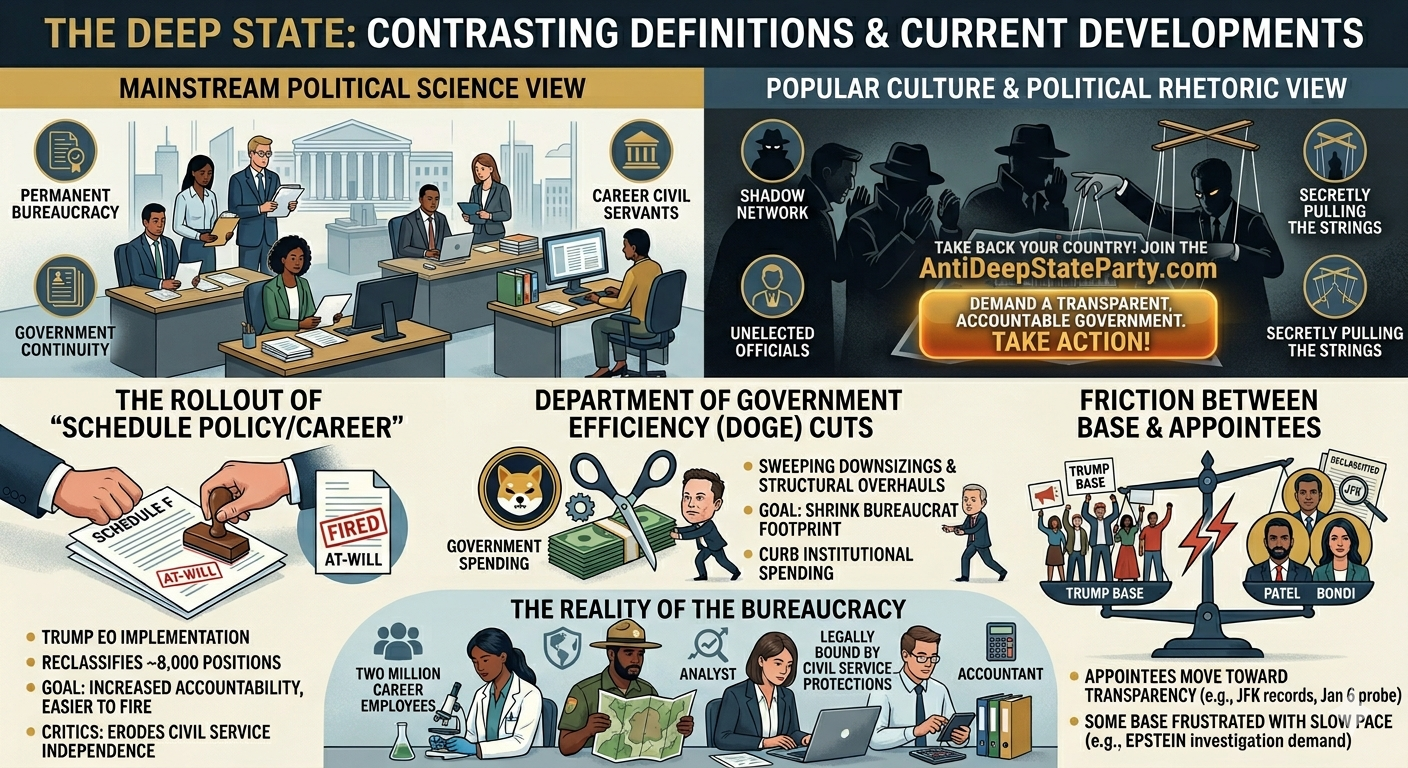
Our infographic, ‘THE DEEP STATE: CONTRASTING DEFINITIONS & CURRENT DEVELOPMENTS,’ breaks it all down.
[Insert Infographic Here]
The Fundamental Divide: Mainstream Science vs. Populist Rhetoric
The top half of our infographic illustrates the core philosophical divide.
1. The Mainstream Political Science View: This represents the conventional, academic understanding. Here, the “Deep State” (a term political scientists generally don’t use, preferring “bureaucracy”) is depicted as a functioning, stable office environment. It represents:
Permanent Bureaucracy: The stable structure of government.
Government Continuity: The institutions that function across multiple administrations.
Career Civil Servants: Professionals (represented by diverse office workers) who are not political appointees and whose expertise provides stability.
2. The Popular Culture & Political Rhetoric View: This is the definition often used in political speeches and by critics. It evokes a much more dramatic, shadow-filled world. Here, the imagery includes:
Shadow Network: Mystical figures conspiring.
Secretly Pulling the Strings: A master manipulator with a puppet.
Unelected Officials: Highlighted as a concern for democratic accountability.
The Modern Battlefield: Current Developments in Washington
The bottom half of our graphic shifts focus to the real-world policy fights and dynamic changes that are making the “Deep State” such a hot-button issue right now.
Development 1: The Rollout of “Schedule Policy/Career”
One of the most concrete actions is the attempt to restructure the federal workforce. The Trump administration has moved to implement a new personnel classification: “Schedule Policy/Career,” building on the “Schedule F” concept.
The Action: As seen in the graphic, this would take positions classified as having policy-making or policy-influencing roles and reclassify them as “at-will.” This means they can be hired and fired with much greater ease.
The Stated Goal: Proponents argue this increases accountability and allows an administration to effectively carry out its mandate.
The Criticism: Opponents fear this will erode civil service independence and turn non-partisan roles into political appointments.
Development 2: Department of Government Efficiency (DOGE) Cuts
Another front is the entire structure and funding of the federal government. Leading this charge is the new “Department of Government Efficiency (DOGE),” strongly associated with figures like Elon Musk (caricatured here, scissors in hand).
The Vision: The DOGE pushes for significant, across-the-board cuts and overhauls.
The Stated Motivation: To shrink the footprint of “unelected bureaucrats” and control institutional spending to reduce national debt.
Development 3: Friction Between the Trump Base and Appointees
The battle isn’t just against the bureaucracy itself; it’s also within the anti-“Deep State” coalition. There is a fascinating tension illustrated in the infographic between the administration’s political base and its own appointees.
Transparency as a Tense Battlefield: Proponents of the shadow government theory demand massive disclosure of “deep state” secrets (like JFK records and Jeffrey Epstein files).
Appointees’ Stance: Prominent Trump administration figures like FBI Director Kash Patel and Attorney General Pam Bondi (labeled on the balance scale) have moved toward transparency, declassifying historical documents and reopening high-profile investigations.
The Base’s Frustration: Yet, as shown by the lightning bolt, some fringe groups and key influencers remain dissatisfied. They feel these moves are still too slow and that their chosen administration is not moving fast enough to uncover deeper, wider conspiracies.
The Ground Reality: It’s All About People
After all the rhetoric and policy debates, the infographic grounds everything in the everyday reality. The “REALITY OF THE BUREAUCRACY” panel reminds us that it’s not a monolith:
It is made up of Two Million Career Employees, from analysts and accountants to scientists and (as shown) park rangers and scientists.
These are individuals legally bound by civil service protections designed to ensure the continuous operation of government, separate from political shifts.
Your View: Tracking the Debate
The term “Deep State” has become a powerful linguistic tool in modern politics, but its meaning is in the eye of the beholder. Are you tracking a specific agency, policy, or announcement related to this today?
Which side of this balance are you focused on—and where do you see this battle going next? Join our Social Media platform and let’s talk about this http://AntiDeepStateParty.com
Many claim that The Shroud of Turin is Jesus Christ but the Knights Templar claim that this is Jacques de Molay. I myself would like to think that this is Jesus Christ but with my research and understanding of history tend to lead me to believe that this is indeed Jacques de Molay and not Jesus Christ.
Geoffroi de Charny (the French Knight who died at the 1356 battle of Poitiers) and his wife Jeanne de Vergy are the first reliably recorded owners of the Turin Shroud. This Geoffroi participated in a failed crusade under Humbert II of Viennois in the late 1340s.[26] He is sometimes confused with Templar Geoffroi de Charney.[27]
Any discussion of the Shroud of Turin is bound to be controversial. Those who view this sacred and holy relic fall into two camps, those that believe it to be the undisputed earthly evidence of a Christ risen and those who believe it to be a medieval forgery.
It is not the intention of this web site to cast doubt on or support the authenticity of the shroud, but rather to show its possible relationship to the Knights Templar. We receive many letters from angry people who wish to enter into lengthy debates about carbon 14 reliability. We are aware of new evidence that puts the reliability of carbon 14 dating in question, so please refrain from telling us of the findings or directing us to URLs that make the claims.
There are two theories that relate to the Templars having been involved with the Shroud, one, which would support the authenticity of the Shroud and another, which would refute it.
In 1204 the Crusaders sacked the city of Constantinople. Among them were the Knights Templar, whom some scholars contend took the Burial shroud of Jesus from the city. To support this theory, author Ian Wilson who wrote the book “The Shroud of Turin: Burial Cloth Of Jesus?” makes the claim that the head that the Templars were accused of worshipping was none other than that of Jesus. His belief is that the Shroud when folded depicted the head of Christ and was referred to as the “Mandylion.” There is a painted panel at Templecombe in England that shows a bearded head like that, which is depicted on the Mandylion.
In their two books, “The Hiram Key” and “The Second Messiah,” authors Christopher Knight and Robert Lomas paint a contrasting picture to the Mandylion theory. The authors theorize that the image on the Shroud of Turin is in fact that of the last Grand Master of the order, Jacques de Molay, who was tortured some months before his execution in 1307. The image on the shroud certainly does fit the description of de Molay as depicted in medieval wood cuts, a long nose, hair shoulder length and parted in the center, a full beard that forked at its base, not to mention the six-foot frame. De Molay was said to be quite tall.
However, many have criticized the theory on the basis that the Templar rule of order forbade the Templars from growing their hair long. What critics of the theory overlook is that during DeMolay’s seven years in prison it is highly unlikely that he would have been afforded such luxuries as good grooming.
Knight and Lomas claim that the shroud figured in the Templars rituals of figurative resurrection and that DeMolay’s tortured body was wrapped in a shroud, which the Templars kept after his death. Lomas and Knight further believe that lactic acid and blood from DeMolay’s tortured body mixed with frankincense (used to whiten the cloth) etching his image into the shroud.
When the shroud was first put on display in 1357 (50 years after the disbanding of the order) by the family of Geoffrey de Charney who was also burned at the stake with de Molay, the first people viewing the shroud recognized the image to be that of Christ.
The authors theorize that Jacques de Molay may have been tortured in a manner similar to Christ as a mockery. Certainly then, the wounds suffered by de Molay where the same as those of Jesus Christ on the Cross.
Today it is commonly believed by many, through carbon dating, that the shroud dates to the late 13th century and not to the date of Christ’s supposed crucifixion. It is interesting that the church revealed these carbon dating results on October 13th, 1989, which is the same day the Templars were arrested by Church and State. According to the authors:
“Carbon dating has conclusively shown that the Shroud of Turin dates from between 1260 and 1380, precisely as we would expect if it were the image of Jacques de Molay. There is no other known theory that fits the scientifically established facts. Through experimentation, we know that the figure on the Shroud was on a soft bed of some kind, which strongly suggests that the victim was not dead and was expected to recover.”
The Second Messiah pg. 161 – Christopher Knight and Robert Lomas
Regardless of whether the findings of Ian Wilson or Knight and Lomas are correct, it is evident that this most holy and venerated relic has found its way into the Templar mythos.
Lynn Picknet and Clive Prince, authors of “Turin Shroud: In Whose Image?” present another theory of interest on the matter. Readers will recognize the authors from the book, “The Templar Revelation.” In the authors’ earlier book the duo claim that Leonardo Da Vinci who created an early photographic technique manufactured the image on the shroud of Turin.
Stephanie Pappas
Live Science
Thu, 05 Apr 2012 17:01 CDT
A hoax or a miracle? The Shroud of Turin has inspired this question for centuries. Now, an art historian says this piece of cloth, said to bear the imprint of the crucified body of Jesus Christ, may be something in between.
According to Thomas de Wesselow, formerly of Cambridge University, the controversial shroud is no medieval forgery, as a 1989 attempt at radiocarbon dating suggests. Nor is the strange outline of the body on the fabric a miracle, de Wesselow writes in his new book, The Sign: The Shroud of Turin and the Secret of the Resurrection (Dutton Adult, 2012). Instead, de Wesselow suggests, the shroud was created by natural chemical processes – and then interpreted by Jesus’ followers as a sign of his resurrection.
“People in the past did not view images as just the mundane things that we see them as today. They were potentially alive. They were seen as sources of power,” de Wesselow told LiveScience. The image of Jesus found on the shroud would have been seen as a “living double,” he said. “It seemed like they had a living double after his death and therefore it was seen as Jesus resurrected.”
Believing the shroud
As de Wesselow is quick to admit, this idea is only a hypothesis. No one has tested whether a decomposing body could leave an imprint on shroud-style cloth like the one seen on the shroud. A 2003 paper published in the journal Melanoidins in Food and Health, however, posited that chemicals from the body could react with carbohydrates on the cloth, resulting in a browning reaction similar to the one seen on baked bread. (De Wesselow said he knows of no plans to conduct an experiment to discover if this idea really works.)
Perhaps more problematic is the authenticity of the shroud itself. Radiocarbon dating conducted in 1988 estimated the shroud to medieval times, between approximately A.D. 1260 and 1390. This is also the same time period when records of the shroud begin to appear, suggesting a forgery.
Critics have charged that the researchers who dated the shroud accidentally chose asample of fabric added to the shroud during repairs in the medieval era, skewing the results. That controversy still rages, but de Wesselow is convinced of the shroud’s authenticity from an art history approach.
“It’s nothing like any other medieval work of art,” de Wesselow said. “There’s just nothing like it.”
Among the anachronisms, de Wesselow said, is the realistic nature of the body outline. No one was painting that realistically in the 14th century, he said. Similarly, the body image is in negative (light areas are dark and vice versa), a style not seen until the advent of photography centuries later, he said.
“From an art historian’s point of view, it’s completely inexplicable as a work of art of this period,” de Wesselow said.
Resurrection: spiritual or physical?
If de Wesselow’s belief in the shroud’s legitimacy is likely to rub skeptics the wrong way, his mundane explanation of how the image of Jesus came to be is likely to ruffle religious feathers. According to de Wesselow, there’s no need to invoke a miracle when simple chemistry could explain the imprint. It’s likely, he says, that Jesus’ female followers returned to his tomb to finish anointing his body for burial three days after his death. When they lifted the shroud to complete their work, they would have seen the outline of the body and interpreted it as a sign of Jesus’ spiritual revival.
From there, de Wesselow suspects, the shroud went on tour around the Holy Land, providing physical proof of the resurrection to Jesus’ followers. When the Bible talks about people meeting Jesus post-resurrection, de Wesselow said, what it really means is that they saw the shroud. He cites the early writings of Saint Paul, which focus on a spiritual resurrection, over the gospels of Mark, Matthew, Luke and John, which were written later and invoke physical resurrection.
“The original conception of the resurrection was that Jesus was resurrected in a spiritual body, not in his physical body,” de Wesselow said.
These ideas are already receiving pushback, though de Wesselow says he’s yet to get responses from people who have read his entire book. Noted skeptic Joe Nickell toldMSNBC’s Alan Boyle that de Wesselow’s ideas were “breathtakingly astonishing,” and not in a good way; Nickell has argued on multiple occasions that the shroud’s spotty historical record and too-perfect image strongly suggest a counterfeit.
On the other end of the religious spectrum, former high-school teacher and Catholic religious speaker David Roemer believes in Jesus’ resurrection, but not the shroud’s authenticity. The image is too clear and the markings said to be blood aren’t smeared as they would be if the cloth had covered a corpse, Roemer told LiveScience.
“When you get an image this detailed, it means it was done by some kind of a human being,” Roemer said.
Unlike many “shroudies,” as believers are deprecatingly called, Roemer suspects the shroud was deliberately created by Gnostic sects in the first or second century. A common religious explanation for the markings is that a flash of energy or radiation accompanied Christ’s resurrection, “burning” his image onto the cloth.
If anything is certain about de Wesselow’s hypothesis, it’s that it is not likely to settle the shroud controversy. Scientific examinations of the delicate cloth are few and far between – and so are disinterested parties. Roemer, for example, recently arrived at a scheduled talk at a Catholic church in New York only to find the talk had been canceled when the priest learned of Roemer’s shroud skepticism. (The Catholic Church has no official position on the shroud’s authenticity.)
Meanwhile, de Wesselow said, people who aren’t driven by faith to accept the cloth as real generally don’t care about the shroud at all.
“The intellectual establishment, if you like, is not interested in shroud science,” he said. “It regards it as fringe and it’s not interested.”