Soil-Derived Compounds Show Promise Against Melanoma Cells in Lab Study
Humic and fulvic acids—organic compounds formed over centuries from the breakdown of plant matter in soil and peat—are best known in agriculture and wellness circles. However, a 2022 study published in the Iranian Journal of Basic Medical Sciences highlights their potential in dermatological and cancer research.
Researchers led by Mitra Salehi at Qazvin University of Medical Sciences investigated how humic acid (HA) and fulvic acid (FA) interact with A375 human melanoma cells, a standard laboratory model for studying aggressive skin cancer. Their findings suggest these natural substances can both trigger cancer cell death and slow down pigment production.
How Humic and Fulvic Acids Affect Melanoma Cells
To understand how HA and FA impact skin cancer cells, the research team looked at cell survival, genetic signaling, and physical cell structure. Here is what they observed after exposing the melanoma cells to the compounds:
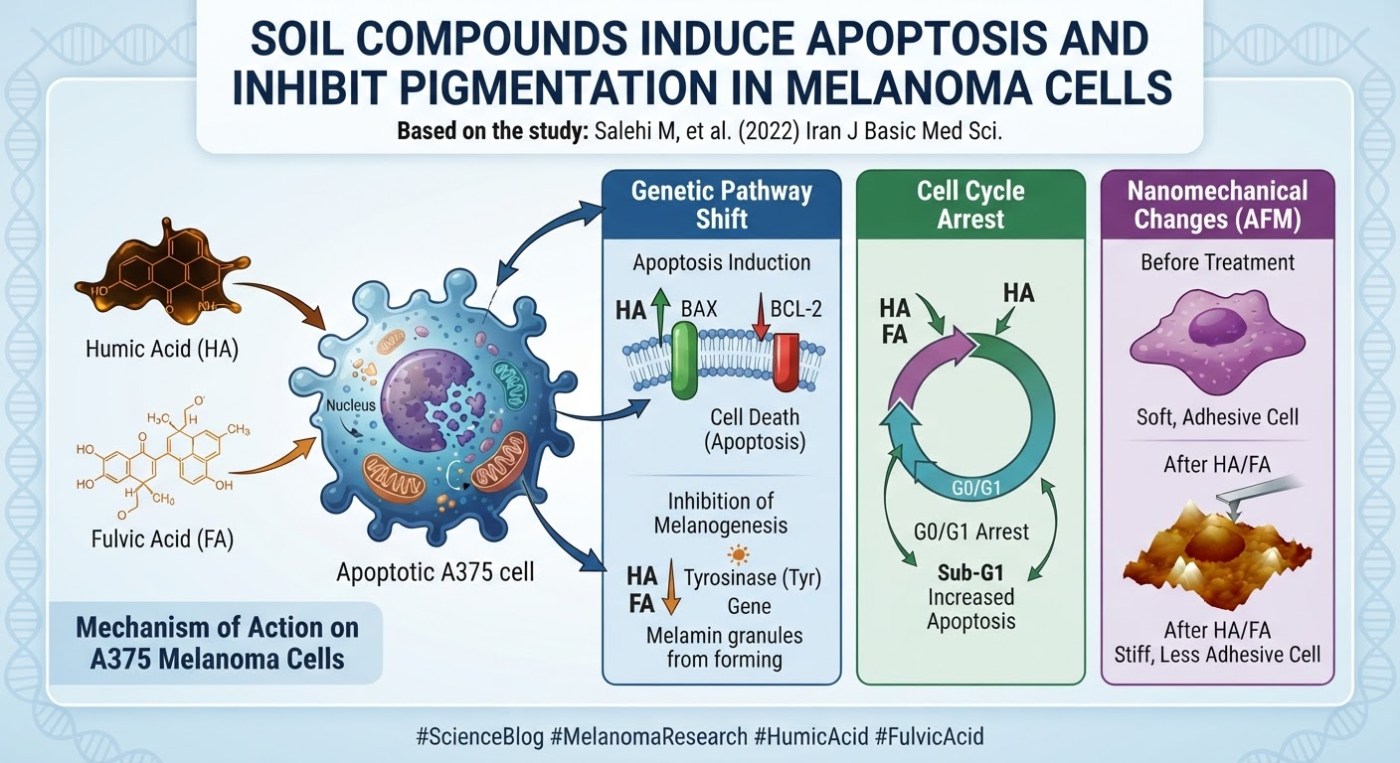
- Halting Growth and Triggering Cell Death: Both HA and FA reduced the survival rate of melanoma cells in a dose-dependent manner, reaching 50% inhibition at a concentration of 50 µg/ml after 14 hours. Flow cytometry revealed that the compounds trapped the cancer cells in the G0/G1 phase (preventing them from dividing) and pushed them toward apoptosis, the body’s natural process of programmed cell death.
- Flipping the Genetic Switch: Cancer cells often survive by suppressing self-destruct signals. Using real-time PCR, the researchers found that HA and FA increased the activity of BAX (a gene that promotes cell death) while dialing down BCL-2 (a gene that protects cancer cells from dying). Shifting this BAX/BCL-2 ratio is a classic hallmark of effective anti-cancer activity.
- Slowing Pigment Production: Alongside their anti-cancer effects, HA and FA decreased the expression of the Tyr (tyrosinase) gene. Because tyrosinase is the primary enzyme responsible for producing melanin, suppressing it demonstrates strong anti-melanogenic (pigment-inhibiting) potential.
- Reshaping the Cell Surface: Using atomic force microscopy (AFM)—a high-resolution imaging technique that measures physical forces at the nanoscale—the team observed distinct structural changes on the melanoma cells’ surfaces. Treated cells became stiffer (measured by an increase in Young’s modulus) and showed greater adhesion force, physical shifts that typically accompany a cell entering apoptosis.
What This Means for Future Research
The study concludes that humic and fulvic acids possess dual-action properties: they encourage melanoma cells to self-destruct while simultaneously curbing melanin synthesis. For researchers, this makes them intriguing candidates for developing future topical skin-lightening agents or complementary anti-cancer therapies.
The Caveat: As promising as these results are, they come from an in vitro study—meaning the tests were performed on isolated cells in a petri dish, not in living organisms. Human skin and internal systems are far more complex, and compounds that work well in a lab still require extensive animal testing and human clinical trials to verify their safety, proper dosing, and effectiveness.
Source: Salehi M, Piri H, Farasat A, Pakbin B, Gheibi N. Activation of apoptosis and G0/G1 cell cycle arrest along with inhibition of melanogenesis by humic acid and fulvic acid: BAX/BCL-2 and Tyr genes expression and evaluation of nanomechanical properties in A375 human melanoma cell line. Iran J Basic Med Sci. 2022;25(4):489-496.
>
>
>
>
Option 3: The “Key Takeaway” (Best for a sidebar or quick summary box)
> Study Snapshot: Soil Acids vs. Melanoma
> * Objective: Test the anti-cancer and anti-pigment effects of Humic Acid (HA) and Fulvic Acid (FA) on A375 melanoma cells.
> * Results: Both acids successfully triggered programmed cell death (apoptosis) and inhibited melanin production (melanogenesis).
> * Mechanism: HA and FA altered the expression of key genes (BAX, BCL-2, Tyr) and increased the physical stiffness of the cancer cells.
> * Conclusion: These compounds show promise as candidates for future dermatological and anti-cancer product design.
>
Let me know if you need an excerpt tailored for a different format, such as a podcast intro or a research abstract.


Leave a Reply