All About Typhoon headed towards Japan Could this be a extinction level event to wreak havoc upon the Earth?

A”Super” Typhoon  with 150 MPH sustained winds heading for Fukushima the crippled nuclear power plant.   Fukushima nuclear power faces its second typhoon in October, according to the weather agency.   The crippled Fukushima nuclear plant is not fully prepared for the heavy rain and winds of a typhoon bearing down on Japan, the plant’s raising the risk of further radiation leaks if storms thrash exposed pools of uranium fuel rods or tanks holding contaminated water.

Logo of the Joint Typhoon Warning Center
Logo of the Joint Typhoon Warning Center (Photo credit: Wikipedia)


This section Copied from: www.conspiracy-cafe.com

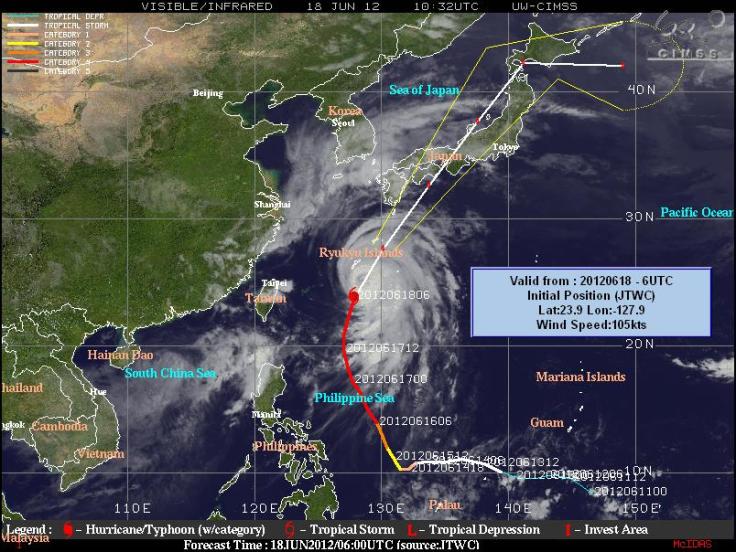
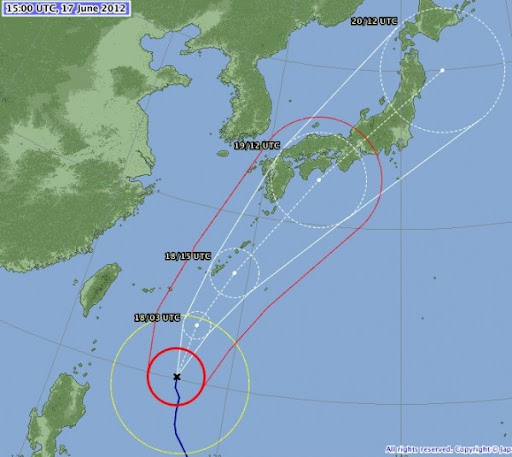
This present course will allow us to see how the storm may be altered to hit Fukushima directly. It is well within the capabilities of technology to steer storms. The NWO is looking for an extinction level event to wreak havoc upon the Earth. Guchol means spice.

Typhoon Guchol from another estimated track

To add insult to injury, this is a one two punch. There is another tropical storm forming in the South China Sea. This storm will most likely trail Guchol. If they join, what then? The storm is called Talim. In Urdu it means education or learning. In the production of rugs it refers to the description of the number of pile knots and their colours.

This section copied from : http://www.bloomberg.com

‘Naked’ Pools

“Uranium spent fuel pools of No. 3 and No. 4 reactors are currently naked,” Kazuhiko Kudo, a research professor of nuclear engineering at Kyushu University, said on June 5. “A tornado with winds of 100 meters per second like the one that hit Tsukuba could suck up the pool water,” exposing the fuel rods. He raised the concern during a meeting assessing safety measures at the crippled plant in May, he said.

As dismantling and decommissioning the reactors will take decades, Tepco should review the plant’s safety measures against not only aftershocks and tsunamis but also tornadoes and huge typhoons, even if the possibility of extreme phenomena are very low, said Kudo, one of 12 members of the advisory panel to the Nuclear and Industrial Safety Agency, or NISA.

Hydrogen explosions blew off the roofs and walls of reactor buildings at the Fukushima Dai-Ichi station after the March 11 quake and tsunami disrupted power and cooling systems. There are 1,535 spent fuel rods in the cooling pool of reactor building four. Without cooling water the rods would heat up and start releasing radioactive material into the atmosphere

This section Copied from: wikipedia.org

Typhoon is a mature Tropical Cyclone that develops in the northwestern part of the Pacific Ocean between 180° and 100°E. This region is referred to as the northwest Pacific basin.[1] For organizational purposes, the northern Pacific Ocean is divided into three regions: the eastern (North America to 140°W), central (140°W to 180°), and western (180° to 100°E). Identical phenomena in the eastern north Pacific are called hurricanes, with tropical cyclones moving into the western Pacific re-designated as typhoons. The Regional Specialized Meteorological Center (RSMC) for tropical cyclone forecasts is in Japan, with other tropical cyclone warning centers for the northwest Pacific in Honolulu (the Joint Typhoon Warning Center), the Philippines, and Hong Kong. While the RSMC names each system, the main name list itself is coordinated amongst 18 countries, including the United States, who have territories threatened by typhoons each year. The Philippines uses their own naming list for systems which approach the country.

Within the northwestern Pacific there are no official typhoon seasons as tropical cyclones form throughout the year. Like any tropical cyclone, there are six main requirements for typhoon formation and development: sufficiently warm sea surface temperatures, atmospheric instability, high humidity in the lower to middle levels of the troposphere, enough Coriolis force to develop a low pressure center, a pre-existing low level focus or disturbance, and low vertical wind shear. The majority of storms form between June and November whilst tropical cyclone formation is at a minimum between December and May. On average, the northwestern Pacific features the most numerous and intense tropical cyclones globally. Like other basins, they are steered by the subtropical ridge towards the west or northwest, with some systems recurving near and east of Japan. The Philippines receive a brunt of the landfalls, with China and Japan being impacted slightly less. Some of the deadliest typhoons in history have struck China. Southern China has the longest record of typhoon impacts for the region, with a thousand year sample via documents within their archives. Taiwan has received the wettest known typhoon on record for the northwest Pacific tropical cyclone basin.

  1. ► 7:21► 7:21

    Japan: “Super Typhoon” Headed For Japan! – YouTube

    youtube.comSep 14, 2012 – 7 min – Uploaded by paulbegley34
    Theologian Paul Begley of Indiana fears for major damage and loss of life http:// http://www.paulbegleyprophecy.com 
  2. ► 1:23► 1:23

    Nasty Typhoon Heading for Japan!! Why Media 

    youtube.comAug 28, 2011 – 1 min – Uploaded by series1riv
    I saw 194 kmh windspeed listed here… what is going on on our planet?
  3. ► 1:41► 1:41

    Raw Video: Typhoon Headed to Japan Disaster 

    youtube.comSep 20, 2011 – 2 min – Uploaded by AssociatedPress
    A powerful typhoon is bearing down on Japan’s tsunami-ravaged northeastern coast, approaching a 
  4. ► 2:17► 2:17

    ALERT: Cat 5 TYPHOON SUPER STORM headed 

    youtube.comSep 14, 2012 – 2 min – Uploaded by idahopicker
    SUBSCRIBE Super typhoon Sanba, with peak winds of 155 mph, continues on its collision course with 
  5. ► 1:41► 1:41

    Raw Video: Typhoon Headed to Japan Disaster 

    dailymotion.comSep 21, 2011 – 2 min
    A powerful typhoon is bearing down on Japan’s tsunami-ravaged northeastern coast, approaching a 
  6. ► 3:03► 3:03

    OYEP BREAKING NEWS!!! “Super Typhoon 

    youtube.comSep 15, 2012 – 3 min – Uploaded by PureGraceEvangelism
    Our prayers are with you all in Jesus name, Amen! For more breaking News matching Bible Prophecy go to: 
  7. ► 2:51► 2:51

    Super Typhoon Sanba (Karen) Headed Towards 

    youtube.comSep 14, 2012 – 3 min – Uploaded by ConservativeNewMedia
    A massive “super”-level typhoon named Sanba (Karen) isheaded towards Okinawa, Japan and then is 
  8. ► 9:08► 9:08

    Typhoon Guchol Blow Past Okinawa, Next on to 

    youtube.comJun 18, 2012 – 9 min – Uploaded by robcenter1
    This clearly an indication that the typhoon season on the westpac  Guchol is expected to skirt Okinawa and 
  9. ►►

    Raw Video: Typhoon Headed to Japan Disaster 

    wsbtv.comSep 20, 2011
    A powerful typhoon is bearing down on Japan’s tsunami-ravaged northeastern coast, approaching a 

The Peaceful Nuclear Explosions Treaty

Peaceful nuclear explosions
From Wikipedia, the free encyclopedia
Peaceful nuclear explosions (PNEs) are nuclear explosions conducted for non-military purposes, such as activities related to economic development including the creation of canals. During the 1960s and 1970s, both the United States and the Soviet Union conducted a number of PNEs.
Six of the explosions by the Soviet Union are considered to have been of an applied nature, not just tests.
Subsequently the United States and the Soviet Union halted their programs. Definitions and limits are covered in the Peaceful Nuclear Explosions Treaty of 1976. The Comprehensive Nuclear-Test-Ban Treaty of 1996 prohibits all nuclear explosions, regardless of whether they are for peaceful purposes or not.
Contents [hide]
1 The Peaceful Nuclear Explosions Treaty
2 United States: Operation Plowshare
3 Soviet Union: Nuclear Explosions for the National Economy
4 Other nations
5 Spaceflight Applications
6 See also
7 References
8 External links
[edit]The Peaceful Nuclear Explosions Treaty

In the PNE Treaty the signatories agreed: not to carry out any individual nuclear explosions having a yield exceeding 150 kilotons; not to carry out any group explosion (consisting of a number of individual explosions) having an aggregate yield exceeding 1,500 kilotons; and not to carry out any group explosion having an aggregate yield exceeding 150 kilotons unless the individual explosions in the group could be identified and measured by agreed verification procedures. The parties also reaffirmed their obligations to comply fully with the Limited Test Ban Treaty of 1963.
The parties reserve the right to carry out nuclear explosions for peaceful purposes in the territory of another country if requested to do so, but only in full compliance with the yield limitations and other provisions of the PNE Treaty and in accord with the Non-Proliferation Treaty.
Articles IV and V of the PNE Treaty set forth the agreed verification arrangements. In addition to the use of national technical means, the Treaty states that information and access to sites of explosions will be provided by each side, and includes a commitment not to interfere with verification means and procedures.
The protocol to the PNE Treaty sets forth the specific agreed arrangements for ensuring that no weapon-related benefits precluded by the Threshold Test Ban Treaty are derived by carrying out a nuclear explosion used for peaceful purposes, including provisions for use of the hydrodynamic yield measurement method, seismic monitoring and on-site inspection.
The agreed statement that accompanies the Treaty specifies that a “peaceful application” of an underground nuclear explosion would not include the developmental testing of any nuclear explosive.
[edit]United States: Operation Plowshare

One of the Chariot schemes involved chaining five thermonuclear devices to create the artificial harbor.
Operation Plowshare was the name of the U.S. program for the development of techniques to use nuclear explosives for peaceful purposes. The name was coined in 1961, taken from Micah 4:3 (“And he shall judge among the nations, and shall rebuke many people: and they shall beat their swords into plowshares, and their spears into pruning hooks: nation shall not lift up sword against nation, neither shall they learn war any more”). Twenty-eight nuclear blasts were detonated between 1961 and 1973.
One of the first U.S. proposals for peaceful nuclear explosions that came close to being carried out was Project Chariot, which would have used several hydrogen bombs to create an artificial harbor at Cape Thompson, Alaska. It was never carried out due to concerns for the native populations and the fact that there was little potential use for the harbor to justify its risk and expense. There was also talk of using nuclear explosions to excavate a second Panama Canal.[1]
The largest excavation experiment took place in 1962 at the Department of Energy’s Nevada Test Site. The Sedan nuclear test carried out as part of Operation Storax displaced 12 million tons of earth, creating the largest man-made crater in the world, generating a large nuclear fallout over Nevada and Utah. Three tests were conducted in order to stimulate natural gas production, but the effort was abandoned as impractical because of cost and radioactive contamination of the gas.[2][3]
There were many negative impacts from Project Plowshare’s 27 nuclear explosions. For example, the Gasbuggy site,[3] located 55 miles east of Farmington, New Mexico, still contains nuclear contamination from a single subsurface blast in 1967.[4] Other consequences included blighted land, relocated communities, tritium-contaminated water, radioactivity, and fallout from debris being hurled high into the atmosphere. These were ignored and downplayed until the program was terminated in 1977, due in large part to public opposition, after $770 million had been spent on the project.[5]
[edit]Soviet Union: Nuclear Explosions for the National Economy

The Soviet Union conducted a much more vigorous program of 239 nuclear tests, some with multiple devices, between 1965 and 1988 under the auspices of Program No. 6 and Program No. 7-Nuclear Explosions for the National Economy. Its aims and results were similar to those of the American effort, with the exception that many of the blasts were considered applications, not tests.[6] The best known of these in the West was the Chagan test in January 1965 as radioactivity from the Chagan test was detected over Japan by both the U.S. and Japan. The United States complained to the Soviets, but the matter was dropped.
In the 1970, the Soviet Union started the “Deep Seismic Sounding” Program, that included the use of peaceful nuclear explosions to create seismic deep profiles. Compared to the usage of conventional explosives or mechanical methods, nuclear explosions allow the collection of longer seismic profiles (up to several thousand kilometers).[7]
There are proponents for continuing the PNE programs in modern Russia. They (e.g. A. Koldobsky) state that the program already paid for itself and saved the USSR billions of rubles and can save even more if continued. They also allege that the PNE is the only feasible way to put out large fountains and fires on natural gas deposits and the safest and most economically viable way to destroy chemical weapons.
Their opponents (include the academician A.V. Yablokov) [8] state that all PNE technologies have non-nuclear alternatives and that many PNEs actually caused nuclear disasters.
Reports on the successful Soviet use of nuclear explosions in extinguishing out-of-control gas well fires were widely cited in United States policy discussions of options for stopping the Deepwater Horizon oil spill.[9][10]
[edit]Other nations

This unreferenced section requires citations to ensure verifiability.
Germany at one time considered manufacturing nuclear explosives for civil engineering purposes. In the early 1970s a feasibility study was conducted for a project to build a canal from the Mediterranean Sea to the Qattara Depression in the Western Desert of Egypt using nuclear demolition. This project proposed to use 213 devices, with yields of 1 to 1.5 megatons detonated at depths of 100 to 500 m, to build this canal for the purpose of producing hydroelectric power.
The Smiling Buddha, India’s first explosive nuclear device was described by the Indian Government as a peaceful nuclear explosion.
In Australia proposed blasting was put forward as a way of mining Iron Ore in the Pilbara [11]
[edit]Spaceflight Applications

Nuclear explosions have been studied as a possible method of spacecraft propulsion. The most well known example was Project Orion, which studied the possibility of a spacecraft propelled by the detonation of nuclear devices which it released behind itself.
Another application would be for deflecting or destroying celestial objects like comets, meteors, or asteroids on a collision course with Earth that have the potential for causing destruction.
[edit]See also

Project Gnome
[edit]References

^ “US Congressional Record pg. 25747, 1968-09-05”. Retrieved 2012-01-22.
^ U.S. Department of Energy, Office of Legacy Management: Rulison, Colorado, Site. Fact Sheet [1].
^ a b Peter Metzger (February 22, 1970). Project Gasbuggy And Catch-85*: *That’s krypton-85, one of the radioactive by-products of nuclear explosions that release natural gas Project Gasbuggy and Catch-85 “It’s 95 per cent safe? We worry about the other 5”. New York Times. p. SM14.
^ “DOE Environmental Management (EM) – Gas Buggy Site”. Em.doe.gov. Retrieved 2010-09-19.
^ Benjamin K. Sovacool (2011). Contesting the Future of Nuclear Power: A Critical Global Assessment of Atomic Energy, World Scientific, pp. 171-172.
^ Nordyke, M. D. (2000-09-01). The Soviet Program for Peaceful Uses of Nuclear Explosions. Lawrence Livermore National Laboratory. pp. 34–35. DOI:10.2172/793554. Report no.: UCRL-ID-124410 Rev 2. U. S. Department of Energy contract no.: W-7405-Eng48.
^ University of Wyoming: http://w3.uwyo.edu/~seismic/dss/
^ “А. В. ЯБЛОКОВ, “ЯДЕРНАЯ МИФОЛОГИЯ КОНЦА XX ВЕКА””. Biometrica.tomsk.ru. Retrieved 2011-08-13.
^ Broad, William J. (2010-06-02). “Nuclear Option on Gulf Oil Spill? No Way, U.S. Says”. New York Times. Retrieved 2010-06-18.
^ Astrasheuskaya, Nastassia; Judah, Ben; Selyukh, Alina (2010-07-02). “Special Report: Should BP nuke its leaking well?”. Reuters. Retrieved 2010-07-08.
^ Nuclear blasting proposed for Pilbara Iron Ore Project in Industrial Reviews and Mining Year Book, 1970 pp.255-259
[edit]External links

Peaceful Nuclear Explosions Comprehensive Nuclear-Test-Ban Treaty Organization Preparatory Commission
Video of the 104Kt Sedan PNE as part of Operation Plowshare.
Video of the Soviet Chagan PNE
Video of the Soviet Taiga PNE
On the Soviet nuclear program
On the Soviet program for peaceful uses of nuclear weapons, American Office of Scientific and Technical Information
United States Nuclear Tests, July 1945 through September 1992 (DOE/NV-209 [Rev.14]).
ARMS CONTROL AGREEMENTS,Federation of American Scientists
World Reaction to the Indian Nuclear Tests, Center for Nonproliferation Studies
Nuclear Files.org Treaty between the USA and USSR on underground nuclear explosions for peaceful purposes
Peter Kuran’s “Atomic Journeys” – documentary film includes tests of Peaceful nuclear Explosions.
[hide] v t e
Nuclear technology
Science
Chemistry Engineering Physics Atomic nucleus Fission Fusion Radiation ionizing
Fuel
Deuterium Fertile material Fissile Helium-3 Isotope separation Plutonium Thorium Tritium Uranium enriched depleted
Neutron
Activation Capture Cross-section Fast Fusion Generator Poison Radiation Reflector Temp Thermal
Reactors
Fission
reactors
by
primary
moderator
Water
Aqueous homogeneous reactor Boiling BWR ABWR Heavy CANDU PHWR SGHWR
Natural (NFR) Pressurized PWR VVER EPR Supercritical (SCWR)
Graphite
by coolant
Water
RBMK
Gas
Advanced gas-cooled (AGR) Magnox Pebble bed (PBMR)
UHTREX UNGG reactor Very high temperature (VHTR)
Molten Salt
FLiBe
Fuji MSR Liquid fluoride thorium reactor (LFTR)
Molten-Salt Reactor Experiment (MSRE)
Hydrocarbon
Organically moderated and cooled reactor
BeO
Aircraft Reactor Experiment (ARE)
None
(Fast)
Breeder (FBR) Integral (IFR) Liquid-metal-cooled (LMFR) SSTAR Traveling Wave (TWR)
Generation IV by coolant Gas (GFR) Lead (LFR) Sodium (SFR)
Fusion
reactors
by
confinement
Magnetic
Field-reversed configuration Levitated dipole Reversed field pinch Spheromak Stellarator Tokamak
Inertial
Bubble fusion (acoustic) Fusor electrostatic Laser-driven Magnetized target Z-pinch
Other
Dense plasma focus Migma Muon-catalyzed Polywell Pyroelectric
List of nuclear reactors
Power
Nuclear power plant By country Economics Fusion Isotope thermoelectric (RTG) Propulsion rocket Safety
Medicine
Imaging
by
radiation
Gamma camera
Scintigraphy Positron emission (PET) Single photon emission (SPECT)
X-ray
Projectional radiography Computed tomography
Therapy
Boron neutron capture (BNCT) Brachytherapy Proton Radiation Tomotherapy
Weapon
Topics
Arms race Delivery Design Explosion effects History Proliferation Testing underground Warfare Yield TNTe
Lists
Popular culture States Tests Treaties Weapon-free zones Weapons
Waste
Products
Actinide: (Reprocessed uranium Reactor-grade plutonium Minor actinide) Activation Fission LLFP
Disposal
Fuel cycle HLW LLW Repository Reprocessing Spent fuel pool cask Transmutation
Debate
Nuclear power debate Nuclear weapons debate Anti-nuclear movement Uranium mining debate Nuclear power phase-out

Be ready for the Bank Run of 2012 Global Financial Meltdown

Bank Run
Bank Run!

Daniel J Leach

I have been saying that the Global Financial Meltdown was just around the corner for years now!  It finally looks like we are on the verge of this happening this year.  I would not be surprised if this happens in October 2012!  This is a case of history repeating itself! “Those who cannot remember the past are condemned to repeat it.” George Santayana

   A bank run occurs when a large number of bank customers withdraw their deposits because they believe the bank might fail. As more people withdraw their deposits, the likelihood of default increases, and this encourages further withdrawals. This can destabilize the bank to the point where it faces bankruptcy.[1]

The stock market crash of October 1929 left the American public highly nervous and at the time, making it the largest single bank failure in American history.

In December 1931, New York’s Bank of the United States collapsed. The bank had more than $200 million in deposits at the time, making it the largest single bank failure in American history.

The bank runs of 1930 were followed by similar banking panics in the spring and fall of 1931 and the fall of 1932. In some instances, bank runs were started simply by rumors of a bank’s inability or unwillingness to pay out funds. In December 1930, the New York Times reported that a small merchant in the Bronx went to a branch of the Bank of the United States and asked to sell his stock in the institution. When told the stock was a good investment and advised not to sell, he left the bank and began spreading rumors that the bank had refused to sell his stock. Within hours, a crowd had gathered outside the bank, and that afternoon between 2,500 and 3,500 depositors withdrew a total of $2 million in funds.


Copied from http://blog.alexanderhiggins.com

The Global Financial Meltdown has dramatically worsened as Corporations and China Jump Aboard The “Institutional” Global Bank Run As Banks Fall Apart As Their Seams.

Earlier today the world saw a global financial meltdown as investors dumped everything from stocks to commodities and literally everything in between.

Global Financial Meltdown: Investors Dump Nearly Everything Amidst Worldwide Market Crash

Global Meltdown - Investors Are Dumping Everything

Major Stock Market Indexes, Commodities, Currencies And Everything In Between Is Being Dumped By Investors Across The Globe In The Midst Of A Global Financial Meltdown.

The financial markets across the globe are facing one of the most massive sell-offs in recent memory.

The Dow Jones Industrial average has sold off over 467 points today. When and when you add that on top of 284 point drop following yesterday’s crash FED’s statement, which announced operation ‘twist’ and warned of significant downside risk and strains in global financial markets, we have a 751 point drop in the DOW since 2:45 PM est yesterday, which is the largest 2 day slump since 2008.

There are an endless parade of economic statistics many of which are the worse since the Great Depression and World War 2 era. We have also seen 111 of the s&P 500 hit fresh 52 week lows, a drop in global currencies – beside the dollar, oil dropping into the high $70 per barrel range and gold plummeting over 5% to trade in the low $1,700 per ounce range.

Business Week points out the massive crash in U.S. stocks immediately below while CNBC points out further below that this in fact a global meltdown – investors are dumping everything.

[…]

Read The Rest…

While today’s sell off was monumental and in fact is on course for the 3rd worse week on Wall Street ever, the sell-off was on the heels of the FED’s economic outlook. Today’s Global Financial Meltdown is about to become much worse as a slew of news reports out today reveal the run on the European banks has spread to include corporations and institutions pulling their money out of banks and China finally arriving at the party.

As a backdrop, the IMF warned the entire global financial systems is more vulnerable to collapse than at any other time since the 2008 financial crisis. The alarm is being sounded with the stern warning the European debt crisis could trigger the complete collapse of the entire global financial system at any minute. On the other hand, the alternative media and independent economists warn we are in fact in of a great depression style collapse. The only difference is this time around we would be facing a global depression. But as the ship their countrymen sail on continues to sink, bureaucrats continueto play politics and put their partisan interests above the interest of their constituents.

The run on European banks has already began with from the customers pulling their money from banks some time ago. While the corporate media kept the run on the Greece banks on the hush the media blackout didn’t stop the run nor did it stop the run from spreading to other nations. Simply put, the public is learning they can’t trust their governments and they can’t trust the media. Indeed the withdrawal of deposits from the banks in Greece has quietly spread across the other European nations only to spread into some of the supposedly most stable banks in the Euro-zone, the French banks.

Now we have learned the run on the banks that was originally limited to customers has now spread to include corporate and institutional clients withdrawing their money from the banks. First, we caught wind of the rumor that Siemens pulled its cash from one of the French banks. Then came theconfirmation came that Siemens pulled $500 million Euros from Societe Generale. Siemens of course is a huge conglomerate. For such a huge corporation to lose trust in one of the supposedly most stable of the French banks is clearly a very significant development. To be clear, the ramification have simply rocked the markets and the many more corporations soon will follow. In fact, some corporations and nations have followed their lead.

Consider the breaking news that The Bank of China has stopped doing business with four major European banks. To be exact thy have stopped trading swaps and foreign exchange forwards with the Societe Gnerale, BNP Paribas, Credit Agricole and the Swiss banking giant UBS.

Speaking of BNP Paribas, Reggie Middleton – who long predicted the collapse of Lehman’s and Bear Stearns far ahead of anyone else because of their shady banking practices – has been warning for months BNP Paribas is ripe for a Lehman style collapse. Reggie argues that BNP Paribas is engaging in the same practices and fraud that caused Lehman’s and Bear Stearn’s to collapse.

While on the subject of China, we learn today they are not immune to the bank run either. China Securities Journal reveals that 420 billion yuan have been pulled out of the big four state-owned Chinese bank during the 15 days of September. Even bank employees are pulling their deposits from the banks as it is estimated that three trillion yuan has been diverted to illegal money lenders which pay interest rates 10 times higher than the one-year Chinese bank deposit rate.

Today we also learn that Insurer Lloyd’s of London confirmed it’s withdrawing deposits from all of the European banks for fear they may collapse. The rationalization for their withdrawal is quite simple – if world is worried about the European governments themselves collapsing then on must assume the sovereign debt collapse will also cause the banks themselves to collapse.

Still that message doesn’t seem to be reaching the retail banking client and the corporate owned media is to blame for repeatedly assuring the public there bank deposits are safe because the banks are insured by their respective European government.

When we see corporations not buying the propaganda being pushed by the media and instead withdrawing their deposits that should be a clear sign to the retail client it is time to withdraw their deposits. Unfortunately, too many people believe their governments and the media would never lie to them so some of them will unfortunately need to learn the hard way.

However, anyone keeping up with the details of latest financial news that doesn’t quite make the headlines knows that banks across the world have been hit with a parade of credit rating cuts warning of their risk of collapse. Those same cuts have been coupled with recent credit rating cuts of the sovereign of nations themselves, most notably the credit downgrades of the United States and Italy.

Adding to the bleak reality a global financial collapse may be imminent is the fact that 9 Banks failed last years EU stress test and another 16 barely passed the test. Yet instead of being proactive and shoring up capital to assure the survival of financial turmoil, we have seen many banks continue to conduct business in absolute denial they were at risk. In ignorance of reality the banks have sat around for over a year knowing they are at risk of collapse while doing little to nothing the improve their situation. Why should they act? They know when shit hits the fan taxpayers will be bent over the barrel and be forced to give the banks billions in bailouts from which the executives will collect lavish bonuses.

Now we have warnings from top economists and the FED that there is significant downside risk and strains in the global financial system that threatens the entire system. The is coupled with warnings from the IMF and EU leaders to immediately recapitalize the banks or face collapse. The calls for recapitalization have persisted for weeks with no action taken to stave off the collapse. Meanwhile, the consequences of not acting immediately continue to become more severe by the day.

The EU credit markets have frozen up and the situation is now beyond the point of dire. The question is which bank will be the first to collapse.

While all eyes seem to be focused on the Euro banks across the pond, banks back in the US are not immune from the crisis and neither are the Chinese banks.

In fact, Bank of America has been hammered by the alternative media as needing capitalization but BAC has denied those allegations and the corporate media has dismissed the alternative media reports as comments from fringe blogs. Until today that is.

Pimco’s Mohamed El-Erian raised the alarm today about the health of French banks and went on to point out there is an institutional run on thosebanks.

CNBC, went on to use the metrics El-Erain used to measure the health of the French banks to measure the health of US banks and found US banks aren’t nearly as healthy as Wall Street would like to believe.

Create a website or blog at WordPress.com

Up ↑