Yes its true and we told you so! Once again we knew it. I hate to say told you so but you silly dumb down American Zombie Sheople deserve everything your going to get. Death Camps and all. First you forgot God when you let him get kicked out of school and then you for got history! Now its all going to come back and bite you in the ass.
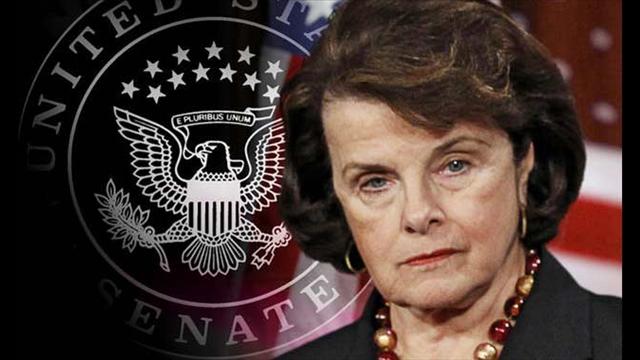
Senator Dianne Feinstein Moves To Ban ALL Assault Rifles, High Capacity Magazines, and Pistol Grips
Mac Slavo: The agenda no longer needs to be hidden from public view. With President Obama winning another term and democrats taking control of the Senate, the move to fundamentally change America from within has begun – with a vengeance.
We’re all aware of the restrictive gun laws in the State of California which require low capacity magazines for handguns, fixed magazines for “assault” rifles, and a whole lot of running around just to be granted the right to carry a concealed firearm.
Now, Senator Dianne Feinstein (D-CA), who has championed gun control in her state for decades and co-wrote the original assault weapons ban enacted by the federal government in the 1990′s, wishes to bring even more stringent federal mandates to the land of the free. What is being proposed by Feinstein is the most significant attack on the second amendment in history.
It would essentially ban thousands of firearms and require gun owners to turn them over to the Federal government.
I don’t have the minutes of the meeting (yet), but sources tell me California Senator and longtime gun-hater Dianne Feinstein’s legal staff held meetings on Friday with FTB/ATF legal staff to discuss a new “Assault Weapons Ban” Madame Feinstein would be looking to push through Congress if President Obama wins reelection.
This same “pretty good intelligence” says the items that would lead to a banwould ban pistol grips and “high-capacity” magazines, eliminate any grandfathering and ban sales of “weapons in possession”.
I don’t know about you, but if these things come to pass and I’m “in possession” I’m certainly not selling.
In fact, the lack of interest in the idea surprised the California liberal’s legal staffers. Apparently, they believe no logical person could possible disagree with them.
…
I began receiving the first reports of increases in gun buying by people concerned about tomorrow’s election. Dealers in Oklahoma, Arkansas, Texas, Kentucky, Tennessee, Alabama and Indiana all tell me there hasn’t been a huge number of buyers expressing those concerns, but the numbers were noticeable.
Among that group -and the majority of “regular” purchasers- the core driving most of the purchasing seem to be in their mid-to-late 30s. Again, home and personal defense are the most frequently cited reasons for buying.
At a Congressional budget meeting in September of this year, Feinstein alluded to her desire to reintroduce federal assault weapons ban regulations similar to those she helped cosponsor and pass in 1994 during the Presidency of Bill Clinton:
“Ladies and gentlemen, it is time to say, once again, in legislation, weapons of war do not belong on our streets…” September 5, 2012
It it any wonder that shares of stocks like Smith & Wesson (NASDAQ:SWHC) and Ruger (NYSE:RGR) surged this morning in response to President Obama winning a second term? While the majority of stocks across the world are in the midst of a sell-off and economic conditions indicate the country is in a recession, America’s gun owners aren’t waiting to see what happens next.
Read the 10 Planks of The Communist Manifesto to discover the truth and learn how to know your enemy…
Karl Marx describes in his communist manifesto, the ten steps necessary to destroy a free enterprise system and replace it with a system of omnipotent government power, so as to effect a communist socialist state. Those ten steps are known as the Ten Planks of The Communist Manifesto… The following brief presents the original ten planks within the Communist Manifesto written by Karl Marx in 1848, along with the American adopted counterpart for each of the planks. From comparison it’s clear MOST Americans have by myths, fraud and deception under the color of law by their own politicians in both the Republican and Democratic and parties, been transformed into Communists.
Another thing to remember, Karl Marx in creating the Communist Manifesto designed these planks AS A TEST to determine whether a society has become communist or not. If they are all in effect and in force, then the people ARE practicing communists.
Communism, by any other name is still communism, and is VERY VERY destructive to the individual and to the society!!
The 10 PLANKS stated in the Communist Manifesto and some of their American counterparts are…
1. Abolition of private property and the application of all rents of land to public purposes. Americans do these with actions such as the 14th Amendment of the U.S. Constitution (1868), and various zoning, school & property taxes. Also the Bureau of Land Management (Zoning laws are the first step to government property ownership)
2. A heavy progressive or graduated income tax. Americans know this as misapplication of the 16th Amendment of the U.S. Constitution, 1913, The Social Security Act of 1936.; Joint House Resolution 192 of 1933; and various State “income” taxes. We call it “paying your fair share”.
3. Abolition of all rights of inheritance. Americans call it Federal & State estate Tax (1916); or reformed Probate Laws, and limited inheritance via arbitrary inheritance tax statutes.
4. Confiscation of the property of all emigrants and rebels. Americans call it government seizures, tax liens, Public “law” 99-570 (1986); Executive order 11490, sections 1205, 2002 which gives private land to the Department of Urban Development; the imprisonment of “terrorists” and those who speak out or write against the “government” (1997 Crime/Terrorist Bill); or the IRS confiscation of property without due process. Asset forfeiture laws are used by DEA, IRS, ATF etc…).
5. Centralization of credit in the hands of the state, by means of a national bank with State capital and an exclusive monopoly. Americans call it the Federal Reserve which is a privately-owned credit/debt system allowed by the Federal Reserve act of 1913. All local banks are members of the Fed system, and are regulated by the Federal Deposit Insurance Corporation (FDIC) another privately-owned corporation. The Federal Reserve Banks issue Fiat Paper Money and practice economically destructive fractional reserve banking.
6. Centralization of the means of communications and transportation in the hands of the State. Americans call it the Federal Communications Commission (FCC) and Department of Transportation (DOT) mandated through the ICC act of 1887, the Commissions Act of 1934, The Interstate Commerce Commission established in 1938, The Federal Aviation Administration, Federal Communications Commission, and Executive orders 11490, 10999, as well as State mandated driver’s licenses and Department of Transportation regulations.
7. Extension of factories and instruments of production owned by the state, the bringing into cultivation of waste lands, and the improvement of the soil generally in accordance with a common plan. Americans call it corporate capacity, The Desert Entry Act and The Department of Agriculture… Thus read “controlled or subsidized” rather than “owned”… This is easily seen in these as well as the Department of Commerce and Labor, Department of Interior, the Environmental Protection Agency, Bureau of Land Management, Bureau of Reclamation, Bureau of Mines, National Park Service, and the IRS control of business through corporate regulations.
8. Equal liability of all to labor. Establishment of industrial armies, especially for agriculture. Americans call it Minimum Wage and slave labor like dealing with our Most Favored Nation trade partner; i.e. Communist China. We see it in practice via the Social Security Administration and The Department of Labor. The National debt and inflation caused by the communal bank has caused the need for a two “income” family. Woman in the workplace since the 1920’s, the 19th amendment of the U.S. Constitution, the Civil Rights Act of 1964, assorted Socialist Unions, affirmative action, the Federal Public Works Program and of course Executive order 11000.
9. Combination of agriculture with manufacturing industries, gradual abolition of the distinction between town and country, by a more equitable distribution of population over the country. Americans call it the Planning Reorganization act of 1949 , zoning (Title 17 1910-1990) and Super Corporate Farms, as well as Executive orders 11647, 11731 (ten regions) and Public “law” 89-136. These provide for forced relocations and forced sterilization programs, like in China.
10. Free education for all children in public schools. Abolition of children’s factory labor in its present form. Combination of education with industrial production. Americans are being taxed to support what we call ‘public’ schools, but are actually “government force-tax-funded schools ” Even private schools are government regulated. The purpose is to train the young to work for the communal debt system. We also call it the Department of Education, the NEA and Outcome Based “Education” . These are used so that all children can be indoctrinated and inculcated with the government propaganda, like “majority rules”, and “pay your fair share”. WHERE are the words “fair share” in the Constitution, Bill of Rights or the Internal Revenue Code (Title 26)?? NO WHERE is “fair share” even suggested !! The philosophical concept of “fair share” comes from the Communist maxim, “From each according to their ability, to each according to their need! This concept is pure socialism. … America was made the greatest society by its private initiative WORK ETHIC … Teaching ourselves and others how to “fish” to be self sufficient and produce plenty of EXTRA commodities to if so desired could be shared with others who might be “needy”… Americans have always voluntarily been the MOST generous and charitable society on the planet.
Do changing words, change the end result? … By using different words, is it all of a sudden OK to ignore or violate the provisions or intent of the Constitution of the united States of America?????
The people (politicians) who believe in the SOCIALISTIC and COMMUNISTIC concepts, especially those who pass more and more laws implementing these slavery ideas, are traitors to their oath of office and to the Constitution of the united States of America… KNOW YOUR ENEMY …Remove the enemy from within and from among us.
VOTE LIBERTARIAN, the only political party in America that still firmly supports and diligently abides by the Constitution of the united States of America.
None are more hopelessly enslaved, as those who falsely believe they are free….
Leaked U.S. Army Document Outlines Plan For Re-Education Camps In America
By Paul Joseph Watson
A leaked U.S. Army document prepared for the Department of Defense contains shocking plans for “political activists” to be pacified by “PSYOP officers” into developing an “appreciation of U.S. policies” while detained in prison camps inside the United States.
The document, entitled FM 3-39.40 Internment and Resettlement Operations (PDF) was originally released on a restricted basis to the DoD in February 2010, but has now been leaked online.
The manual outlines policies for processing detainees into internment camps both globally and inside the United States. International agencies like the UN and the Red Cross are named as partners in addition to domestic federal agencies including the Department of Homeland Security and FEMA.
The document makes it clear that the policies apply “within U.S. territory” and involve, “DOD support to U.S. civil authorities for domestic emergencies, and for designated law enforcement and other activities,” including “man-made disasters, accidents, terrorist attacks and incidents in the U.S. and its territories.”
The manual states, “These operations may be performed as domestic civil support operations,” and adds that “The authority to approve resettlement such operations within U.S. territories,” would require a “special exception” to The Posse Comitatus Act, which can be obtained via “the President invoking his executive authority.” The document also makes reference to identifying detainees using their “social security number.”
Aside from enemy combatants and other classifications of detainees, the manual includes the designation of “civilian internees,” in other words citizens who are detained for, “security reasons, for protection, or because he or she committed an offense against the detaining power.”
Once the detainees have been processed into the internment camp, the manual explains how they will be “indoctrinated,” with a particular focus on targeting political dissidents, into expressing support for U.S. policies.
The re-education process is the responsibility of the “Psychological Operations Officer,” whose job it is to design “PSYOP products that are designed to pacify and acclimate detainees or DCs to accept U.S. I/R facility authority and regulations,” according to the document.
Political activists would be pacified to sympathize with the government
Paul Joseph Watson
Infowars.com
Thursday, May 3, 2012
A leaked U.S. Army document prepared for the Department of Defense contains shocking plans for “political activists” to be pacified by “PSYOP officers” into developing an “appreciation of U.S. policies” while detained in prison camps inside the United States.
The document, entitled FM 3-39.40 Internment and Resettlement Operations (PDF) was originally released on a restricted basis to the DoD in February 2010, but has now been leaked online.
The manual outlines policies for processing detainees into internment camps both globally and inside the United States. International agencies like the UN and the Red Cross are named as partners in addition to domestic federal agencies including the Department of Homeland Security and FEMA.
The document makes it clear that the policies apply “within U.S. territory” and involve, “DOD support to U.S. civil authorities for domestic emergencies, and for designated law enforcement and other activities,” including “man-made disasters, accidents, terrorist attacks and incidents in the U.S. and its territories.”
The manual states, “These operations may be performed as domestic civil support operations,” and adds that “The authority to approve resettlement such operations within U.S. territories,” would require a “special exception” to The Posse Comitatus Act, which can be obtained via “the President invoking his executive authority.” The document also makes reference to identifying detainees using their “social security number.”
Aside from enemy combatants and other classifications of detainees, the manual includes the designation of “civilian internees,” in other words citizens who are detained for, “security reasons, for protection, or because he or she committed an offense against the detaining power.”
Once the detainees have been processed into the internment camp, the manual explains how they will be “indoctrinated,” with a particular focus on targeting political dissidents, into expressing support for U.S. policies.
The re-education process is the responsibility of the “Psychological Operations Officer,” whose job it is to design “PSYOP products that are designed to pacify and acclimate detainees or DCs to accept U.S. I/R facility authority and regulations,” according to the document.
The manual lists the following roles that are designated to the “PSYOP team”.
– Identifies malcontents, trained agitators, and political leaders within the facility who may try to organize resistance or create disturbances.
– Develops and executes indoctrination programs to reduce or remove antagonistic attitudes.
– Identifies political activists.
– Provides loudspeaker support (such as administrative announcements and facility instructions when necessary).
– Helps the military police commander control detainee and DC populations during emergencies.
– Plans and executes a PSYOP program that produces an understanding and appreciation of U.S. policies and actions.
Remember, this is not restricted to insurgents in Iraq who are detained in prison camps – the manual makes it clear that the policies also apply “within U.S. territory” under the auspices of the DHS and FEMA. The document adds that, “Resettlement operations may require large groups of civilians to be quartered temporarily (less than 6 months) or semipermanently (more than 6 months).”
A D V E R T I S E M E N T
The historical significance of states using internment camps to re-educate detainees centers around the fact that it is almost exclusively practiced by repressive and dictatorial regimes like the former Soviet Union and Stalinist regimes like modern day North Korea.
We have exhaustively documented preparations for the mass internment of citizens inside America, but this is the first time that language concerning the re-education of detainees, in particular political activists, has cropped up in our research.
In 2009, the National Guard posted a number of job opportunities looking for “Internment/Resettlement Specialists” to work in “civilian internee camps” within the United States.
In December last year it was also revealed that Halliburton subsidiary KBR is seeking sub-contractors to staff and outfit “emergency environment” camps located in five regions of the United States.
In 2006, KBR was contracted by Homeland Security to build detention centers designed to deal with “an emergency influx of immigrants into the U.S,” or the rapid development of unspecified “new programs” that would require large numbers of people to be interned.
Rex 84, short for Readiness Exercise 1984, was established under the pretext of a “mass exodus” of illegal aliens crossing the Mexican/US border, the same pretense used in the language of the KBR request for services.
During the Iran-Contra hearings in 1987, however, it was revealed that the program was a secretive “scenario and drill” developed by the federal government to suspend the Constitution, declare martial law, assign military commanders to take over state and local governments, and detain large numbers of American citizens determined by the government to be “national security threats.”
Read a portion of the Internment and Resettlement Operations manual below.
The following portions of the document make it clear that the policies apply “within U.S. territory” (as well as abroad in countries like Iraq and Afghanistan) and that domestic federal agencies are involved.
*********************
Paul Joseph Watson is the editor and writer for Prison Planet.com. He is the author of Order Out Of Chaos. Watson is also a regular fill-in host for The Alex Jones Show and Infowars Nightly News.
Austerity Measures and Bailouts are just payments to the Illuminati Family’s by way or proxy! First the Banksters get Nations in dept by loans and bailouts that can not be paid back, like what is happening in America. Second The Nation makes governmental cuts like what is happening in EUROPE aka stealing pensions , cutting services like Parks, Police Teachers Firemen ect ect! Then the Government sells off Parks Government owned property, Roads Water ways Parks ect ect to the Illuminati Bankster Familys AKA the MOBSTERS!
This is all part of the(The Hegelian Dialectic) aka The Problem Reaction Solution method! .. the Illuminati family’s or the ruling elite create a problem, anticipating in advance the reaction that the population will have to the problem and then have the prepared Solution! Example an Global Economic Melt down. The after the people react and demand a solution to the created problems that was the desired agenda of the ruling elite. Then and only then the Pre prepared agenda of the Global Elite Banksters presented as the solution such as a one world Governmental Monetary system or Global Governmental system to fix the problem.
The bad part about this conspiracy is that along with the reaction to the problem the population becomes violent, in protesting the Austerity Measures implemented by the Governments! And once again (The Hegelian Dialectic)comes into place with FEMA CampsAKA Concentration Camps for the protesters dissidents and homeless people effected by the Illuminati s Global Agenda
The Expansionary fiscal contraction hypothesis is the economic theory that explores whether government austerity can result in economic expansion. This hypothesis indicates that expansion from austerity is very limited and occurs only during periods when consumption is not constrained.
Austerity measures are typically taken if there is a threat that a government cannot honor its debt liabilities. Such a situation may arise if a government has borrowed in foreign currencies that they have no right to issue or they have been legally forbidden from issuing their own currency. In such a situation, banks may lose trust in a government’s ability and/or willingness to pay and either refuse to roll over existing debts or demand extremely high interest rates. In such situations, inter-governmental institutions such as the International Monetary Fund (IMF) may demand austerity measures in exchange for functioning as a lender of last resort. When the IMF requires such a policy, the terms are known as ‘IMF conditionalities‘.
Development projects, welfare, and other social spending are common programs that are targeted for cuts: Taxes, port and airport fees, train and bus fares are common sources of increased user fees.
In many cases, austerity measures have been associated with protest movements claiming significant decline in standard of living. A case in point is the nation of Greece. The financial crisis—particularly the austerity package put forth by the EU and the IMF— was met with great anger by the Greek public, leading to riots and social unrest. On 27 June 2011, trade union organizations commenced a forty-eight hour labor strike in advance of a parliamentary vote on the austerity package, the first such strike since 1974. Massive demonstrations were organized throughout Greece, intended to pressure parliament members into voting against the package. The second set of austerity measures was approved on 29 June 2011, with 155 out of 300 members of parliament voting in favor. However, one United Nations official warned that the second package of austerity measures in Greece could pose a violation of human rights.[5]
Austerity programs can be controversial. In the Overseas Development Institute briefing paper “The IMF and the Third World” the ODI addresses five major complaints against the IMF’s austerity ‘conditionalities’. These complaints include these measures being “anti-developmental”, “self-defeating”, and “they tend to have an adverse impact on the poorest segments of the population”. In many situations, austerity programs are implemented by countries that were previously under dictatorial regimes, leading to criticism that the citizens are forced to repay the debts of their oppressors.[6][7][8]
Economist Richard D. Wolff has stated that instead of cutting government programs and raising taxes, austerity should be attained by collecting (taxes) from non-profitmultinational corporations, churches, and private tax-exempt institutions such as universities, which currently pay no taxes at all.[9]
In 2009, 2010, and 2011, workers and students in Greece and other European countries demonstrated against cuts to pensions, public services and education spending as a result of government austerity measures.[10][11] Following the announcement of plans to introduce austerity measures in Greece, massive demonstrations were witnessed throughout the country, aimed at pressing parliamentarians to vote against the austerity package. In Athens alone 19 arrests were made while 46 civilians and 38 policemen had been injured by June 29, 2011. The third round austerity has been approved by the Greece parliament on February 12, 2012 and has met strong opposition especially in the cities of Athens and Thessaloniki where the police have clashed with demonstrators.
Opponents argue that austerity measures tend to depress economic growth, which ultimately causes governments to lose more money in tax revenues. In countries with already anemic economic growth, austerity can engender deflation which inflates existing debt. This can also cause the country to fall into a liquidity trap, causing credit markets to freeze up and unemployment to increase. Opponents point to cases in Ireland and Spain in which austerity measures instituted in response to financial crises in 2009 proved ineffective in combating public debt, and placing those countries at risk of defaulting in late 2010.[12]
The term “Age of austerity” was popularized by British Conservative leader David Cameron in his keynote speech to the Conservative party forum in Cheltenham on April 26, 2009, when he committed to put an end to what he called years of excessive government spending.[13][14]
Merriam-Webster’s Dictionary named the word “austerity” as its “Word of the Year” for 2010 because of the number of web searches this word generated that year. According to the president and publisher of the dictionary, “austerity had more than 250,000 searches on the dictionary’s free online [website] tool” and the spike in searches “came with more coverage of the debt crisis”.[15]
This section is in a list format that may be better presented using prose. You can help by converting this section to prose, if appropriate. Editing help is available. (June 2011)
Anti-austerity protests, chiefly taking the form of massive street protests by those affected by them and some of them also involving a greater or lesser degree of militancy, have happened regularly across various countries, especially on the European continent, since the onset of the present-day worldwide financial crisis. The phenomena are, collectively, decidedly separate, conceptually, from the austerity measures themselves, even though the enactment of the latter is a prerequisite for the former. This is because they are of the sizes they are; that they cut across age groups (e.g., both students and older workers) and other demographics; that they can incorporate many different types of actions in many different segments of a given country’s economy including educationfunding, infrastructure funding, manufacturing, aviation, social welfare, and many many others; and that the phenomenon of austerity, when explained by itself, is inadequate to properly encompass the phenomenon of widespread opposition to it, and that opposition’s nuances and fluctuations.
Anti-austerity actions are varied, ongoing, and can be either sporadic and loosely-organised or longer-term and tightly-organised. Theycontinue as of the present day. Recent upheavals in Tunisia and in Egypt in 2011 were originally largely anti-austerity and anti-unemployment before turning into wider social revolutions.
Most recently, the global and still-spreading Occupy movement has arguably been the most noticeable physical enactment of anti-austerity and populist sentiment.
Austerity is mainly noticed by a country when its aspects (usually known as ‘cuts’) are implemented unilaterally and forcibly (a “hatchet job“) rather than through a more careful strategy of creeping normalcy wherein such cuts are made to seem reasonable, or at least tolerable. Austerity is usually only referred to by that name when it is part of a sweeping package or packages of reforms that have the openly-admitted effect of great or even complete overhaul of major aspects of a society’s socioeconomic core facilities, programs and/or services. Because of this nature, austerity programs in general often are virulently opposed by the populations experiencing them, as they tend to have an impact on the poorest segments of the population. Those who are pro-austerity (who usually refer to the process as “deficit reduction”) usually counter that these poorest segments of the population would also suffer the most should a debt crisisoccur[citation needed], an argument rejected by most anti-austerity individuals.
Prior to the 2010 European sovereign debt crisis, in many situations, austerity programs were implemented by countries that were previously under dictatorial regimes (e.g., Portugal, Greece, Spain), leading to criticism that the citizens are forced to repay the debts of their oppressors.[1][2][3] In Greece, for example, the current austerity measures are popularly viewed as a combination of leftover policies of the 1967-1974 military dictatorship in that country on the one hand, and the “betrayal” of socialist principles by the current parliamentary-majority Panhellenic Socialist Movement on the other hand, due to that party’s wholesale enactment of extremely severe austerity measures in the country, which most everyday Greeks conceive of as intensely right-wing in nature, at least when compared to the party’s officially-stated core beliefs.[citation needed]
In the present-day enactments of various “austerity budgets”, however, a prior history of dictatorship is not necessarily a precondition for the implementation of such a budget by a given government. Examples of countries implementing severe austerity measures without a history of what the world’s mainstream media would typically consider a ‘dictatorship’, include the United Kingdom and the Republic of Ireland, the latter of which witnessed its housing market completely (rather than partially as elsewhere) collapse, and the Republic eventually appealing for a massive bailout from the International Monetary Fund, “in exchange for” implementation of a very severe austerity programme. The austerity measures and the terms of the IMF bailout became major aspects of the 2008–2011 Irish financial crisis, and popular anger over these issues played a very major role in the loss of governmental power of Fianna Fáil to opposition parties in the 2011 Irish general election. The loss was so complete and so total for Fianna Fáil that many commentators remarked that the results were “historic”. Fine Gael and the Labour Party entered in to a coalition government with one another, and Fine Gael’s leaders have vowed to re-negotiate the terms of the IMF bailout so that austerity can be slowed or stopped and the Irish economy can be given a chance to grow again.[4]Sinn Féin, which for the first time also won a notable percentage in the election, has called for a nationwide referendum over whether the bailout agreement should be scrapped altogether, but this suggestion has been met with dismissal by officials.[5]
Austerity in most European countries, including Spain and Italy — where there have been massive anti-austerity protests, wildcat strikes, and union-organized industrial actions of various types at semi-regular intervals since late 2008, earning for the most part massive worldwide media attention — is by no means limited to what could be the ‘expected’ areas of the economy that might in theory experience direct penalties as a result of gross mismanagement, such as financial institutions. In fact, financial institutions rarely, if ever, truly receive such ‘punishment’ by a country’s government; austerity-like levies could perfectly well be imposed on them for causing, or helping to cause, the crisis that leads to the austerity measures in the first place, but typically are not. Instead, it is argued (chiefly by people engaging in anti-austerity protests, but also some economists as well) that rather than ‘punish’ the banks and others truly responsible for the crisis, the government is instead ‘punishing’ regular people for the ‘crimes’ of others, namely the ‘elite’ and/or greedy professional money-handlers engaging in market manipulation.
100,000 peaceful anti-austerity protesters in front of the parliament of Greece on 29 June 2011.
The May–July 2011 Greek protests, also known as the “Indignant Citizens Movement” or the “Greek indignados”, started demonstrating throughout Greece on 25 May 2011;[6] the movement’s largest demonstration was on 5 June, with 300,000 people gathering in front of the Greek Parliament,[7] while the organizers put the number to 500,000.[8] The protests lasted for over a month without any violent incidents, while on 29 June 2011, amid a violent police crackdown and accusations of police brutality by international media and Amnesty International,[9][10][11][12][13][14][15] the square was evacuated but demonstrations continued the next day despite the crackdown;[16][17] they officially ended on 7 August 2011,[18] but resumed in October.
The 2011 Spanish protests, whose participants are sometimes referred to as the “indignados“, are a series of ongoing anti-austerity demonstrations in Spain that rose to prominence beginning on 15 May 2011; thus, the movement is also sometimes referred to as the May 15 or M-15 movement as well. It is a collection of several different instances of continuous demonstrations countrywide, with a common origin in internet social networks and the Democracia Real Ya web presence, along with 200 other small associations.[19]
In late March 2011 the Portuguese Prime Minister resigned a few hours after the latest austerity bill he backed was rejected by the rest of government. The government called that particular austerity round unacceptable.[20] In his resignation speech, Jose Socrates expressed concern that an IMF bailout akin to Greece and Ireland would now be unavoidable.
In mid-March 2011 the British Medical Association held an emergency meeting at which it broadly decided to emphatically oppose pending legislation in the British Parliament, the Health and Social Care Bill, that would overhaul the functioning of the National Health Service. Dr Layla Jader, a public health physician, said: “The NHS needs evolution not revolution – these reforms are very threatening to the future of the NHS. If they go through, our children will look back and say how could you allow this to happen?” And Dr Barry Miller, an anaethetist from Bolton, added: “The potential to do phenomenal damage is profound. I haven’t seen any evidence these proposals will improve healthcare in the long-term.”[21] There have also been various grassroots groups of UK citizenry virulently opposing the pending new bill, including NHS Direct Action,[22] 38 Degrees,[23] and the trade unionUnite.[24]
One of the United Kingdom‘s most severe austerity measures came into the force of law on 9 December 2010: spending for higher education and tuition subsidies and assistance in Englishuniversities — historically rather substantial in scale — was cut by an astounding total of 80%.[25] That announcement and its implications, which included a near-tripling of student tuition fees from their previous levels[26] up to a new ceiling of £9000/year, led to a huge backlash amongst students who almost immediately took to the streets over various non-sequential days against this announcement, squaring off with police on several occasions including an instance where some students angrily entered the Conservative headquarters and smashed windows and destroyed its interior.[27]On the day of the passage of the measure itself, there was an explosion of street violence by enraged students and their allies, especially in London. There is an ongoing law enforcement investigation into, and even active pursuing of,[28] the participants of the violence over the various protest days, with particular attention focusing on the moments when a number of protesters successfully attacked a royal car driving on its way to a London event,[29] although they did not injure its occupants. Shouts of “off with their heads” were reportedly heard.[30] On 25 March 2011, Charlie Gilmour, son of Pink Floyd guitarist David Gilmour, became one of the more high-profile individuals to be officially charged in relation to those events.[31] As a result of these protests, a number of groups formed to combat the austerity measures that began with the cuts to higher education. One such example is Bloomsbury Fightback!, which is a group of radical students and workers in Bloomsbury, London, centred around the Bloomsbury Colleges in theUniversity of London and focusing on organising around education and employment issues, of which many are the result of the austerity measures, .
The group UK Uncut is one outgrowth of the anger felt by average citizens at austerity, albeit the group focuses not so much on combating the cuts themselves as on demanding that the rich, rather than the poor, pay the shortfalls causing the austerity in the first place — a sort of “tax the rich” movement. UK Uncut attempts to organise flash mob protests inside the highest-profile buildings of the businesses of the rich people avoiding tax or paying less than they should.
Around the same time as the heating-up of the England protests (but before the passing of the bill), students in Italy occupied theleaning tower of Pisa in a similar protest regarding its own educational system.[32]
On 27 November 2010, a massive protest against pending austerity took place in Dublin;[33]The Irish Examiner news service also reports on a 7 December 2010 clash around the Dáil where protesters threw smoke bombs and flares at police.[34] Additionally, La Scala in Italy experienced a clash on 8 December 2010 including scuffles with police.[35]
More generally, throughout 2009 and 2010, workers and students in Greece and other European countries demonstrated against cuts to pensions, public services and education spending as a result of government austerity measures.[36] There was a brief airport strike in Spain in December 2010, and assorted brief “general strike”-like actions in France have taken place, particularly around the very controversial plan of the French government to raise the retirement age from 60 to 62, a proposal which eventually successfully passed.
Further protests have since taken place in Greece and elsewhere, have continued throughout 2011 and 2012,[37] including in Nigeriawith major large street clashes against the withdrawal of fuel subsidies. There was also a major protest in London by UK groups from across that country on 26 March 2011,[38] centred around a protest call initially made by the Trades Union Congress but subsequently involving many other groups. In general, the UK’s round of austerity measures, or “cuts”, from April 2011 onward are understood by most of the population to be, as an aggregated phenomenon, the worst withdrawal of public services since those services’ foundings, in the early 20th century and the post-World War II era. The coalition government currently in power in Britain repeatedly reassures the public that these public sector cuts will be replaced by a “Big Society” underpinned by charities, start-up businesses and private enterprise. Critics counter on the one hand that such a model is effective back-door privatisation, and on the other hand that even assuming the “Big Society” is a genuine populist initiative, it still fails conceptually, since the very charities and start-up businesses touted in this model are also the ones being severely slashed or eliminated by the new austerity-fuelled economics of the government.
Participants in more militant forms of protest engaged in during the 26th March demonstration, who in total only comprised 1,500 people out of the estimated 250,000-500,000 total participants, have been relentlessly attacked by the government as “mindless thugs”[39] with the UK’s mainstream media including the BBC generally supporting this perception. This remains the case even though the fundamental seriousness of damage thus far remains debatable; much reporting seems to have focused on the smashing of a Santander bank branch’s glass entranceway doors by largely anarchist activists, who would have also been behind the simultaneous destruction of several automated teller machines and the scrawling of “class war” in graffiti on neighbouring walls — rather than destruction of infrastructure such as roads, bridges, schools or homes that would have indisputably comprised terrorismby any objective measure. There are those who would therefore argue that the activists, even if misguided in their actions, still technically only targeted the institutions (i.e., banks) perceived responsible for the cuts, and did not cross the line into more general mayhem. Nevertheless, the Home Secretary Theresa May vociferously advocates the review by authorities of UK terrorism law to determine whether the Metropolitan Police can legally extend their own powers of arrest and detention using those provisions. Talk of the approximately 1,500 people involved in the militant aspects of the anti-cuts march almost totally eclipsed the more general event of up to half a million peaceable, albeit still angry, protesters who say they have very real, very personal grievances against the government’s cuts plans.
Economist Richard D. Wolff has stated that instead of cutting government programs and raising taxes, austerity should be attained by collecting from non-profitmultinational corporations, churches, and private tax-exempt institutions such as universities, which currently pay no taxes at all.[40] Groups like UK Uncut and the campaigners for a Robin Hood tax argue for a “tax the banks” strategy that is similar, as well as to argue that the banks and corporations severely underpay the taxes they already owe, and need to stop tax-dodging.
There are also those like Nobel PrizelaureatePaul Krugman, who argue that austerity measures tend to be counterproductive when applied to the populations and programs they are usually applied to.[41] This argument holds that austerity measures tend not to revitalize economies by ‘getting people off of benefits and back to work,’ and similar, but rather that austerity simply depresses economic growth wholesale, which ultimately causes governments to lose more money in tax revenues than they would have if they had not enacted the austerity and instead created jobs and new infrastructure and industries. In countries with already anemic economic growth, austerity can engender deflation which inflates existing debt. This can also cause the country to fall into a liquidity trap, causing credit markets to freeze up and unemployment to increase. Advocates of these positions point to cases in Ireland and Spain in which austerity measures instituted in response to financial crises in 2009 proved ineffective in combating public debt and the countries got in ever more dire financial straits as 2010 and 2011 progressed.[42]
Many claim that The Shroud of Turin is Jesus Christ but the Knights Templar claim that this is Jacques de Molay. I myself would like to think that this is Jesus Christ but with my research and understanding of history tend to lead me to believe that this is indeed Jacques de Molay and not Jesus Christ.
Geoffroi de Charny (the French Knight who died at the 1356 battle of Poitiers) and his wife Jeanne de Vergy are the first reliably recorded owners of the Turin Shroud. This Geoffroi participated in a failed crusade under Humbert II of Viennois in the late 1340s.[26] He is sometimes confused with Templar Geoffroi de Charney.[27]
Any discussion of the Shroud of Turin is bound to be controversial. Those who view this sacred and holy relic fall into two camps, those that believe it to be the undisputed earthly evidence of a Christ risen and those who believe it to be a medieval forgery.
It is not the intention of this web site to cast doubt on or support the authenticity of the shroud, but rather to show its possible relationship to the Knights Templar. We receive many letters from angry people who wish to enter into lengthy debates about carbon 14 reliability. We are aware of new evidence that puts the reliability of carbon 14 dating in question, so please refrain from telling us of the findings or directing us to URLs that make the claims.
There are two theories that relate to the Templars having been involved with the Shroud, one, which would support the authenticity of the Shroud and another, which would refute it.
In 1204 the Crusaders sacked the city of Constantinople. Among them were the Knights Templar, whom some scholars contend took the Burial shroud of Jesus from the city. To support this theory, author Ian Wilson who wrote the book “The Shroud of Turin: Burial Cloth Of Jesus?” makes the claim that the head that the Templars were accused of worshipping was none other than that of Jesus. His belief is that the Shroud when folded depicted the head of Christ and was referred to as the “Mandylion.” There is a painted panel at Templecombe in England that shows a bearded head like that, which is depicted on the Mandylion.
In their two books, “The Hiram Key” and “The Second Messiah,” authors Christopher Knight and Robert Lomas paint a contrasting picture to the Mandylion theory. The authors theorize that the image on the Shroud of Turin is in fact that of the last Grand Master of the order, Jacques de Molay, who was tortured some months before his execution in 1307. The image on the shroud certainly does fit the description of de Molay as depicted in medieval wood cuts, a long nose, hair shoulder length and parted in the center, a full beard that forked at its base, not to mention the six-foot frame. De Molay was said to be quite tall.
However, many have criticized the theory on the basis that the Templar rule of order forbade the Templars from growing their hair long. What critics of the theory overlook is that during DeMolay’s seven years in prison it is highly unlikely that he would have been afforded such luxuries as good grooming.
Knight and Lomas claim that the shroud figured in the Templars rituals of figurative resurrection and that DeMolay’s tortured body was wrapped in a shroud, which the Templars kept after his death. Lomas and Knight further believe that lactic acid and blood from DeMolay’s tortured body mixed with frankincense (used to whiten the cloth) etching his image into the shroud.
When the shroud was first put on display in 1357 (50 years after the disbanding of the order) by the family of Geoffrey de Charney who was also burned at the stake with de Molay, the first people viewing the shroud recognized the image to be that of Christ.
The authors theorize that Jacques de Molay may have been tortured in a manner similar to Christ as a mockery. Certainly then, the wounds suffered by de Molay where the same as those of Jesus Christ on the Cross.
Today it is commonly believed by many, through carbon dating, that the shroud dates to the late 13th century and not to the date of Christ’s supposed crucifixion. It is interesting that the church revealed these carbon dating results on October 13th, 1989, which is the same day the Templars were arrested by Church and State. According to the authors:
“Carbon dating has conclusively shown that the Shroud of Turin dates from between 1260 and 1380, precisely as we would expect if it were the image of Jacques de Molay. There is no other known theory that fits the scientifically established facts. Through experimentation, we know that the figure on the Shroud was on a soft bed of some kind, which strongly suggests that the victim was not dead and was expected to recover.”
The Second Messiah pg. 161 – Christopher Knight and Robert Lomas
Regardless of whether the findings of Ian Wilson or Knight and Lomas are correct, it is evident that this most holy and venerated relic has found its way into the Templar mythos.
Lynn Picknet and Clive Prince, authors of “Turin Shroud: In Whose Image?” present another theory of interest on the matter. Readers will recognize the authors from the book, “The Templar Revelation.” In the authors’ earlier book the duo claim that Leonardo Da Vinci who created an early photographic technique manufactured the image on the shroud of Turin.
Stephanie Pappas
Live Science
Thu, 05 Apr 2012 17:01 CDT
A hoax or a miracle? The Shroud of Turin has inspired this question for centuries. Now, an art historian says this piece of cloth, said to bear the imprint of the crucified body of Jesus Christ, may be something in between.
According to Thomas de Wesselow, formerly of Cambridge University, the controversial shroud is no medieval forgery, as a 1989 attempt at radiocarbon dating suggests. Nor is the strange outline of the body on the fabric a miracle, de Wesselow writes in his new book, The Sign: The Shroud of Turin and the Secret of the Resurrection (Dutton Adult, 2012). Instead, de Wesselow suggests, the shroud was created by natural chemical processes – and then interpreted by Jesus’ followers as a sign of his resurrection.
“People in the past did not view images as just the mundane things that we see them as today. They were potentially alive. They were seen as sources of power,” de Wesselow told LiveScience. The image of Jesus found on the shroud would have been seen as a “living double,” he said. “It seemed like they had a living double after his death and therefore it was seen as Jesus resurrected.”
Believing the shroud
As de Wesselow is quick to admit, this idea is only a hypothesis. No one has tested whether a decomposing body could leave an imprint on shroud-style cloth like the one seen on the shroud. A 2003 paper published in the journal Melanoidins in Food and Health, however, posited that chemicals from the body could react with carbohydrates on the cloth, resulting in a browning reaction similar to the one seen on baked bread. (De Wesselow said he knows of no plans to conduct an experiment to discover if this idea really works.)
Perhaps more problematic is the authenticity of the shroud itself. Radiocarbon dating conducted in 1988 estimated the shroud to medieval times, between approximately A.D. 1260 and 1390. This is also the same time period when records of the shroud begin to appear, suggesting a forgery.
Critics have charged that the researchers who dated the shroud accidentally chose asample of fabric added to the shroud during repairs in the medieval era, skewing the results. That controversy still rages, but de Wesselow is convinced of the shroud’s authenticity from an art history approach.
“It’s nothing like any other medieval work of art,” de Wesselow said. “There’s just nothing like it.”
Among the anachronisms, de Wesselow said, is the realistic nature of the body outline. No one was painting that realistically in the 14th century, he said. Similarly, the body image is in negative (light areas are dark and vice versa), a style not seen until the advent of photography centuries later, he said.
“From an art historian’s point of view, it’s completely inexplicable as a work of art of this period,” de Wesselow said.
Resurrection: spiritual or physical?
If de Wesselow’s belief in the shroud’s legitimacy is likely to rub skeptics the wrong way, his mundane explanation of how the image of Jesus came to be is likely to ruffle religious feathers. According to de Wesselow, there’s no need to invoke a miracle when simple chemistry could explain the imprint. It’s likely, he says, that Jesus’ female followers returned to his tomb to finish anointing his body for burial three days after his death. When they lifted the shroud to complete their work, they would have seen the outline of the body and interpreted it as a sign of Jesus’ spiritual revival.
From there, de Wesselow suspects, the shroud went on tour around the Holy Land, providing physical proof of the resurrection to Jesus’ followers. When the Bible talks about people meeting Jesus post-resurrection, de Wesselow said, what it really means is that they saw the shroud. He cites the early writings of Saint Paul, which focus on a spiritual resurrection, over the gospels of Mark, Matthew, Luke and John, which were written later and invoke physical resurrection.
“The original conception of the resurrection was that Jesus was resurrected in a spiritual body, not in his physical body,” de Wesselow said.
These ideas are already receiving pushback, though de Wesselow says he’s yet to get responses from people who have read his entire book. Noted skeptic Joe Nickell toldMSNBC’s Alan Boyle that de Wesselow’s ideas were “breathtakingly astonishing,” and not in a good way; Nickell has argued on multiple occasions that the shroud’s spotty historical record and too-perfect image strongly suggest a counterfeit.
On the other end of the religious spectrum, former high-school teacher and Catholic religious speaker David Roemer believes in Jesus’ resurrection, but not the shroud’s authenticity. The image is too clear and the markings said to be blood aren’t smeared as they would be if the cloth had covered a corpse, Roemer told LiveScience.
“When you get an image this detailed, it means it was done by some kind of a human being,” Roemer said.
Unlike many “shroudies,” as believers are deprecatingly called, Roemer suspects the shroud was deliberately created by Gnostic sects in the first or second century. A common religious explanation for the markings is that a flash of energy or radiation accompanied Christ’s resurrection, “burning” his image onto the cloth.
If anything is certain about de Wesselow’s hypothesis, it’s that it is not likely to settle the shroud controversy. Scientific examinations of the delicate cloth are few and far between – and so are disinterested parties. Roemer, for example, recently arrived at a scheduled talk at a Catholic church in New York only to find the talk had been canceled when the priest learned of Roemer’s shroud skepticism. (The Catholic Church has no official position on the shroud’s authenticity.)
Meanwhile, de Wesselow said, people who aren’t driven by faith to accept the cloth as real generally don’t care about the shroud at all.
“The intellectual establishment, if you like, is not interested in shroud science,” he said. “It regards it as fringe and it’s not interested.”




 Anti Deep State Party