Location: Municipal Center Plaza, Dearborn, Michigan
Time: 10:00 AM Sharp
Patriots, Warriors of Christ, and Men of Faith:
The frontline of the cultural battle is no longer online. It is on the concrete.
For too long, traditional values have been sidelined, pushed out of our public squares, and ignored in our civic halls. Nowhere is this more evident than in Dearborn, Michigan—a city that has become a symbol of the fundamental transformation threatening our constitutional republic and our religious heritage.
We cannot afford to sit quietly behind our screens while our culture is dismantled piece by piece.
Led by the Spirit of Freedom and JESUS CHRIST, an army of faithful, bold Christian men is mobilizing to make a definitive stand for truth, faith, and freedom. This is our moment to draw a line in the sand. We are calling on every able-bodied patriot, every man willing to stand shoulder-to-shoulder with his brothers, to answer the call.
What You Need to Know:
The Mission: A peaceful, unyielding public demonstration to reclaim our public space and voice our unwavering opposition to local policies and cultural shifts that marginalize Christian faith.
The Dress Code: Heavy-duty outdoor gear. Dress for the November cold. Bring your flags, your crosses, and your resolve.
The Objective: Show up in numbers too large to ignore. Stand firm, stay unified, and let our presence echo from Michigan Avenue to Washington, D.C.
“Be on your guard; stand firm in the faith; be courageous; be strong.” — 1 Corinthians 16:13
The media will try to silence us. Local officials will try to block us. But an army united in purpose cannot be turned back.
Set your alarms. Fuel your vehicles. Meet us in Dearborn on November 18.
The battle belongs to the Lord, but the boots on the ground must be ours.
Published by the Coalition for Faith and Freedom via JesusChristParty.com
Escalation in Dearborn: Breaking Down the Jake Lang Protest and Aftermath
The intersection of local governance, free speech, and community safety took center stage in Dearborn, Michigan, following a volatile protest led by far-right activist and U.S. Senate candidate Jake Lang.
What started as a planned demonstration outside Dearborn City Hall quickly spiraled into a tense confrontation, drawing intense local condemnation and triggering a multi-million-dollar federal lawsuit. Here is a closer look at what happened, how the community responded, and what is unfolding in the aftermath.
Anatomy of the Demonstration
Lang and a group of his supporters traveled to Dearborn—a city home to one of the largest and most vibrant Arab American and Muslim populations in the United States—to stage an anti-Muslim protest outside City Hall.
The demonstration quickly turned hostile. According to reports and eyewitness accounts, Lang attempted to burn a Quran and used provocations, such as taunting counter-demonstrators with bacon. The deliberate nature of the stunts was aimed at maximizing friction with the local community.
A Powerful Community Response
Rather than escalating into chaos, the demonstration was met by a massive and unified wall of counter-protesters.
The Turnout: Hundreds of local residents—representing a diverse mix of Muslim and non-Muslim community members—showed up to drown out the hate with messages of unity, peace, and solidarity.
Intervention: Counter-protesters actively worked to prevent the burning of the Quran, successfully thwarting the primary provocative objective of the demonstration.
Official Condemnation: Dearborn Mayor Abdullah Hammoud and city officials sharply denounced Lang’s rhetoric, while publicly praising local residents for their restraint and unified pushback against outside agitation.
The Aftermath: A $200 Million Federal Lawsuit
The fallout from the protest has extended far beyond the steps of City Hall.
Dissatisfied with how the event unfolded and claiming that local authorities failed to maintain order, Jake Lang filed a staggering $200 million federal lawsuit. The legal action targets:
The City of Dearborn
The Dearborn City Council
Mayor Abdullah Hammoud
The Dearborn Police Department
Lang’s suit alleges that he and his supporters were assaulted during the demonstration and that law enforcement failed to adequately protect their constitutional right to free speech and safety. City officials have maintained that police managed a volatile situation professionally while balancing public safety and constitutional protections.
Looking Ahead
The events in Dearborn highlight the ongoing challenges municipalities face when balancing the legal protections of inflammatory free speech with the safety, dignity, and peace of local communities. As the federal lawsuit moves through the legal system, Dearborn remains a focal point for conversations surrounding civil discourse, community resilience, and the limits of provocative activism.
What are your thoughts on how cities should navigate high-tension protests? Let us know in the comments below.
When we think of wildfires, we usually picture a combination of dry lightning, extreme heat, and climate-fueled droughts. But across the globe, a far more sinister force is driving some of the world’s most devastating blazes: **deliberate destruction for profit.**
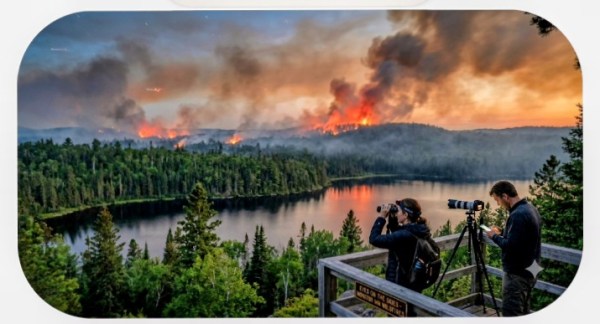
As of today, **July 17, 2026**, there is intense wildfire activity across the United States, with **68 large active fires** burning roughly **638,070 acres** across 15 states. Firefighters are facing mid-August conditions early due to severe drought, extreme heat domes, and recent massive lightning storms. The situation is split between massive blazes in the West and Midwest, coupled with widespread hazardous air quality affecting millions of Americans. ## 1. Hotspots by Region ### The Pacific Northwest & West A prolonged period of dry lightning has caused a massive surge of new fires in this region. * **Oregon & Washington:** Oregon is currently managing the highest volume of major blazes with **19 active large fires**. Tens of thousands of lightning strikes earlier this week sparked dozens of new starts across both states. * **Colorado & Utah:** Highly destructive fires continue to burn here. Large incidents like the *Aspen Acres Fire* (nearly 100,000 acres in Colorado) and the *Babylon Fire* (over 107,000 acres in Utah) are keeping thousands of personnel deployed. ### The Midwest (Minnesota) * **Boundary Waters Fires:** In northeastern Minnesota, the **Superior National Forest** is experiencing extreme fire behavior. About 17 lightning-caused fires exploded this week, forcing the complete evacuation and closure of the **Boundary Waters Canoe Area Wilderness**. Forest rangers have been canoeing and motorboating through waterways to safely evacuate an estimated 6,000 to 10,000 campers. Major uncontained blazes here include the *Bear Trap Fire* (34,422 acres) and the *Thumb Fire* (15,394 acres). ## 2. Smoke and Air Quality Crisis The combination of out-of-control fires in Western Ontario (Canada) and Northern Minnesota has funneled a thick, dangerous blanket of smoke southward and eastward. * **Cities Affected:** Over 109 million Americans are under air quality alerts today. **Detroit, Chicago, Baltimore, and Washington, D.C.** have topped charts for the worst air quality of major world cities. Air Quality Index (AQI) levels hit “hazardous” territory in Detroit (peaking past 700) and reached highly toxic “Code Purple/Red” levels across the Mid-Atlantic today. * **Weather Relief Timeline:** A strong storm system moving from the west is expected to bring heavy rain to the Midwest and East Coast late Saturday. This should wash a significant amount of particulate matter out of the air, offering noticeable breathing relief by Sunday afternoon. If you are downwind of these plumes, health officials strongly advise keeping windows shut, running central air on a high-efficiency filter (MERV-13 or higher), and utilizing an N95 mask if you must go outdoors. You can track real-time localized smoke conditions at **Fire.airnow.gov**.
What happens when wildfires aren’t an accident of nature, but a calculated weapon? This tactic—often referred to as **land-grab arson**—is a devastating method used by corrupt developers, corporate speculators, and sometimes state-backed actors to force communities off their land and seize their natural resources. Here is a look inside the dark world of manufacturing disasters for profit. ## 1. The Mechanics of Land-Grab Arson The playbook for land-grab arson is as simple as it is brutal: * **The Target:** Indigenous groups, smallholder farmers, or traditional communities who hold valuable, resource-rich land but lack formalized or heavily defended legal titles. * **The Ignition:** Perpetrators intentionally set fires during the dry season. The goal is to destroy homes, wipe out livestock, and ruin agricultural soil in a single swoop. * **The Displacement:** Left with nothing but ash, the community is forced to flee the area for basic survival. * **The Seizure:** With the community gone, speculators swoop in to claim the “abandoned” territory, often using forged paperwork to clear the way for cattle ranching, mega-farms, or mining operations. ## 2. *Grilagem*: The Amazon’s Forest-Clearing Weapon Nowhere is this crisis more visible than in the Amazon rainforest, where the practice is deeply institutionalized under the name ***grilagem*** (land grabbing). In Brazil, professional land grabbers (*grileiros*) view standing forests as an economic roadblock. Because cutting down massive trees by hand is slow and expensive, they use fire as a cheap, rapid bulldozing tool. By burning out indigenous territories and public forests, they instantly clear thousands of acres. Once the smoke clears, they forge land deeds, plant pasture grass, and sell the stolen land to large-scale agricultural operations. ## 3. Disaster Capitalism and “Eco-Displacement” Sometimes, the theft doesn’t happen during the fire, but in the immediate aftermath. This falls under a concept known as **disaster capitalism**—exploiting a crisis to push through policies that would have been impossible during normal times. When a manufactured or natural fire tears through a community, governments or corporate interests may declare the zone “environmentally unstable” or “too high-risk” for residents to return. Under the guise of public safety or environmental conservation, locals are permanently barred from rebuilding. Years later, those same strict zoning laws are quietly lifted or bypassed, opening the door for luxury eco-tourism, private real estate, or industrial resource extraction. ## 4. Urban Arson-for-Profit This tactic isn’t strictly limited to remote jungles or rural valleys. A localized version exists in urban planning, often called **arson-for-profit** or **gentrification by fire**. In high-value metropolitan areas, landlords or developers looking to cash in on skyrocketing real estate prices have historically used arson to clear out rent-controlled buildings or low-income neighborhoods. By making the property unlivable, they force out tenants, bypass lengthy eviction courts, collect insurance payouts, and clear the land for profitable luxury developments. > ### The Bottom Line > Fire is being used as a weapon of displacement because it leaves behind a blank slate. It destroys evidence, erases physical community history, and forces immediate evacuation. > Recognizing **land-grab arson** for what it is—corporate warfare and violent theft, rather than a natural disaster—is the first step toward creating international legal frameworks that protect vulnerable communities from being burned out of their homes. >Here is an additional section you can help our readers dig deeper into the identity of the aircraft they are tracking. ### **How to Identify the “Invisible” Owners** Seeing a plane on a map is only the first step. To truly hold these operations accountable, we need to know who is behind the controls. Most aircraft in the U.S. carry a “license plate” known as an **N-Number** (or tail number). #### **1. The FAA Registry (The Primary Source)** Every aircraft registered in the United States is listed in the **FAA Aircraft Registration Inquiry** database. * **How to search:** Go to registry.faa.gov. * **The Pro-Tip:** When searching, **do not include the ‘N’**. If the tail number is N12345, just type “12345.” * **What you’ll find:** This will give you the name of the registered owner, their address, and the specific type of aircraft. #### **2. Peeling Back Corporate Layers** Often, suspicious planes are registered to an LLC (Limited Liability Company) or a “Trust” to hide the true owner. If the FAA shows a name like *”Alpha-Bravo Holdings LLC,”* don’t stop there: * **Secretary of State Search:** Go to the Secretary of State website for the state listed in the FAA address. Search for that LLC name to see who the “Registered Agent” or “Manager” is. * **OpenCorporates:** Use OpenCorporates.com to see if that company is linked to other businesses or individuals. #### **3. Tracking “Blocked” Aircraft** Some owners pay to have their tail numbers hidden from popular sites like FlightRadar24. This is a red flag for watchdogs. * **Use ADS-B Exchange:** This site is community-run and **does not filter out blocked aircraft**. If a plane is invisible on other apps, it will often still show up here. * **Check the Serial Number:** If you can’t find the tail number but have the “Hex Code” (a series of letters and numbers from the tracking site), you can often trace that back to the original registration. #### **4. Identifying Flight Schools & Contractors** If the owner is listed as **UND Aerospace** or a private contractor like **Dynamic Aviation** or **Bridger Aerospace**, take note of the duration they spend over fire zones. Are they performing standard maneuvers, or are they loitering in ways that don’t match official firefighting procedures? ### **Important Safety Note for Watchdogs** * **Stay Legal:** All of this information is **public record**. You have every right to access it and share it. * **Stay Focused:** The goal is transparency. Focus on documenting the *facts*: times, tail numbers, and coordinates. The more precise our data, the harder it is for them to ignore us.
Official Watchdog Resources:
MNICS.org: The home of the Minnesota Incident Command System for coordination and updates.
InciWeb: For official status reports on active, major federal incidents.
DNR Fire Danger Rating Map: For real-time updates on color-coded danger zones.
NASA FIRMS Map: For satellite-detected hotspots.
**The land is burning.** From the plains of Kansas and Iowa to the forests of North Dakota and Minnesota, our communities—and our national food supply—are under threat. But while the smoke rises, something else is happening in the air. Many of us have noticed unusual flight patterns over sensitive areas like the **White Earth** and **Leech Lake** Reservations. When private university planes and “untraceable” aircraft circle active fire zones under the cover of darkness, we have a right to ask: **Why?** If we want to protect our land and our future, we need a community of watchdogs. We aren’t just bystanders; we are witnesses. Here is how you can help monitor the situation and document what’s happening in real-time. ### **1. Track the Patterns in Real-Time** You don’t need a radar dish to see what’s flying overhead. Use these open-source tools to identify aircraft: * **FlightRadar24:** The gold standard for real-time tracking. Use the “Playback” feature to go back in time and see if flight records are being altered or removed. * **ADS-B Exchange:** Unlike other sites, ADS-B Exchange does not filter out “blocked” or private aircraft. If a plane is trying to fly “dark,” this is often where you can still find it. * **Look for “Grid” Patterns:** Official survey and firefighting planes fly in specific back-and-forth “mowing the lawn” patterns. Anything that deviates from this—or circles aimlessly over hotspots—needs to be documented. ### **2. Match the Fire to the Flight** To see if planes are targeting specific areas, overlay flight data with live fire maps: * **NASA FIRMS (Fire Information for Resource Management System):** This tool shows satellite-detected “hotspots” within 3 hours of observation. * **InciWeb:** Check the official status of fires. If a plane is circling a “new” fire that hasn’t been reported on InciWeb yet, that is a red flag. ### **3. Document Everything** A screenshot is worth a thousand words. If you see something suspicious: * **Capture the Tail Number (N-Number):** If available, this is the aircraft’s “license plate.” * **Note the Altitude:** Most firefighting or legitimate surveillance happens at specific, regulated altitudes. * **Log the Time and Location:** Be precise about which reservation or town the activity is over. ### **4. Why This Matters** When institutions like **UND Aerospace** or private contractors operate over sensitive areas, there should be full transparency. Our food supply and our indigenous lands are too important to leave to “untraceable” maneuvers. **Knowledge is our best defense.** When we all watch together, it becomes much harder for things to happen “under cover of darkness.” ### **CALL TO ACTION** Are you seeing strange flight paths over your area tonight? **Post your screenshots in the comments or share them with the hashtag #EyesOnTheSkies.** **Stay alert. Stay loud. Protect the land.** ### **Watchdog Resources:** * FlightRadar24 * ADS-B Exchange * NASA FIRMS Map We have added a section specifically about how to research the owners of the private planes once a tail number is identified.
Before an army can march into battle, it needs a fortified base of operations. The two-party establishment operates out of a highly guarded, bureaucratic fortress designed specifically to keep regular citizens out. If we want to dismantle that machine, we cannot just be a loose collection of frustrated voices—we must build a permanent, legally recognized political entity capable of launching a coordinated counter-offensive.
Today, we are lifting the curtain on Phase 1: Building the Infrastructure.
Here is exactly how we are laying the bedrock for the Anti-Deep State Party to ensure it remains a force of the people, by the people, and completely uncorruptible.
Step 1: Draft the Constitution and Bylaws (The Shield Against Bureaucracy)
A political party’s core governing documents do far more than just fulfill a legal checkbox for state and federal election boards. They protect the very soul of the movement. Without a strict, legally binding framework, young political organizations easily fall victim to internal infighting, corporate infiltration, or “mission drift.”
Our team is currently finalizing a decentralized framework designed to:
Enforce Absolute Accountability: Establish clear, unalterable mechanisms for members to hold leadership accountable.
Empower Local Chapters: Ensure that decision-making power originates from grassroots local chapters, legally preventing the party from ever hardening into a top-down, centralized oligarchy.
Protect the Platform: Lock in our core principles so that no outside special interests can ever hijack our mission.
🛑 Crucial Vetting & Membership Standards
To truly dismantle the Deep State, our infrastructure must be completely impenetrable to the networks that control the establishment. Therefore, our bylaws will include a strict, non-negotiable membership clause:
No member, officer, or candidate of the Anti-Deep State Party may belong to any secret societies, globalist Illuminati networks, Masonic lodges, or any other occult or satanic organizations.
We are drawing a hard line in the sand. Total transparency requires absolute loyalty to the people, and we will not allow our ranks to be infiltrated, compromised, or influenced by subterranean networks or shadow allegiances. Period.
Step 2: Establish the Mandatory Separation of Powers
To achieve official recognition, election laws demand strict structural guardrails. Chief among them is a total firewall between the party’s public leadership and its financial management.
We are currently establishing our mandatory, independent leadership roles to create total operational transparency:
    [ Chairperson ]                     [ Treasurer ]
 (Public Face & Strategy)   <--->   (Financial Gatekeeper)
                                    *Legally Accountable to FEC*
The Chairperson: Operates as the public face, strategic leader, and ideological compass of the party—focusing on national messaging, grassroots growth, and candidate recruitment.
The Treasurer: Holds the ultimate legal and financial responsibility. In the eyes of election compliance boards, the Treasurer is the absolute gatekeeper. They are personally responsible for tracking every single donation and ensuring microscopic accuracy in public disclosures.
Keeping these roles entirely separate eliminates conflicts of interest and proves to our early supporters that every single dollar raised is handled with institutional-grade integrity.
Step 3: Activating the Compliance Engine
Once our bylaws are locked in and our core officers are designated, we move immediately into the legal activation phase:
Securing our EIN: Formally registering our completed framework with the IRS to establish our unique Employer Identification Number.
Opening Compliance-Ready Banking: Setting up dedicated political banking accounts explicitly structured to handle the granular, transparent tracking required for upcoming state and federal filings.
How You Can Help Right Now
We are building the stadium so that our candidates can take the field. But a stadium requires a dedicated crew to erect the steel. As we finalize this first phase, we need patriots ready to step into key foundational roles:
Bylaw & Policy Reviewers: If you have a background in constitutional law, corporate governance, or compliance, we need your eyes on our draft frameworks to ensure our membership clauses and operational structures are legally airtight.
Organizational Builders: We need detail-oriented patriots ready to help coordinate early state-level paperwork as we prepare for Phase 2 (Ballot Access).
The establishment has the money, but we have the truth—and the people. Let’s build this right, from the ground up.
In the heart of the Duck Valley Indian Reservation, a young Shoshone-Paiute researcher named Destany “Sky” Pete has bridged a gap that has long divided modern medicine and Indigenous knowledge. Her investigation into toishabui (traditional chokecherry pudding) isn’t just a win for a science fair—it’s a masterclass in biochemical engineering hidden in plain sight for generations.
The Experiment: Cracking the Code
Growing up, Sky noticed a troubling trend: as her community moved away from traditional diets toward processed, Westernized foods, rates of diabetes and cancer began to climb. Driven by a desire to validate the wisdom of her elders, she partnered with Dr. Ken Cornell at Boise State University to put traditional chokecherry pudding to the test.
The study focused on uterine sarcoma cells, an aggressive form of cancer. Sky tested different variations of the chokecherry:
The Fruit & Juice: Showed little to no effect on the cancer cells.
The Traditional Recipe (toishabui): This version, which includes crushed pits, was a game-changer.
Within just 24 hours, the traditional preparation successfully inhibited the growth of the uterine sarcoma cells.
The Science of the Seed
Why did the pits make the difference? Modern science often warns against cherry pits because they contain amygdalin, a compound that can release cyanide. However, the traditional Shoshone-Paiute method involves a specific process of crushing, drying, and cooking.
Sky’s research suggests that this ancient preparation method acts as a sophisticated form of chemical engineering. By crushing the seeds, the medicinal compounds are “unlocked.” When prepared correctly, these compounds appear to target malignant cells without the toxicity associated with raw pits.
“It wasn’t just the berry,” the research implies, “it was the knowledge of the preparation that created the medicine.”
The Secret is in the Crush
For years, Western botanical guidelines have issued a stern warning: Do not eat the pits. Chokecherry (Prunus virginiana) seeds contain cyanogenic glycosides, specifically amygdalin, which can release hydrogen cyanide when ingested.
However, Sky Pete’s research turned this warning on its head. By collaborating with Boise State University, she tested three versions of the traditional pudding against uterine sarcoma cells:
The Fruit Only: No significant effect on the cancer cells.
The Juice Only: No significant effect.
The Traditional Preparation (Crushed Pits included): A dramatic inhibition of cancer cell growth within just 24 hours.
The Chemical Paradox: Toxicity vs. Therapy
How does a known toxin become a targeted treatment? The answer lies in the mechanical activation of the seeds.
When the pits are crushed, the amygdalin comes into contact with the plant’s natural enzymes (beta-glucosidase). This triggers a reaction that releases controlled amounts of hydrogen cyanide. While this sounds dangerous, the traditional Shoshone-Paiute processing method includes air-drying and boiling, which allows the cyanide levels to dissipate to a safe, consumable threshold while retaining the compounds that appear to target malignant cells.
“It’s a natural laboratory process. The ancestral method isn’t just about flavor; it’s about activating a precise medicinal delivery system.”
More Than a Breakthrough: Food Sovereignty
This research arrives at a critical time for the Duck Valley community. Like many Indigenous nations, the Shoshone-Paiute people have faced a shift toward Westernized diets, often due to “food deserts” and the loss of traditional food sources like salmon. This shift has correlated with a rise in chronic diseases, including diabetes and cancer.
By validating that toishabui is active medicine, Sky Pete is helping to reverse a damaging narrative. She is proving that:
Traditional Ecological Knowledge (TEK) is a rigorous scientific discipline.
The decline in traditional diets isn’t just a loss of culture; it’s the loss of a preventative healthcare system.
The Path Forward: From Uterine Sarcoma to Breast Cancer
The initial results were so compelling that they’ve opened doors for further clinical inquiry. While the 2017 studies focused on uterine sarcoma, the data suggests that higher concentrations or longer exposure times could yield even more significant results. Preliminary discussions have already begun regarding the pudding’s effectiveness against other aggressive cancers, such as breast cancer.
Sky Pete’s journey—from the Elko County Science Fair to the international stage in Los Angeles—serves as a powerful reminder: The answers to our most modern problems may be tucked away in the recipes of our ancestors.
From Elko to the Global Stage
The impact of Sky’s work was immediate. Her project took home the First Grand Prize at the Elko County Science Fair, standing out among more than 440 competing entries. But the accolades were secondary to the message the research sent to the world: Indigenous knowledge is rigorous, evidence-based science.
Mapping the Path Forward
Sky isn’t stopping at uterine sarcoma. Her success has laid the groundwork for a broader investigation into how traditional foods can combat other forms of the disease.
What’s next for this research?
Expanding to Breast Cancer: Sky plans to apply her testing protocols to breast cancer cell lines to see if the toishabui maintains its inhibitory effects.
Revitalizing Native Health: This study is a powerful tool for the Duck Valley community to advocate for food sovereignty, encouraging a return to traditional diets to reverse chronic health trends.
Clinical Collaboration: By continuing her work with Boise State, Sky is helping to create a new model for how universities and tribal nations can collaborate respectfully and effectively.
Summary of Findings
Component
Preparation
Result on Cancer Cells
Flesh/Juice
Standard Extraction
Ineffective
Whole Seed
Intact
Potentially Toxic/Ineffective
Traditional Toishabui
Crushed, Dried, Boiled
Significant Cell Inhibition
This research continues to be a beacon for Indigenous students in STEM, proving that you don’t have to leave your culture behind to change the world of science.
The Bigger Picture
Sky Pete’s work reminds us that while modern medicine looks to the future for cures, some of the most potent answers may already exist in our history. By honoring her heritage and applying the scientific method, Sky has proved that for the Shoshone-Paiute people, the path to health is a return to their roots—one crushed seed at a time
Forced by Fire: How “Land-Grab Arson” is Used to Steal Community Resources
When we think of wildfires, we usually picture a combination of dry lightning, extreme heat, and climate-fueled droughts. But across the globe, a far more sinister force is driving some of the world’s most devastating blazes: **deliberate destruction for profit.**
As of today, **July 17, 2026**, there is intense wildfire activity across the United States, with **68 large active fires** burning roughly **638,070 acres** across 15 states. Firefighters are facing mid-August conditions early due to severe drought, extreme heat domes, and recent massive lightning storms. The situation is split between massive blazes in the West and Midwest, coupled with widespread hazardous air quality affecting millions of Americans. ## 1. Hotspots by Region ### The Pacific Northwest & West A prolonged period of dry lightning has caused a massive surge of new fires in this region. * **Oregon & Washington:** Oregon is currently managing the highest volume of major blazes with **19 active large fires**. Tens of thousands of lightning strikes earlier this week sparked dozens of new starts across both states. * **Colorado & Utah:** Highly destructive fires continue to burn here. Large incidents like the *Aspen Acres Fire* (nearly 100,000 acres in Colorado) and the *Babylon Fire* (over 107,000 acres in Utah) are keeping thousands of personnel deployed. ### The Midwest (Minnesota) * **Boundary Waters Fires:** In northeastern Minnesota, the **Superior National Forest** is experiencing extreme fire behavior. About 17 lightning-caused fires exploded this week, forcing the complete evacuation and closure of the **Boundary Waters Canoe Area Wilderness**. Forest rangers have been canoeing and motorboating through waterways to safely evacuate an estimated 6,000 to 10,000 campers. Major uncontained blazes here include the *Bear Trap Fire* (34,422 acres) and the *Thumb Fire* (15,394 acres). ## 2. Smoke and Air Quality Crisis The combination of out-of-control fires in Western Ontario (Canada) and Northern Minnesota has funneled a thick, dangerous blanket of smoke southward and eastward. * **Cities Affected:** Over 109 million Americans are under air quality alerts today. **Detroit, Chicago, Baltimore, and Washington, D.C.** have topped charts for the worst air quality of major world cities. Air Quality Index (AQI) levels hit “hazardous” territory in Detroit (peaking past 700) and reached highly toxic “Code Purple/Red” levels across the Mid-Atlantic today. * **Weather Relief Timeline:** A strong storm system moving from the west is expected to bring heavy rain to the Midwest and East Coast late Saturday. This should wash a significant amount of particulate matter out of the air, offering noticeable breathing relief by Sunday afternoon. If you are downwind of these plumes, health officials strongly advise keeping windows shut, running central air on a high-efficiency filter (MERV-13 or higher), and utilizing an N95 mask if you must go outdoors. You can track real-time localized smoke conditions at **Fire.airnow.gov**.
What happens when wildfires aren’t an accident of nature, but a calculated weapon? This tactic—often referred to as **land-grab arson**—is a devastating method used by corrupt developers, corporate speculators, and sometimes state-backed actors to force communities off their land and seize their natural resources. Here is a look inside the dark world of manufacturing disasters for profit. ## 1. The Mechanics of Land-Grab Arson The playbook for land-grab arson is as simple as it is brutal: * **The Target:** Indigenous groups, smallholder farmers, or traditional communities who hold valuable, resource-rich land but lack formalized or heavily defended legal titles. * **The Ignition:** Perpetrators intentionally set fires during the dry season. The goal is to destroy homes, wipe out livestock, and ruin agricultural soil in a single swoop. * **The Displacement:** Left with nothing but ash, the community is forced to flee the area for basic survival. * **The Seizure:** With the community gone, speculators swoop in to claim the “abandoned” territory, often using forged paperwork to clear the way for cattle ranching, mega-farms, or mining operations. ## 2. *Grilagem*: The Amazon’s Forest-Clearing Weapon Nowhere is this crisis more visible than in the Amazon rainforest, where the practice is deeply institutionalized under the name ***grilagem*** (land grabbing). In Brazil, professional land grabbers (*grileiros*) view standing forests as an economic roadblock. Because cutting down massive trees by hand is slow and expensive, they use fire as a cheap, rapid bulldozing tool. By burning out indigenous territories and public forests, they instantly clear thousands of acres. Once the smoke clears, they forge land deeds, plant pasture grass, and sell the stolen land to large-scale agricultural operations. ## 3. Disaster Capitalism and “Eco-Displacement” Sometimes, the theft doesn’t happen during the fire, but in the immediate aftermath. This falls under a concept known as **disaster capitalism**—exploiting a crisis to push through policies that would have been impossible during normal times. When a manufactured or natural fire tears through a community, governments or corporate interests may declare the zone “environmentally unstable” or “too high-risk” for residents to return. Under the guise of public safety or environmental conservation, locals are permanently barred from rebuilding. Years later, those same strict zoning laws are quietly lifted or bypassed, opening the door for luxury eco-tourism, private real estate, or industrial resource extraction. ## 4. Urban Arson-for-Profit This tactic isn’t strictly limited to remote jungles or rural valleys. A localized version exists in urban planning, often called **arson-for-profit** or **gentrification by fire**. In high-value metropolitan areas, landlords or developers looking to cash in on skyrocketing real estate prices have historically used arson to clear out rent-controlled buildings or low-income neighborhoods. By making the property unlivable, they force out tenants, bypass lengthy eviction courts, collect insurance payouts, and clear the land for profitable luxury developments. > ### The Bottom Line > Fire is being used as a weapon of displacement because it leaves behind a blank slate. It destroys evidence, erases physical community history, and forces immediate evacuation. > Recognizing **land-grab arson** for what it is—corporate warfare and violent theft, rather than a natural disaster—is the first step toward creating international legal frameworks that protect vulnerable communities from being burned out of their homes. >
Focus: Breaking the algorithm, independence, and the “Line in the Sand.”
A revolution is quietly brewing, and today, we draw a line in the sand. 🚩
Algorithms shouldn’t govern your connection. Big Tech shouldn’t stifle your voice.
Welcome to Suite 1776: The definitive home for the new media pioneer. We are a decentralized, multi-platform ecosystem where authenticity is the only currency.
🎙️ Studio 1776 | Audio amplified. 📺 1776 Video | Cinematic VOD. 🤝 Social 1776 | Direct community.
No “Top 40” noise. No vulgarity. Just sophisticated, independent discovery.
The media landscape has been redrawn. Claim your sovereignty: Suite1776.com
Here’s a blog post summarizing the research on the Dos Palms flying serpent and the broader phenomenon of “American Dragons”:
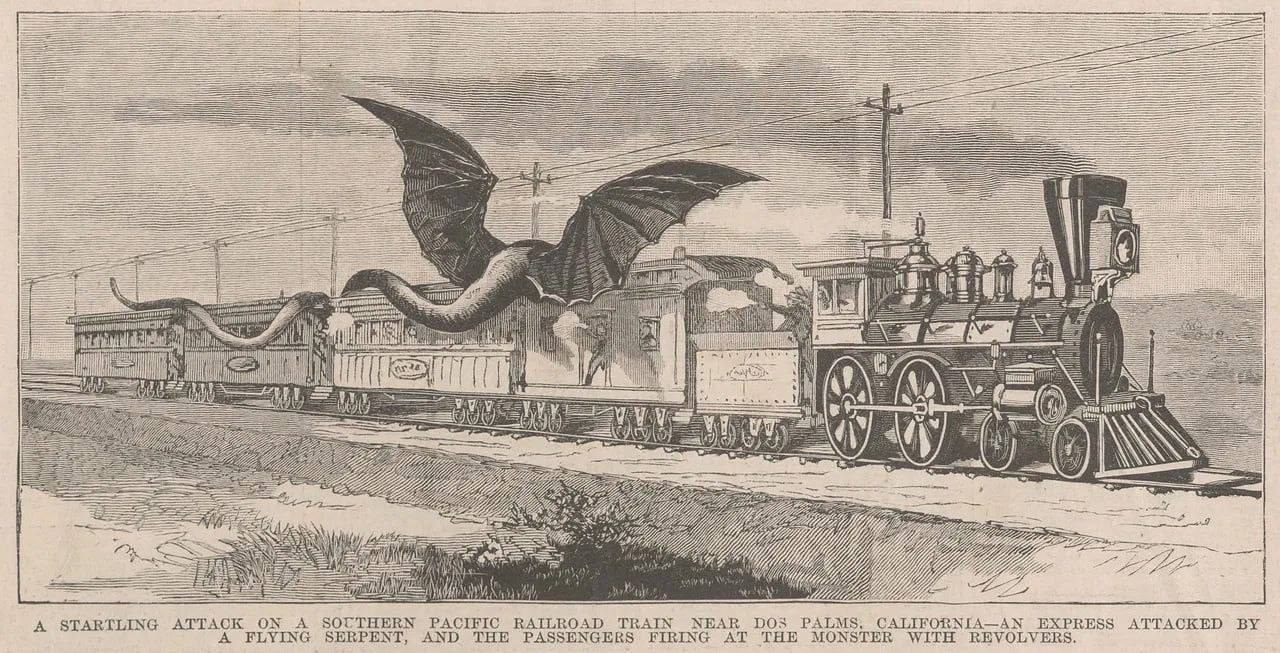
Imagine this: It’s 1882, and you’re on a Southern Pacific train, rumbling through the California desert. Suddenly, a colossal, winged serpent—30 feet long with bat-like wings—attacks your locomotive! Passengers are screaming, revolvers are firing, and the beast is “roaring like a cow in distress.” Sounds like something out of a fantasy novel, right? Yet, this was the sensational headline from The Illustrated Police News on March 18, 1882, detailing an alleged incident near Dos Palms, California.1
This isn’t just a wild tale; it’s a fascinating peek into the “weird news” landscape of 19th-century America, an era when “American Dragons” supposedly terrorized the Western territories.
The Dos Palms Incident: A Thrilling (and Dubious) Account
The story, purportedly relayed by the train’s engineer and fireman and “corroborated by passengers,” claimed the train clipped the serpent’s tail, enraging it. The creature then pursued the train “two miles faster than chain lightning,” thrashed it, shattered windows, and then sailed off, seemingly impervious to the passengers’ bullets.1 The
Los Angeles Times was even cited as reporting the event, though historical archives show some discrepancies in that claim.1 The
Times‘s concluding line, “This is vouched for by everyone who was on the train, and is given for what it is worth,” hints at the era’s blend of sensationalism and a subtle wink to the reader about the story’s incredible nature.1
“American Dragons”: A Pattern of the Peculiar
The Dos Palms serpent was far from unique. Mark Chorvinsky, editor of Strange Magazine, coined the term “American Dragons” to describe a recurring motif of winged reptilian monsters reported across the American West in the late 19th and early 20th centuries.3 These creatures shared remarkably consistent, often biologically impossible, traits:
Flight, Aquatic, and Terrestrial Abilities: They could fly, live underwater, and walk on land.3
Bullet Immunity: Bullets “invariably ‘rang as though striking armor plate’,” having “no effect”.1
Consistent Size: Typically 28 to 45 feet long, with the Dos Palms serpent fitting right in at 30 feet.1
Dramatic Encounters: Often involved confrontations with trains or livestock, vouched for by “reliable witnesses”.3
Lack of Evidence: Despite claims of specimens being killed, there was “invariably lacked follow-up coverage or physical evidence”.3
Beyond Dos Palms, other notable “American Dragons” included the fearsome Lake Elizabeth Monster in California 1, the legendary Tombstone Thunderbird of Arizona 4, and the “River Dragon” of Napoleon, Ohio.5
The Age of “Yellow Journalism” and Tall Tales
Why did such fantastical stories flourish? The late 1800s were a “perfect storm for sensational storytelling”.3 This was the heyday of “yellow journalism,” a style that prioritized “sensationalism over facts” to “boost circulation”.3 Publishers like Hearst and Pulitzer were locked in fierce competition, and outrageous stories, regardless of their factual basis, sold newspapers.3
Communication technology was limited, making “fact-checking nearly impossible”.3 Moreover, the frontier culture itself “embraced tall tales as entertainment,” with Western newspapers serving as “creative outlets for writers” who knew their readers expected that “almost anything could actually happen in this Lawless land”.3 It was an era where “even major newspapers ran stories of sea serpents, apelike wild men and haunted houses alongside more sober reporting”.1 Hoaxes like the Great Moon Hoax of 1835 and the Great Wall of China Demolition Hoax of 1899 were widely circulated, demonstrating the public’s appetite for a blend of information and fantasy.7
More Than Just Monsters: Cultural Significance
These “weird news” stories were more than just entertainment. They functioned as “cultural categories and symbols,” reflecting the “anxieties, concerns, and power dynamics of the time”.9 Monsters represented the “unknown and uncategorizable,” much like they did on earlier maps, symbolizing the uncertainties of exploration.9
In the American West, these monster encounters also played a role in “the construction and consolidation of masculine identities”.9 Confronting these creatures in the wilderness was framed as an opportunity for “daring adventurers” to “discover, combat, and capture unknown creatures,” symbolically “claiming the unknown for ‘civilization’ and scientific categorization”.9 The image of passengers firing revolvers at the flying snake perfectly embodies this cultural assertion of control over the wild and inexplicable.1
The prevalence of “weird news” also challenges the idea that the 19th century was a period of complete “disenchantment” from supernatural belief. Instead, it suggests a “continued, or at least semi-enchanted, worldview,” where a deep fascination with the preternatural persisted despite scientific advancements.9
Mark Chorvinsky: The Skeptical Investigator
Mark Chorvinsky, the researcher who documented “American Dragons,” approached these phenomena with “open-minded skepticism”.10 His
Strange Magazine aimed to apply the “scientific method to scientifically delinquent topics” like cryptozoology, not to convince readers to believe, but to investigate.10 He famously spent years researching the “infamous Thunderbird Photo,” ultimately concluding it “most likely does not exist,” but found value in studying why so many credible witnesses believed they had seen it.10 His work highlights the crucial distinction between studying folklore as a cultural artifact and attempting to validate it as biological fact, a common pitfall of cryptozoology.12
The Dos Palms flying serpent, and its “American Dragon” kin, may not have been real, but their stories offer a captivating window into a bygone era of journalism, frontier culture, and the enduring human fascination with the mysterious. They remind us that sometimes, the most incredible tales reveal the most about ourselves.
The Dos Palms Flying Serpent: A Case Study in 19th-Century American “Weird News”
Executive Summary
This report investigates the sensational 1882 “flying snake” attack on a Southern Pacific Railroad train near Dos Palms, California, as reported by The Illustrated Police News and purportedly by the Los Angeles Times. The incident is examined within the broader context of “American Dragons”—a recurring motif of winged reptilian monsters prominent in 19th and early 20th-century American folklore. The analysis reveals that the Dos Palms event, while presented as a factual account, exemplifies the pervasive “yellow journalism” of the era and the frontier culture’s embrace of tall tales, which often blurred the lines between genuine news and creative fiction. These “American Dragon” narratives, despite lacking verifiable evidence, functioned as significant cultural signifiers, reflecting societal anxieties, shaping masculine identities, and challenging the notion of a fully “disenchanted” world. The report underscores the critical work of folklorists and researchers, such as Mark Chorvinsky, in analyzing these phenomena as cultural artifacts rather than literal cryptozoological claims.
1. Introduction: The Dos Palms Flying Serpent – A Glimpse into 19th-Century “Weird News”
The headline from The Illustrated Police News on March 18, 1882, dramatically announced a “Terrible attack on Southern Pacific Railroad train near Dos Palms, Calif. Express attacked by flying snake, passengers firing at monster with revolvers”.1 This striking declaration immediately immerses the reader in an extraordinary historical account, one that defies conventional understanding of reality. The very existence of such a headline, presented as news in a widely circulated publication, signals a fundamental divergence in journalistic standards and public expectations compared to contemporary media.
The central inquiry of this report is how such extraordinary historical accounts, which challenge modern interpretations of factual reporting, are critically interpreted. This investigation aims to frame the Dos Palms incident not merely as a historical news item, but as a complex interplay of folkloric narrative, prevalent journalistic practices, and the broader cultural environment of its time. The initial encounter with such a sensational headline prompts an immediate recognition of the distinct historical, journalistic, and cultural contexts that allowed such stories to flourish, setting the stage for a deeper exploration of their origins and significance.
2. The Dos Palms Incident: Anatomy of a Frontier Sensation
The narrative of the Dos Palms flying serpent attack unfolds with vivid detail, placing the reader on a Southern Pacific express steam locomotive as it traversed the Colorado Desert from Yuma, Arizona, to Los Angeles, having just passed the oasis of Dos Palmas.1 Eyewitness accounts, purportedly relayed by the engineer and fireman and corroborated by passengers upon their arrival in Los Angeles, describe a peculiar sight: a “column of sand” about a half-mile ahead that inexplicably transformed into a strange animal, moving perpendicularly towards the train.1
The creature was described as approximately 30 feet long and 12 inches in diameter, with its tail dragging on the ground and two large wings positioned near its head, suggesting a serpentine yet avian or bat-like morphology.1 The encounter escalated violently when the swiftly moving train reportedly clipped a portion of the creature’s tail, an act that “enraged the enormous serpent.” It then pursued its “steel attacker” at an incredible speed, described as “two miles faster than chain lightning,” quickly overtaking the locomotive. Striking from a position of safety above, the monster “gave the train a lively thrashing, roaring like a cow in distress all the time,” shattering several windows in its onslaught.1 After the serpent pulled back and sailed off, passengers, given a moment to recover, unholstered their pistols and unleashed a “shower of lead” after the beast. However, the bullets, “if they hit their target at all, had no effect as the monster winged its way back across the desert sands”.1
The narrative is characterized by its highly dramatic and evocative language, employing vivid imagery such as “chain lightning” and “roaring like a cow” to captivate and thrill the reader. This stylistic choice is a hallmark of the sensationalist journalistic practices prevalent in the era. The inclusion of specific eyewitnesses—the engineer, fireman, and corroborating passengers—lends a superficial air of credibility to the fantastical event, despite its inherent implausibility.
A critical examination of the primary source claims reveals a significant discrepancy. While multiple sources explicitly state that the Los Angeles Times reported the incident on January 17, 1882 1, the provided digitized archive snippet for that date 2 shows the
Daily Los Angeles Herald with unrelated content. This contradiction highlights the inherent challenges of historical source verification and the potential for misattribution or unverified claims to be propagated through secondary sources. This factual inconsistency directly impacts the perceived “corroboration” of the event, suggesting that the Times citation might be a later, unverified reference in a secondary source, or that the specific Times article is not easily accessible in the particular archive consulted. This necessitates a critical re-evaluation of the claims of corroboration.
The concluding phrase attributed to the Los Angeles Times, “This is vouched for by everyone who was on the train, and is given for what it is worth” 1, is particularly revealing. This cautious phrasing indicates a degree of journalistic detachment or perhaps a tacit acknowledgment of the story’s incredible nature. This reveals a subtle yet significant tension within 19th-century journalism. While actively engaging in sensationalism to attract readers, there was often an implicit understanding, or even a playful acknowledgment, between the newspaper and its audience regarding the literal veracity of such outlandish tales. This suggests that readers might have consumed and enjoyed these stories primarily as entertainment, rather than strictly factual reporting, even when published by “major newspapers.” This dynamic underscores the blurred lines between news and fiction that characterized the era, where readers expected a blend of information and fantasy.3
3. “American Dragons”: A Recurring Motif in the American West
The Dos Palms incident is not an isolated anomaly but rather an early example of a rich tradition of winged reptilian monsters that were purportedly sighted terrorizing America’s western territories and wild environs during the latter half of the 19th and early 20th centuries.1 This phenomenon was notably dubbed “American Dragons” by Mark Chorvinsky, the founder and editor of
Strange Magazine, in a 2000 article.4 Chorvinsky, a multifaceted figure with a background as a stage magician, entrepreneur, filmmaker, and writer, dedicated his life to investigating strange and anomalous phenomena. His approach was characterized by “open-minded skepticism,” aiming to conduct in-depth investigations rather than simply to prove or disprove the existence of these creatures.5
Chorvinsky documented that these creatures exhibited “remarkably consistent patterns” across various Western states, suggesting a shared narrative template rather than independent biological sightings.4 They shared distinctive, often biologically impossible, characteristics: alleged ability to fly, live underwater, and walk on land—abilities “unknown to any real animal”.4 A recurring motif was their apparent invulnerability to conventional weaponry; bullets fired at them “invariably ‘rang as though striking armor plate’,” having “no effect”.1 Reported sizes consistently ranged between 28 to 45 feet in length, with the Dos Palms serpent, at 30 feet long, fitting squarely within this range.1 Encounters were typically dramatic, featuring “reliable witnesses who vouched for authenticity” and involved “dramatic confrontations with trains or livestock”.1 Crucially, despite claims of specimens being killed and pieces taken for analysis, these accounts “invariably lacked follow-up coverage or physical evidence”.4
The striking consistency in the characteristics attributed to “American Dragons” (e.g., flight, amphibious capabilities, bullet immunity, specific size ranges) points strongly to a shared cultural template or journalistic formula rather than independent sightings of a real cryptid. This suggests that these narratives were likely constructed or heavily embellished using established tropes from global dragon folklore 8 and then adapted to resonate with the specific cultural anxieties and expectations of the American frontier. This adaptation allowed these stories to serve particular cultural functions beyond simple entertainment.
Table 1: Recurring Characteristics of “American Dragons”
Characteristic Category
Specific Trait
Description/Observed Pattern
Locomotion
Flight
Capable of sustained flight, often described as fast (e.g., “two miles faster than chain lightning”).
Locomotion
Aquatic Ability
Able to inhabit and move through water bodies (e.g., Lake Elizabeth monster, Maumee River dragon).
Locomotion
Terrestrial Movement
Capable of movement on land, sometimes with difficulty (e.g., “tail dragging on the ground”).
Defense
Bullet Immunity
Bullets consistently described as ineffective, “ringing as though striking armor plate,” or having “no effect.”
Size
Length
Generally reported between 28-45 feet in length (Dos Palms serpent at 30 feet).
Witness Accounts
Witness Credibility
Accounts often “vouched for by everyone” on scene, with claims of “reliable witnesses.”
Witness Accounts
Type of Confrontation
Frequent dramatic confrontations with trains, livestock, or human adventurers.
Evidence
Physical Evidence
Persistent absence of physical specimens, follow-up evidence, or verifiable photographs (e.g., Thunderbird Photo).
Beyond the Dos Palms incident, other notable “American Dragon” reports include:
Lake Elizabeth Monster (California): Active from 1830 to around 1890, this creature was described as “probably the most fearsome being ever recorded in… America”.4 Its presence was heralded by volcanic rumbling and a potent, unsettling odor, and its roar was said to “curdle the blood of a mummy”.1 Physically, it was a slimy, reddish beast, about 30 feet long, with a long snout, jagged yellow teeth, enormous bat wings, long hind legs, a barbed tail, a shaggy yellow mane, and emerald, dinner-plate-sized eyes. It was known to attack livestock.1
Tombstone Thunderbird (Arizona, 1890): This legend involves a giant flying bird, initially reported with an alarming wingspan of 160 feet and a length of 92 feet, possessing smooth skin and transparent membrane wings.9 Later, more “reasonable” estimates for its wingspan were between 20-30 feet.9 The legend was significantly embellished by later accounts, particularly by Pearl, who added the now-famous element of a photograph depicting the carcass, which subsequently became a widely believed but ultimately non-existent “phantom photo”.6
Fletcher, Illinois “Huge Reptile” (1896): A farmer was startled by a huge reptile, described as 15 feet in length, as thick as a telegraph pole, black, and with a hooded head. Three smaller ones, measuring 18-20 feet, were seen struggling with a lamb. This sighting was reportedly witnessed by at least twenty persons.10
Napoleon, Ohio “River Dragon” (1902): Reports of this creature circulated for 15 years prior to 1902. It was seen on the banks of the Maumee River, moving with ease both on land and in water. Described as resembling a river lizard, it was 9-10 feet long, 24-30 inches high, and 14 inches across, featuring a large tail covered in minute scales and and two small, web-shaped feet.10
Snallygaster (Maryland, 18th-20th century): A bird-reptile chimera with a metallic beak, razor-sharp teeth, and sometimes octopus-like tentacles, rumored to suck blood. Notably, 1909 sightings were later revealed to be a hoax orchestrated by a Middletown Valley Register editor and reporter to boost readership, drawing themes from existing German folklore and the Jersey Devil legend.11
Crawfordsville Monster (Indiana, 1890s): Described as a “horrible apparition” in the sky, this creature became significant fodder for newspaper headlines. While its origins were eventually discovered to be earthly, its legendary status highlights the power of “fake news” in shaping public perception.12
4. The Press Landscape of the Late 19th Century: Breeding Ground for the Bizarre
The late 1800s in the American West provided a “perfect storm for sensational storytelling” within the burgeoning newspaper industry.4 This period coincided directly with the rise of “yellow journalism,” a distinctive journalistic style that prioritized “sensationalism over facts” primarily to “boost circulation”.4 Major newspaper publishers, such as William Randolph Hearst and Joseph Pulitzer, were engaged in “fierce battles for readership,” driving the competitive adoption of sensationalist tactics.4 The term “yellow journalism” itself originated from a popular cartoon strip, “Hogan’s Alley,” and subsequently expanded to describe the profit-driven, often exaggerated coverage of various events, including significant international conflicts.13
Several cultural and technological factors facilitated the proliferation of hoaxes during this era:
Communication Technology: The technological limitations of the 1880s meant that “fact-checking nearly impossible,” creating an environment where “outrageous stories” could “spread across the country before they could be properly verified”.4 This allowed hoaxes to gain widespread traction.
Frontier Culture: The prevailing frontier culture actively “embraced tall tales as entertainment.” Western newspapers, therefore, functioned not only as news sources but also as “creative outlets for writers” who found fertile ground in their readers’ expectations that “almost anything could actually happen in this Lawless land”.4
Blurred Lines in Reporting: It was a distinctive era in American journalism where “even major newspapers ran stories of sea serpents, apelike wild men and haunted houses alongside more sober reporting on politics, crime and daily life”.1 This demonstrates a fluid boundary between factual reporting and fantastical narratives.
Journalistic Ethics: 19th-century journalism, particularly the “New Journalism,” was characterized by a “less stringent adherence to facts compared to scientific documents”.14 Furthermore, practices such as the widespread “borrowing” of items from other newspapers, often “without attribution,” and the common inclusion of “gossip, rumors, and scurrilous personal attacks” contributed to a less rigorous ethical environment.3
The confluence of “yellow journalism,” limited communication technology, and a frontier culture that embraced tall tales created a powerful feedback loop. Sensational stories, regardless of their factual basis, demonstrably increased newspaper circulation 3, which in turn incentivized publishers to produce even more outlandish content. This dynamic actively shaped journalistic content, prioritizing reader engagement and entertainment over strict factual accuracy, effectively normalizing the inclusion of “weird news” as a legitimate and profitable journalistic genre. This represents a causal relationship where market forces fundamentally altered the definition and practice of “news” itself, transforming it into a hybrid of information and entertainment.
The period saw numerous prominent hoaxes widely circulated by American newspapers:
Table 2: Prominent 19th-Century American Newspaper Hoaxes
Hoax Name
Approximate Year(s)
Key Newspaper(s) / Originators
Nature of Hoax
Primary Purpose / Impact
The Great Moon Hoax
1835
The Sun
Fictional astronomical discoveries of lunar life
Boost circulation, entertainment, catalyst for journalism ethics discussion
Great Wall of China Demolition Hoax
1899
Four Denver reporters
Fabricated international news about demolishing the Great Wall
Satirical fiction mistakenly reported as genuine news
Highlights susceptibility to misinterpretation
Cardiff Giant / Taughannock Giant
1869 / 1879
Various newspapers
Fake archaeological finds of petrified giants
Entertainment, copycat hoaxes
Snallygaster (1909)
1909
Middletown Valley Register editor and reporter
Monster sightings
Explicitly designed to increase readership
Crawfordsville Monster
1890s
Various newspapers in Indiana
“Horrible apparition” in the sky
Cited as an example of “fake news” from the period
The Great Moon Hoax of 1835, published by The Sun, claimed astronomical discoveries of lunar life. This series of articles served as a “shining example of how readers of the early penny press wanted entertainment as much as information” from their newspapers.3 The hoax, which presented a satirical analysis, succeeded due to the “vulnerability of the reading audience who by this time began to expect a dose of fantasy with factual information”.3 The publisher never fully admitted fraud but acknowledged its “useful effect in diverting”.3 This event is considered a “catalyst for the discussion of what readers expected and needed from their news media in a time when objectivity was just a concept”.3 Other examples include the Great Wall of China Demolition Hoax of 1899, an elaborate fake news article concocted by four Denver reporters that spread internationally 4, and Mark Twain’s satirical massacre story, which was mistakenly reported as genuine news.4 The Cardiff Giant (1869) and its copycat, the Taughannock Giant (1879), were notable hoaxes involving the “discovery” of petrified giants.16 The 1909 Snallygaster reports were later revealed to be a hoax orchestrated by a
Middletown Valley Register editor and reporter, explicitly designed to increase readership.11 Similarly, the Crawfordsville Monster of the 1890s, described as a “horrible apparition” in the sky, became significant fodder for newspaper headlines in Indiana and is cited as an example of “fake news” from the period.12 These examples collectively demonstrate that the Dos Palms incident was not an isolated oddity but rather a typical manifestation of a well-established journalistic practice, where sensationalism and hoaxes were integral to the business model and cultural function of newspapers.
5. Folklore, Cryptozoology, and the Enduring Myth
Mark Chorvinsky posited that the “American Dragons” phenomenon was a cultural amalgamation, drawing from diverse sources including traditional European dragon legends, Native American beliefs in the Thunderbird as an avian storm deity, and the intricate lore surrounding the Piasa, a pre-European mural depicting a dragon-like creature.1 Globally, dragon legends, though varying in specific features across cultures (e.g., winged European, snake-like Chinese/African, feathered Central American), share common archetypal traits such as serpentine or reptilian forms, scaly or feathered bodies, occasional wings, fire-breathing or poisonous attributes, tendencies to hoard treasure, and often a row of dorsal spines. Many narratives culminate in heroes slaying these formidable beasts.8 Native American cultures possess a rich tapestry of myths and legends that serve to explain natural phenomena and the intricate relationship between humans and the spirit world. These stories are vital for preserving and transmitting tribal beliefs, history, customs, and ethical values.17 Examples of other vaguely dragon-like or monstrous cryptids in American folklore include the Cumberland dragon (also known as goosefoot or cheeklaceella) from Tennessee in 1794, described as a two-legged creature that emitted red matter from its mouth 18, and the Wimpus from Eastern Tennessee woodsmen folklore, a gorilla-shaped creature with giant claws that spins invisibly, turning anything that approaches into “syrup or varnish”.19
Mark Chorvinsky was renowned for his “in-depth, and sometimes controversial, investigations” and his commitment to “open-minded skepticism” in the study of anomalous phenomena.5 His publication,
Strange Magazine, aimed to apply the “scientific method to scientifically delinquent topics” such as ufology, parapsychology, and cryptozoology. Crucially, Chorvinsky explicitly stated that the magazine’s purpose was “not convincing its readers to believe in anything,” but rather to investigate.6 A notable example of his work is the Thunderbird Photo legend. Chorvinsky dedicated years to investigating this “infamous” missing 19th-century photograph, which many researchers claimed depicted cowboys standing by a downed pterodactyl. Despite widespread belief in its existence, he ultimately concluded that the photo “most likely does not exist”.6 However, he found significant value in studying the phenomenon of so many credible witnesses believing they had seen it.7 He meticulously traced the Thunderbird legend to an 1890 article in the
Tombstone Epitaph, noting that the original story did not include a picture and that the photographic element was a later embellishment by Pearl, which subsequently fueled the widespread belief in the phantom photo.6
Chorvinsky’s rigorous and skeptical approach to “American Dragons” and, specifically, the Thunderbird Photo 6 stands in stark contrast to the typical methodologies and objectives of cryptozoology. Cryptozoology is defined as a “pseudoscience and subculture” dedicated to the search for and study of unknown, legendary, or extinct animals (termed “cryptids”) that are popular in folklore, such as Bigfoot, the Loch Ness Monster, and the Yeti.20 Mainstream science widely regards cryptozoology as a pseudoscience because it “does not follow the scientific method” and relies heavily on anecdotal information rather than empirical evidence.20 Scholars have observed cryptozoology’s tendency to reject mainstream scientific approaches and, at times, exhibit hostility towards established science, often drawing parallels with other pseudoscientific pursuits like ghost hunting.20 Historically, instances of “irrefutable evidence” presented by notable cryptozoologists have frequently been exposed as hoaxes upon closer examination or confession by the perpetrators.20 A subset of cryptozoology actively promotes Young Earth Creationism, thereby rejecting conventional scientific understandings of geology and evolution.20 By shifting the focus from attempting to prove the literal existence of these creatures to analyzing the phenomenon of belief and the narrative construction behind them, Chorvinsky elevates the study from pseudoscience to a legitimate academic pursuit within folklore and cultural studies. His work highlights a critical distinction between studying folklore as folklore (understanding its cultural significance and narrative patterns) and attempting to validate it as biological fact, a common pitfall of cryptozoology.
6. Beyond the Headlines: Cultural Significance of Monster Narratives
The emergence of “weird news” served as a new, prominent medium for the fantastical in the 19th century, particularly as monsters seemingly disappeared from more intellectualized and scientific cartography.14 Monsters featured in “weird news” were more than mere entertainment; they functioned as “cultural categories and symbols,” directly reflecting the “anxieties, concerns, and power dynamics of the time”.14 These creatures represented the “unknown and uncategorizable,” mirroring how monsters on earlier maps symbolized the uncertainties and dangers of exploration.14 More broadly, monster narratives help societies process and articulate shared experiences of horror and address “real anxieties, from wars and economic disasters, to insane political situations, climatic ruin and other issues in the news”.21 They serve to convey deeper “truths” about societal fears: “evil is afoot, you can’t trust what you see, the future is grim, you’re going to die”.21 The 19th century itself was a period marked by significant intellectual shifts, including an “apocalyptic vision” of Earth’s history (e.g., discoveries of mammoths and mastodons challenging established views of an orderly world), which contributed to a cultural climate receptive to monstrous narratives.22
Within Western nations, particularly the United States, monster encounters reported in “weird news” played a significant role in the “construction and consolidation of masculine identities”.14 These encounters with monstrous creatures in wilderness or frontier zones were framed as opportunities for “daring adventurers” to brave risks, and to “discover, combat, and capture unknown creatures,” thereby symbolically “claiming the unknown for ‘civilization’ and scientific categorization”.14 The act of passengers firing revolvers at the flying snake in the Dos Palms incident 1 or cowboys shooting at the Thunderbird 9 directly embodies this cultural imperative to assert control and dominance over the wild and the inexplicable. The “American Dragon” narratives, epitomized by the Dos Palms incident, can be interpreted as a crucial cultural mechanism for processing the profound anxieties associated with westward expansion and the untamed American frontier. The recurring motif of “claiming the unknown for ‘civilization’ and scientific categorization” 14 through fictionalized or exaggerated encounters suggests a deep societal need to impose order and meaning upon a chaotic, unpredictable, and often dangerous environment. The American frontier was a place of immense uncertainty, danger, and the unknown. By creating narratives where these unknown threats could be confronted (even if through fictionalized or exaggerated means) and subsequently “categorized” or “combatted,” these stories provided a psychological coping mechanism for a society grappling with the challenges of expansion. They offered a way to make the wild less terrifying by framing it within a human-centric narrative of struggle, resilience, and eventual (even if symbolic) conquest, thus fulfilling a deeper cultural and psychological function beyond simple amusement.
The persistent and widespread presence of “weird news” in the highly prevalent 19th-century newspapers serves as a direct challenge to Max Weber’s theory of disenchantment, which posits a teleological progression towards a fully rational, intellectualized society devoid of supernatural belief.14 Instead, it suggests a “continued, or at least semi-enchanted, worldview,” where a deep-seated fascination with the preternatural and the unknown persisted, even flourished, despite the advancements of science and industrialization.14
7. Conclusion: The Legacy of the Flying Serpent
The Dos Palms flying serpent attack, as presented in the sensationalist press of 1882, was more than a mere sensational headline or an isolated incident. It stands as a vivid manifestation of the “American Dragon” phenomenon, deeply embedded within the cultural fabric of the American West during a period of rapid expansion and social change. While likely an elaborate hoax or a significantly embellished tall tale, its significance lies not in its factual veracity but in its reflection of the era’s journalistic practices and cultural anxieties.
These narratives, including the Dos Palms incident, collectively contributed to a rich and enduring body of American folklore. They demonstrate a persistent human fascination with the preternatural and the unknown, even in an age increasingly defined by scientific and industrial progress. Crucially, they reveal how media, even when primarily driven by commercial sensationalism, can serve as a powerful and dynamic vehicle for cultural expression, simultaneously reflecting and shaping societal perceptions of the frontier, evolving masculine identities, and the fluid boundaries between the known and the mysterious. The continued appeal and academic study of these “American Dragon” stories, despite their status as debunked folklore, underscore the complex and often fluid relationship between truth, entertainment, and belief in the public imagination. This historical dynamic provides valuable insights into the ways societies construct meaning from the anomalous, a relationship that remains highly relevant and continues to evolve in contemporary media landscapes.
Here are some tags that would be suitable for the blog post:
American Dragons,19th Century, Journalism,Yellow Journalism,Frontier Folklore,Monster Stories,Weird News,Historical Hoaxes,Dos Palms,Mark Chorvinsky,Cryptozoology (as a cultural phenomenon,Wild West,Sensationalism,
You’ve probably heard the whispers, seen the headlines: Yellowstone. The name alone conjures images of a sleeping giant, a supervolcano capable of unleashing unimaginable power. Barely a month goes by without some new tremor or steam-driven explosion sending shivers down the spines of disaster preppers and news editors alike. Sometimes, it feels like the whole world is holding its breath, almost willing Yellowstone to blow.
But what’s the real story? Do the latest scientific findings bring good news or bad? Let’s dig into what a Yellowstone super-eruption could truly mean for our planet.
Peering Beneath the Surface: New Clues from Yellowstone
Recent research by the United States Geological Survey (USGS), published in Nature in January 2025, has given us an unprecedented look at what’s brewing beneath Yellowstone National Park. By meticulously mapping the electrical conductivity of the underground rocks, scientists were able to create a 3D picture of the magma reservoirs. Why electrical conductivity? Because molten rock is up to a thousand times more conductive than solid rock, making it relatively easy to pinpoint.
So, what did they find? The good news is that the magma isn’t one giant, unified pool filling a subterranean void. Instead, it’s mostly contained in pockets, making up a relatively small percentage (2-30%) of the surrounding hot, solid rock. Even better, these magma-hosting areas aren’t all connected, meaning a single, colossal eruption that empties everything in one go is unlikely.
The most intriguing revelation, however, points to where the next major eruption might be centered. The magma isn’t evenly distributed. A significant concentration — somewhere between 400 and 500 cubic kilometers of sticky, silica-rich rhyolite magma — is lurking beneath the northeast section of the Yellowstone Caldera, the massive crater left by the last super-eruption 630,000 years ago. This is a larger volume than what erupted in Yellowstone’s considerable Mesa Falls blast about 1.3 million years ago. Adding to this, hot basalt magma from deep within the Earth is continuously pumping heat into this region, keeping the rhyolite magma hot and steadily increasing its volume.
While this might sound alarming, remember that the magma is spread out. For a truly “super” eruption to occur, these pockets of molten rock would need to connect and pool together, accumulating enough volume to be expelled in one massive event. Nevertheless, the researchers behind the Nature paper suggest this area is the most probable location for the next significant outburst. The burning question remains: when?
Is a Super-Eruption “Overdue”?
Despite popular belief, a Yellowstone super-eruption is not overdue. The idea that it’s on a strict schedule is a misconception. Looking back at Yellowstone’s history, there have been three major eruptions: the Huckleberry Ridge eruption (around 2.1 million years ago), the Mesa Falls eruption (around 1.3 million years ago), and the Lava Creek outburst (630,000 years ago).
The average time between these three events is about 735,000 years. However, if we only consider the two truly “super” eruptions (those exceeding the 1,000 cubic kilometer threshold for ejected material), the return period is closer to 1.5 million years. Given this geological timeline, the next Yellowstone super-eruption could still be a very, very long time away. But make no mistake, it will happen eventually, and its impact will be immense, affecting not just the United States but the entire planet.
What a Super-Eruption Would Look Like
To understand what a future Yellowstone eruption might entail, we can look to its past. All previous super-eruptions shared common characteristics: an explosion so powerful that magma was ripped apart, generating colossal amounts of ash. Each eruption was also followed by the collapse of the crust above the emptied magma reservoir, forming a giant caldera—like the 60-kilometer-wide Yellowstone Caldera we see today, which was created during the most recent Lava Creek eruption.
It’s also important to remember that between these enormous events, Yellowstone has experienced many smaller eruptions, often non-explosive lava flows. The last eruption, around 70,000 years ago, was a relatively quiet extrusion of lava.
So, what about the big one? What would we experience as Yellowstone prepares for a volcanic cataclysm, and during the eruption itself?
The Warning Signs
Predicting the exact timeline and warning signs for a super-eruption is challenging. Yellowstone is a restless place, with constant seismic activity, bubbling mud pools, and the ground continually rising and falling. While it seems logical that a super-eruption would be preceded by more intense versions of these same warning signs, research from other supervolcanoes, like Mount Toba in Indonesia, suggests that warning signs could be minimal, offering little notice of an impending, world-changing event.
This is particularly concerning for anyone living within about 100 kilometers (60 miles) of the Yellowstone volcano, as escape might be nearly impossible once the eruption begins. However, recent geological fieldwork indicates that the Lava Creek event was preceded by two smaller, explosive eruptions, perhaps separated by years or even decades. We might see similar “starter” events before the main course. The challenge, from a mitigation standpoint, is that it would be difficult to determine which eruption, if any, is the “super” one until after the fact, once the volume of disgorged material can be quantified. Regardless of the exact volume, any eruption of this magnitude would be cataclysmic for the country.
The Eruption Unfolds
When it comes, the next Yellowstone super-eruption will be impossible to ignore, and its consequences unavoidable, whether you’re nearby or on the other side of the world.
The eruption would likely begin at a single vent where the crust above the magma reservoir is weakest. As gas-rich, highly viscous rhyolite magma, under immense pressure, breaches the surface, it would violently tear itself apart. The initial detonation would be deafening to anyone in the vicinity.
A towering plume of ash and pumice would blast upwards faster than the speed of sound, reaching the edge of space within minutes and then spreading laterally, plunging everything below into darkness. A torrent of hot ash and pumice falling across Yellowstone and the surrounding region would ignite fires, heat the air, and make breathing nearly impossible. But that’s just the beginning.
As parts of the eruption column collapse under their own weight, they would trigger pyroclastic flows—fast-moving surges of hot ash, incandescent gas, and near-molten pumice fragments. These flows would hurtle outwards at speeds exceeding 300 km/h (180 mph), overtopping hills and filling valleys, incinerating and burying everything within about 100 kilometers (60 miles) of the vent.
Meanwhile, the upper part of the ash and pumice column would expand rapidly, forming a gigantic “umbrella” cloud that spreads darkness and a deluge of ash. Within 24 hours, ash would be falling across much of the United States and parts of Canada, causing widespread disruption: power outages, electronic failures, transportation chaos, flattened crops, and contaminated water supplies. Normal life would grind to a halt.
USGS modeling suggests that in most scenarios, ash more than a centimeter deep would cover an area of several million square kilometers. While cities like Miami and New York might only see a few millimeters of ash, Chicago, San Francisco, and Winnipeg could receive up to 3 centimeters. Areas closer to Yellowstone, such as Denver and Salt Lake City (within 1,500 km or 930 miles), would experience extremely disruptive ashfall, potentially meters deep closer to the volcano.
The ash, laden with toxic metals like arsenic, cadmium, lead, and mercury, would pose a long-term contamination threat to water, crops, and animal feed. The eruption would likely unfold in stages, possibly with new vents opening, prolonging its disruptive impact. The most intense phase could occur as the central block of crust above the magma reservoir sinks into the evacuated space, forming a new caldera. In total, the entire event could last for weeks, perhaps even a month. But the immediate aftermath is only part of the story.
A Global Sunshade and Catastrophic Aftermath
While the heavy ashfall would devastate agriculture across North America and cripple the U.S. economy, the truly global impact would come from the vast quantities of sulfur dioxide gas blasted into the stratosphere. Within weeks, this gas would spread across the planet. When combined with atmospheric water vapor, it would form an aerosol of tiny particles, creating a global “veil” that reflects incoming sunlight and significantly lowers surface temperatures.
To put this in perspective, the 1991 eruption of Mount Pinatubo, though a major 20th-century volcanic event, was about one hundred times smaller than Yellowstone’s Lava Creek eruption. Yet, it caused a global temperature drop of about 0.5°C (1°F) for a couple of years. The 1815 eruption of Indonesia’s Tambora volcano, three to four times larger than Pinatubo, had a much greater impact, leading to the infamous “Year Without a Summer” in Europe, with widespread harvest failures and civil unrest.
So, what if Yellowstone, an eruption 25 times larger than Tambora, were to blow? Computer models predict a global temperature drop of up to 4°C (7°F) on average, up to 7°C (13°F) across land, and more than 10°C (18°F) across central North America. While temperatures would slowly climb back within a few years, it could take a couple of decades to return to previous levels. This severe cooling, nearly matching Ice Age temperatures, would be catastrophic for global agriculture, leading to widespread harvest failures and famine on an unimaginable scale, affecting both developed and developing nations. It’s hard to imagine global society and economy surviving in any recognizable form.
A Glimmer of Hope?
There is one small ray of light. A recent NASA study, though breaking with the general consensus, speculates that the temperature fall after a Yellowstone super-eruption might not be significantly greater than that following Pinatubo or Tambora, although the researchers acknowledge significant uncertainties.
Ultimately, the true severity of the resulting cooling won’t be known until Yellowstone erupts again. However cold it gets, the direct impact on the United States would have enormous repercussions worldwide and would severely test the resilience of global society and economy.
Perhaps the only true saving grace, as the latest research tells us, is that it doesn’t look like happening anytime soon.
Want to keep up to date with the latest news from Science Focus? Sign up to receive our free newsletter!
Bill McGuire is a volcanologist, climate scientist, writer, and broadcaster. His latest book is Sky Seed.
Yellowstone Park Ranger Injury please hang up and dial 911 for the most up-to-date planning information on Park lodging camping and things to do visit the park website at http://www.n ps.gov/ye ll Please listen carefully the following menu for information on the status of roads in the park press one for recorded message on how to reserve lodging and camping in the park. Press two for information about planning back country trip or obtaining a back country permit press three if you were inquiring about a lost and found item press four if you have further questions, please email YELL _ Information at nps .gov or press five thank you Yellowstone National Park
You Yeah, hey good afternoon. How are you?
Yellowstone Park Ranger Good how are you?
You Pretty good just I’m calling. I’m sure you’ve been getting maybe a lot of different phone calls lately. I’m just about on TikTok and across social media. They’ve been talking about animals acting funny in the park there. Just wondering if there’s any truth to that.
Yellowstone Park Ranger No, there’s not. I got someone who called earlier asking about I guess on TikTok they saw bison and bears like leaving the park and that is not true so
You That’s not true you guys haven’t had any seismic activity lately. That’s been a little odd at all.
Yellowstone Park Ranger No, we have not. That is also false. Whatever I mean we have about 3 000 earthquakes per year here in Yellowstone most than you don’t even feel as far as the giant volcano that we have we would be able to tell about 5 to 8 years in advance when that would go off so no.
You 5 to 8 years in advance wow that’s pretty good So there’s nothing strange going on up there at all at this point
Yellowstone Park Ranger Nope
You That’s definitely good. Relief to know OK Would you recommend any websites for people to look at to find out information?
Yellowstone Park Ranger I mean, it would just be our website the national Park service Yellowstone website or our national Park service app as well
You And if they do go on those apps, what they look for as far as information
Yellowstone Park Ranger I mean, it’s I mean it depends what are you trying to find I don’t I don’t understand. What are you trying to look for
You Just different activity, strange activities, nature, wise
Yellowstone Park Ranger Yeah, we don’t really have anything that talks about that unnecessarily you could I mean another reliable source would be are the Yellowstone official Instagram sometimes they’ll post things that are going on in the park that are maybe a little weird but not that would be the best
You OK, so there’s like no alert pages or anything like that
Yellowstone Park Ranger Not that I know of not not that would be reliable that are for the public
You OK, well yeah I was just kind of wondering about that as far as like if there were natural disasters or anything like that you know like storms or you know regular alert type things
Yellowstone Park Ranger I mean that you would probably find again on our website there’s like areas where you can kind of. See you know if there’s any like if places are closed or trails are closed for any sort of reason they would say it on there but no there’s there’s nothing really like that. We are explaining.
You Well, that’s good. I’m glad I gave you guys a call cause I kinda like to do a little bit of research into things you know as far as like I’m more of a skeptic than anything so that’s why I’m calling to kind of clear things up. So well, I appreciate your you know your answers and stuff. What’s your name by the way?
Yellowstone Park Ranger You Southeast
You Oh, that’s interesting. What culture is that from?
Yellowstone Park Ranger It’s a French name I’m not French, but the name is French yeah
You The first time I’ve ever heard that name that’s pretty cool All right, well thank you for your time. I appreciate it and you have a wonderful day and God bless you.
Yellowstone Park Ranger Of course, thank you so much. Have a good day bye-bye.