Do to others as you would have them do to you. JesusChristParty.com podcast with us 1 (713) 574-9075 use code 4900891#
Author: Daniel J Leach Jr
Intro
Reporter Studio1776.org Man of Faith, Messianic, trailblazer, Patriot, Truth Seeker ,Go getter!
Media reporter at Studio 1776
Floorhand at Smelting precious metals
Founder at Oilfield Business Network
CEO at Single Parents Helping Single Parents
Founder and CEO at Jesus Christ Party
Owner-operator at All Pro Moving Company
Former Roustabout at North Dakota Oil Fields
Went to Eastridge Senior High School
Lives in Williston, North Dakota
In a relationship with Theresa Marie Rogers 1 (701)339-3131
Focus: Breaking the algorithm, independence, and the “Line in the Sand.”
A revolution is quietly brewing, and today, we draw a line in the sand. 🚩
Algorithms shouldn’t govern your connection. Big Tech shouldn’t stifle your voice.
Welcome to Suite 1776: The definitive home for the new media pioneer. We are a decentralized, multi-platform ecosystem where authenticity is the only currency.
🎙️ Studio 1776 | Audio amplified. 📺 1776 Video | Cinematic VOD. 🤝 Social 1776 | Direct community.
No “Top 40” noise. No vulgarity. Just sophisticated, independent discovery.
The media landscape has been redrawn. Claim your sovereignty: Suite1776.com
As the smoke clears from the initial strikes of Operation Epic Fury, a different kind of firestorm is brewing within the Pentagon. It’s not about logistics or air superiority—it’s about the soul of the United States military and a sudden, sharp spike in religious nationalism within the chain of command. Over the last 72 hours, the Military Religious Freedom Foundation (MRFF) has reported an unprecedented surge in complaints. Over 200 service members have come forward, alleging that their commanders are framing the current conflict with Iran not as a matter of national security, but as a divine mandate. “Anointed for Armageddon” The most jarring report comes from a combat-unit briefing held this past Monday. According to a formal complaint filed by a non-commissioned officer (NCO), a commander told his troops that the war in Iran is a central piece of “God’s plan.” The rhetoric reportedly went further, claiming that:
President Trump was “anointed by Jesus” to lead this charge.
The strikes are the “signal fire” intended to trigger Armageddon.
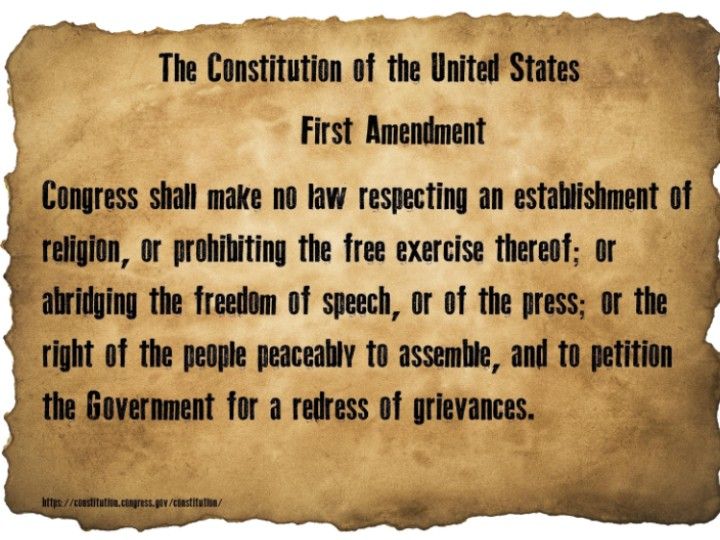
The conflict is a necessary precursor to the Second Coming. This isn’t an isolated incident. The MRFF indicates that since Saturday morning, similar reports have flooded in from every branch of the military, suggesting a coordinated or at least widespread shift in how some officers are justifying the mission to their subordinates. The Legal and Ethical Battlefield The U.S. military is governed by the Establishment Clause of the First Amendment, which prohibits the government (and by extension, military officers) from establishing or favoring a specific religion. When a commander uses their rank to promote apocalyptic theology, it creates a massive rift in unit cohesion. Why this matters now:
Unit Cohesion: Troops include Christians, Muslims, Jews, atheists, and practitioners of many other faiths. Forcing an “End Times” narrative on a diverse unit can alienate personnel and degrade trust.
Global Perception: Framing a strategic campaign as a “Holy War” or “Crusade” provides immense propaganda value to adversaries, potentially escalating the conflict beyond its original scope.
Command Influence: Subordinates often feel they cannot challenge these statements without risking their careers, leading to “toxic leadership” environments. A Divided Front While the White House and Defense Secretary Pete Hegseth maintain that the objective of Operation Epic Fury is the neutralization of nuclear threats, the “on-the-ground” messaging from some commanders tells a different story. Organizations like the Council on American-Islamic Relations (CAIR) and several mainline Christian denominations have already issued statements of “grave concern,” calling for an immediate investigation into these briefings. As the war enters its next phase, the Pentagon faces a two-front battle: one against a foreign adversary, and another against the erosion of the secular principles that define the American military. What do you think about the intersection of faith and the chain of command? Should commanders be allowed to share their personal convictions if they believe it motivates their troops, or is this a bridge too far? If you want to stay updated on the legal fallout, I can look into the specific Uniform Code of Military Justice (UCMJ) articles that these commanders may be violating. Would you like me to do that?
The situation regarding the U.S.-Israeli military operation in Iran and the confirmed death of Supreme Leader Ayatollah Ali Khamenei on February 28, 2026, represents a major geopolitical escalation. Markets typically react to such events with extreme caution, driven by uncertainty and the potential for long-term regional instability.
While I cannot offer financial advice, I can provide an analysis of how such events generally affect global markets.
1. Oil Market Implications
The primary concern for the energy market in a conflict of this scale is supply disruption.
Risk Premium: When conflict flares in the Middle East, oil prices often experience a “risk premium”—a price increase based on the fear that supply will be restricted. Even if physical supply is not immediately halted, traders bid up prices in anticipation of potential blockades.
The Strait of Hormuz: A critical concern for energy markets is the security of the Strait of Hormuz, a vital chokepoint through which a significant portion of the world’s daily oil production passes. If the conflict threatens this passage, the impact on global oil prices could be substantial and immediate.
Supply Concerns: With reports of strikes on Iranian infrastructure, markets will be closely watching for any damage to production or export facilities. Any sustained military engagement that affects Iran’s ability to export oil—or triggers retaliatory actions against regional infrastructure—would likely keep upward pressure on prices.
2. Stock Market Implications
Equity markets generally react negatively to geopolitical uncertainty. The typical behaviors include:
Heightened Volatility: Investors often move to reduce risk, leading to broader market sell-offs or high volatility (as measured by indexes like the VIX).
Flight to Safety: Capital often migrates toward “safe-haven” assets. Historically, this means increased demand for:
Government Bonds (e.g., U.S. Treasuries).
Gold and other precious metals.
The U.S. Dollar (USD), which is often viewed as a reserve currency in times of crisis.
Sector Divergence:
Energy Stocks: While oil prices rise, energy companies may see gains, though this is often balanced against the potential for general market downturns.
Defensive Sectors: Investors often rotate into sectors considered more resilient, such as utilities, consumer staples, or defense (due to increased military spending).
Travel and Discretionary: Industries like aviation, tourism, and consumer discretionary spending often face pressure due to rising fuel costs (which lower profit margins) and the general dampening of consumer sentiment during wartime.
3. The Factor of Uncertainty
The most significant variable right now is the duration and scope of the conflict.
The current reports indicate that the objective is “regime change” and the neutralizing of military capabilities. Markets despise ambiguity; until the path of this conflict—and the potential for a wider regional war—becomes clearer, analysts expect the markets to remain highly reactive to every new headline. Iran #OilPrices #StockMarket #Geopolitics #Khamenei
The audiobook for Rise of the Clones: The Cabbage Patch Babies is finally here and I’ve got a limited number of free trials to give away!
This isn’t just another book; it’s a mind-bending journey into the hidden origins of mankind. From the Anunnaki and Darwin’s Origin of Species to the dark history of human cloning, this audiobook peels back the layers of deception we’ve been fed for centuries.
We’ll dive deep into why figures like John Dee dedicated their lives to creating artificial life through the Homunculus and uncover the shocking connections between Ancestry.com, Blackstone and the global race to control your DNA.
The physical edition also includes dozens of images that bring these hidden histories to life.
Inside, you’ll uncover chilling chapters on:
• 🕸 The Darker Side of Disney • 🎭 Celebrity Cloning • 🍼 Cabbage Patch Babies • 🚂 The Orphan Trains • 👶 Baby Farms • 🧬 Hybrids & Inbreeding
Plus, you’ll hear firsthand stories from contributors whose families experienced child trafficking and life aboard the Orphan Trains; stories that have been buried for generations.
If you’ve ever wondered how we really got here, who pulled the strings, how far back cloning goes and what truly happened after the fall of Tartaria, this audiobook will change everything you thought you knew.
Want a free trial?
If you’re willing to leave an honest review, send me a direct message and I’ll personally send you the link.
Thank you all for your incredible support, let’s pull back the curtain together.
Guy Anderson – Author Tesla & The Cabbage Patch Kids Rise of the Clones: The Cabbage Patch Babies
Here’s a blog post summarizing the research on the Dos Palms flying serpent and the broader phenomenon of “American Dragons”:
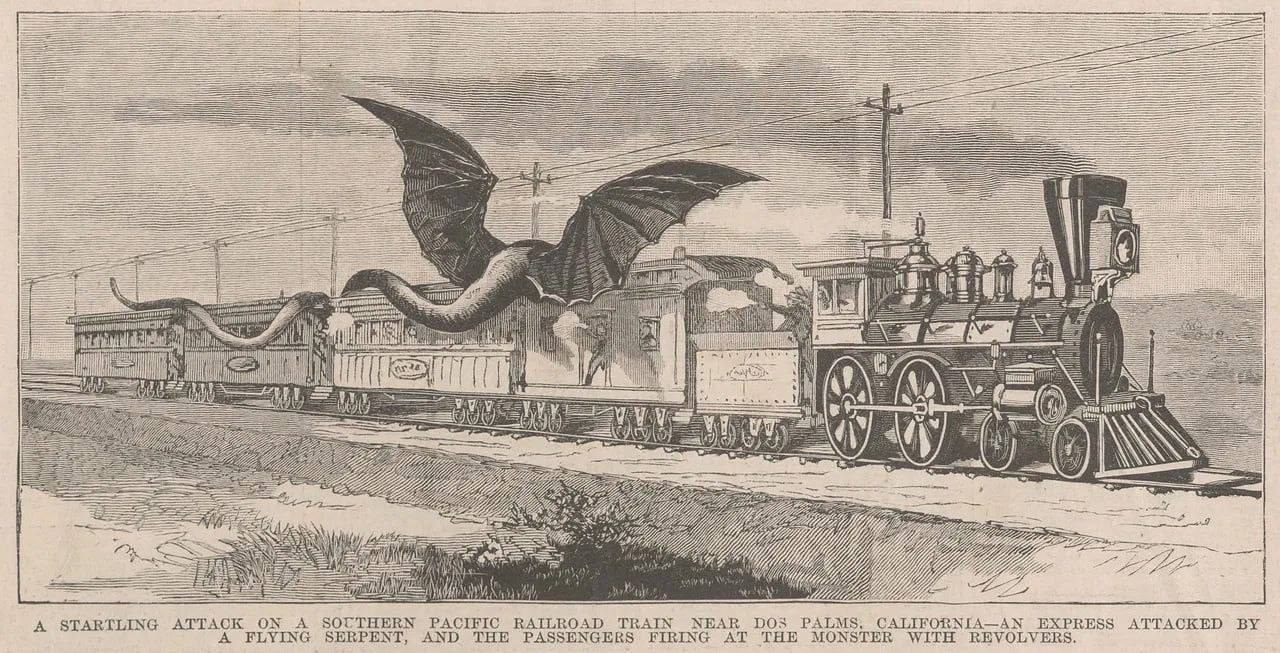
Imagine this: It’s 1882, and you’re on a Southern Pacific train, rumbling through the California desert. Suddenly, a colossal, winged serpent—30 feet long with bat-like wings—attacks your locomotive! Passengers are screaming, revolvers are firing, and the beast is “roaring like a cow in distress.” Sounds like something out of a fantasy novel, right? Yet, this was the sensational headline from The Illustrated Police News on March 18, 1882, detailing an alleged incident near Dos Palms, California.1
This isn’t just a wild tale; it’s a fascinating peek into the “weird news” landscape of 19th-century America, an era when “American Dragons” supposedly terrorized the Western territories.
The Dos Palms Incident: A Thrilling (and Dubious) Account
The story, purportedly relayed by the train’s engineer and fireman and “corroborated by passengers,” claimed the train clipped the serpent’s tail, enraging it. The creature then pursued the train “two miles faster than chain lightning,” thrashed it, shattered windows, and then sailed off, seemingly impervious to the passengers’ bullets.1 The
Los Angeles Times was even cited as reporting the event, though historical archives show some discrepancies in that claim.1 The
Times‘s concluding line, “This is vouched for by everyone who was on the train, and is given for what it is worth,” hints at the era’s blend of sensationalism and a subtle wink to the reader about the story’s incredible nature.1
“American Dragons”: A Pattern of the Peculiar
The Dos Palms serpent was far from unique. Mark Chorvinsky, editor of Strange Magazine, coined the term “American Dragons” to describe a recurring motif of winged reptilian monsters reported across the American West in the late 19th and early 20th centuries.3 These creatures shared remarkably consistent, often biologically impossible, traits:
Flight, Aquatic, and Terrestrial Abilities: They could fly, live underwater, and walk on land.3
Bullet Immunity: Bullets “invariably ‘rang as though striking armor plate’,” having “no effect”.1
Consistent Size: Typically 28 to 45 feet long, with the Dos Palms serpent fitting right in at 30 feet.1
Dramatic Encounters: Often involved confrontations with trains or livestock, vouched for by “reliable witnesses”.3
Lack of Evidence: Despite claims of specimens being killed, there was “invariably lacked follow-up coverage or physical evidence”.3
Beyond Dos Palms, other notable “American Dragons” included the fearsome Lake Elizabeth Monster in California 1, the legendary Tombstone Thunderbird of Arizona 4, and the “River Dragon” of Napoleon, Ohio.5
The Age of “Yellow Journalism” and Tall Tales
Why did such fantastical stories flourish? The late 1800s were a “perfect storm for sensational storytelling”.3 This was the heyday of “yellow journalism,” a style that prioritized “sensationalism over facts” to “boost circulation”.3 Publishers like Hearst and Pulitzer were locked in fierce competition, and outrageous stories, regardless of their factual basis, sold newspapers.3
Communication technology was limited, making “fact-checking nearly impossible”.3 Moreover, the frontier culture itself “embraced tall tales as entertainment,” with Western newspapers serving as “creative outlets for writers” who knew their readers expected that “almost anything could actually happen in this Lawless land”.3 It was an era where “even major newspapers ran stories of sea serpents, apelike wild men and haunted houses alongside more sober reporting”.1 Hoaxes like the Great Moon Hoax of 1835 and the Great Wall of China Demolition Hoax of 1899 were widely circulated, demonstrating the public’s appetite for a blend of information and fantasy.7
More Than Just Monsters: Cultural Significance
These “weird news” stories were more than just entertainment. They functioned as “cultural categories and symbols,” reflecting the “anxieties, concerns, and power dynamics of the time”.9 Monsters represented the “unknown and uncategorizable,” much like they did on earlier maps, symbolizing the uncertainties of exploration.9
In the American West, these monster encounters also played a role in “the construction and consolidation of masculine identities”.9 Confronting these creatures in the wilderness was framed as an opportunity for “daring adventurers” to “discover, combat, and capture unknown creatures,” symbolically “claiming the unknown for ‘civilization’ and scientific categorization”.9 The image of passengers firing revolvers at the flying snake perfectly embodies this cultural assertion of control over the wild and inexplicable.1
The prevalence of “weird news” also challenges the idea that the 19th century was a period of complete “disenchantment” from supernatural belief. Instead, it suggests a “continued, or at least semi-enchanted, worldview,” where a deep fascination with the preternatural persisted despite scientific advancements.9
Mark Chorvinsky: The Skeptical Investigator
Mark Chorvinsky, the researcher who documented “American Dragons,” approached these phenomena with “open-minded skepticism”.10 His
Strange Magazine aimed to apply the “scientific method to scientifically delinquent topics” like cryptozoology, not to convince readers to believe, but to investigate.10 He famously spent years researching the “infamous Thunderbird Photo,” ultimately concluding it “most likely does not exist,” but found value in studying why so many credible witnesses believed they had seen it.10 His work highlights the crucial distinction between studying folklore as a cultural artifact and attempting to validate it as biological fact, a common pitfall of cryptozoology.12
The Dos Palms flying serpent, and its “American Dragon” kin, may not have been real, but their stories offer a captivating window into a bygone era of journalism, frontier culture, and the enduring human fascination with the mysterious. They remind us that sometimes, the most incredible tales reveal the most about ourselves.
The Dos Palms Flying Serpent: A Case Study in 19th-Century American “Weird News”
Executive Summary
This report investigates the sensational 1882 “flying snake” attack on a Southern Pacific Railroad train near Dos Palms, California, as reported by The Illustrated Police News and purportedly by the Los Angeles Times. The incident is examined within the broader context of “American Dragons”—a recurring motif of winged reptilian monsters prominent in 19th and early 20th-century American folklore. The analysis reveals that the Dos Palms event, while presented as a factual account, exemplifies the pervasive “yellow journalism” of the era and the frontier culture’s embrace of tall tales, which often blurred the lines between genuine news and creative fiction. These “American Dragon” narratives, despite lacking verifiable evidence, functioned as significant cultural signifiers, reflecting societal anxieties, shaping masculine identities, and challenging the notion of a fully “disenchanted” world. The report underscores the critical work of folklorists and researchers, such as Mark Chorvinsky, in analyzing these phenomena as cultural artifacts rather than literal cryptozoological claims.
1. Introduction: The Dos Palms Flying Serpent – A Glimpse into 19th-Century “Weird News”
The headline from The Illustrated Police News on March 18, 1882, dramatically announced a “Terrible attack on Southern Pacific Railroad train near Dos Palms, Calif. Express attacked by flying snake, passengers firing at monster with revolvers”.1 This striking declaration immediately immerses the reader in an extraordinary historical account, one that defies conventional understanding of reality. The very existence of such a headline, presented as news in a widely circulated publication, signals a fundamental divergence in journalistic standards and public expectations compared to contemporary media.
The central inquiry of this report is how such extraordinary historical accounts, which challenge modern interpretations of factual reporting, are critically interpreted. This investigation aims to frame the Dos Palms incident not merely as a historical news item, but as a complex interplay of folkloric narrative, prevalent journalistic practices, and the broader cultural environment of its time. The initial encounter with such a sensational headline prompts an immediate recognition of the distinct historical, journalistic, and cultural contexts that allowed such stories to flourish, setting the stage for a deeper exploration of their origins and significance.
2. The Dos Palms Incident: Anatomy of a Frontier Sensation
The narrative of the Dos Palms flying serpent attack unfolds with vivid detail, placing the reader on a Southern Pacific express steam locomotive as it traversed the Colorado Desert from Yuma, Arizona, to Los Angeles, having just passed the oasis of Dos Palmas.1 Eyewitness accounts, purportedly relayed by the engineer and fireman and corroborated by passengers upon their arrival in Los Angeles, describe a peculiar sight: a “column of sand” about a half-mile ahead that inexplicably transformed into a strange animal, moving perpendicularly towards the train.1
The creature was described as approximately 30 feet long and 12 inches in diameter, with its tail dragging on the ground and two large wings positioned near its head, suggesting a serpentine yet avian or bat-like morphology.1 The encounter escalated violently when the swiftly moving train reportedly clipped a portion of the creature’s tail, an act that “enraged the enormous serpent.” It then pursued its “steel attacker” at an incredible speed, described as “two miles faster than chain lightning,” quickly overtaking the locomotive. Striking from a position of safety above, the monster “gave the train a lively thrashing, roaring like a cow in distress all the time,” shattering several windows in its onslaught.1 After the serpent pulled back and sailed off, passengers, given a moment to recover, unholstered their pistols and unleashed a “shower of lead” after the beast. However, the bullets, “if they hit their target at all, had no effect as the monster winged its way back across the desert sands”.1
The narrative is characterized by its highly dramatic and evocative language, employing vivid imagery such as “chain lightning” and “roaring like a cow” to captivate and thrill the reader. This stylistic choice is a hallmark of the sensationalist journalistic practices prevalent in the era. The inclusion of specific eyewitnesses—the engineer, fireman, and corroborating passengers—lends a superficial air of credibility to the fantastical event, despite its inherent implausibility.
A critical examination of the primary source claims reveals a significant discrepancy. While multiple sources explicitly state that the Los Angeles Times reported the incident on January 17, 1882 1, the provided digitized archive snippet for that date 2 shows the
Daily Los Angeles Herald with unrelated content. This contradiction highlights the inherent challenges of historical source verification and the potential for misattribution or unverified claims to be propagated through secondary sources. This factual inconsistency directly impacts the perceived “corroboration” of the event, suggesting that the Times citation might be a later, unverified reference in a secondary source, or that the specific Times article is not easily accessible in the particular archive consulted. This necessitates a critical re-evaluation of the claims of corroboration.
The concluding phrase attributed to the Los Angeles Times, “This is vouched for by everyone who was on the train, and is given for what it is worth” 1, is particularly revealing. This cautious phrasing indicates a degree of journalistic detachment or perhaps a tacit acknowledgment of the story’s incredible nature. This reveals a subtle yet significant tension within 19th-century journalism. While actively engaging in sensationalism to attract readers, there was often an implicit understanding, or even a playful acknowledgment, between the newspaper and its audience regarding the literal veracity of such outlandish tales. This suggests that readers might have consumed and enjoyed these stories primarily as entertainment, rather than strictly factual reporting, even when published by “major newspapers.” This dynamic underscores the blurred lines between news and fiction that characterized the era, where readers expected a blend of information and fantasy.3
3. “American Dragons”: A Recurring Motif in the American West
The Dos Palms incident is not an isolated anomaly but rather an early example of a rich tradition of winged reptilian monsters that were purportedly sighted terrorizing America’s western territories and wild environs during the latter half of the 19th and early 20th centuries.1 This phenomenon was notably dubbed “American Dragons” by Mark Chorvinsky, the founder and editor of
Strange Magazine, in a 2000 article.4 Chorvinsky, a multifaceted figure with a background as a stage magician, entrepreneur, filmmaker, and writer, dedicated his life to investigating strange and anomalous phenomena. His approach was characterized by “open-minded skepticism,” aiming to conduct in-depth investigations rather than simply to prove or disprove the existence of these creatures.5
Chorvinsky documented that these creatures exhibited “remarkably consistent patterns” across various Western states, suggesting a shared narrative template rather than independent biological sightings.4 They shared distinctive, often biologically impossible, characteristics: alleged ability to fly, live underwater, and walk on land—abilities “unknown to any real animal”.4 A recurring motif was their apparent invulnerability to conventional weaponry; bullets fired at them “invariably ‘rang as though striking armor plate’,” having “no effect”.1 Reported sizes consistently ranged between 28 to 45 feet in length, with the Dos Palms serpent, at 30 feet long, fitting squarely within this range.1 Encounters were typically dramatic, featuring “reliable witnesses who vouched for authenticity” and involved “dramatic confrontations with trains or livestock”.1 Crucially, despite claims of specimens being killed and pieces taken for analysis, these accounts “invariably lacked follow-up coverage or physical evidence”.4
The striking consistency in the characteristics attributed to “American Dragons” (e.g., flight, amphibious capabilities, bullet immunity, specific size ranges) points strongly to a shared cultural template or journalistic formula rather than independent sightings of a real cryptid. This suggests that these narratives were likely constructed or heavily embellished using established tropes from global dragon folklore 8 and then adapted to resonate with the specific cultural anxieties and expectations of the American frontier. This adaptation allowed these stories to serve particular cultural functions beyond simple entertainment.
Table 1: Recurring Characteristics of “American Dragons”
Characteristic Category
Specific Trait
Description/Observed Pattern
Locomotion
Flight
Capable of sustained flight, often described as fast (e.g., “two miles faster than chain lightning”).
Locomotion
Aquatic Ability
Able to inhabit and move through water bodies (e.g., Lake Elizabeth monster, Maumee River dragon).
Locomotion
Terrestrial Movement
Capable of movement on land, sometimes with difficulty (e.g., “tail dragging on the ground”).
Defense
Bullet Immunity
Bullets consistently described as ineffective, “ringing as though striking armor plate,” or having “no effect.”
Size
Length
Generally reported between 28-45 feet in length (Dos Palms serpent at 30 feet).
Witness Accounts
Witness Credibility
Accounts often “vouched for by everyone” on scene, with claims of “reliable witnesses.”
Witness Accounts
Type of Confrontation
Frequent dramatic confrontations with trains, livestock, or human adventurers.
Evidence
Physical Evidence
Persistent absence of physical specimens, follow-up evidence, or verifiable photographs (e.g., Thunderbird Photo).
Beyond the Dos Palms incident, other notable “American Dragon” reports include:
Lake Elizabeth Monster (California): Active from 1830 to around 1890, this creature was described as “probably the most fearsome being ever recorded in… America”.4 Its presence was heralded by volcanic rumbling and a potent, unsettling odor, and its roar was said to “curdle the blood of a mummy”.1 Physically, it was a slimy, reddish beast, about 30 feet long, with a long snout, jagged yellow teeth, enormous bat wings, long hind legs, a barbed tail, a shaggy yellow mane, and emerald, dinner-plate-sized eyes. It was known to attack livestock.1
Tombstone Thunderbird (Arizona, 1890): This legend involves a giant flying bird, initially reported with an alarming wingspan of 160 feet and a length of 92 feet, possessing smooth skin and transparent membrane wings.9 Later, more “reasonable” estimates for its wingspan were between 20-30 feet.9 The legend was significantly embellished by later accounts, particularly by Pearl, who added the now-famous element of a photograph depicting the carcass, which subsequently became a widely believed but ultimately non-existent “phantom photo”.6
Fletcher, Illinois “Huge Reptile” (1896): A farmer was startled by a huge reptile, described as 15 feet in length, as thick as a telegraph pole, black, and with a hooded head. Three smaller ones, measuring 18-20 feet, were seen struggling with a lamb. This sighting was reportedly witnessed by at least twenty persons.10
Napoleon, Ohio “River Dragon” (1902): Reports of this creature circulated for 15 years prior to 1902. It was seen on the banks of the Maumee River, moving with ease both on land and in water. Described as resembling a river lizard, it was 9-10 feet long, 24-30 inches high, and 14 inches across, featuring a large tail covered in minute scales and and two small, web-shaped feet.10
Snallygaster (Maryland, 18th-20th century): A bird-reptile chimera with a metallic beak, razor-sharp teeth, and sometimes octopus-like tentacles, rumored to suck blood. Notably, 1909 sightings were later revealed to be a hoax orchestrated by a Middletown Valley Register editor and reporter to boost readership, drawing themes from existing German folklore and the Jersey Devil legend.11
Crawfordsville Monster (Indiana, 1890s): Described as a “horrible apparition” in the sky, this creature became significant fodder for newspaper headlines. While its origins were eventually discovered to be earthly, its legendary status highlights the power of “fake news” in shaping public perception.12
4. The Press Landscape of the Late 19th Century: Breeding Ground for the Bizarre
The late 1800s in the American West provided a “perfect storm for sensational storytelling” within the burgeoning newspaper industry.4 This period coincided directly with the rise of “yellow journalism,” a distinctive journalistic style that prioritized “sensationalism over facts” primarily to “boost circulation”.4 Major newspaper publishers, such as William Randolph Hearst and Joseph Pulitzer, were engaged in “fierce battles for readership,” driving the competitive adoption of sensationalist tactics.4 The term “yellow journalism” itself originated from a popular cartoon strip, “Hogan’s Alley,” and subsequently expanded to describe the profit-driven, often exaggerated coverage of various events, including significant international conflicts.13
Several cultural and technological factors facilitated the proliferation of hoaxes during this era:
Communication Technology: The technological limitations of the 1880s meant that “fact-checking nearly impossible,” creating an environment where “outrageous stories” could “spread across the country before they could be properly verified”.4 This allowed hoaxes to gain widespread traction.
Frontier Culture: The prevailing frontier culture actively “embraced tall tales as entertainment.” Western newspapers, therefore, functioned not only as news sources but also as “creative outlets for writers” who found fertile ground in their readers’ expectations that “almost anything could actually happen in this Lawless land”.4
Blurred Lines in Reporting: It was a distinctive era in American journalism where “even major newspapers ran stories of sea serpents, apelike wild men and haunted houses alongside more sober reporting on politics, crime and daily life”.1 This demonstrates a fluid boundary between factual reporting and fantastical narratives.
Journalistic Ethics: 19th-century journalism, particularly the “New Journalism,” was characterized by a “less stringent adherence to facts compared to scientific documents”.14 Furthermore, practices such as the widespread “borrowing” of items from other newspapers, often “without attribution,” and the common inclusion of “gossip, rumors, and scurrilous personal attacks” contributed to a less rigorous ethical environment.3
The confluence of “yellow journalism,” limited communication technology, and a frontier culture that embraced tall tales created a powerful feedback loop. Sensational stories, regardless of their factual basis, demonstrably increased newspaper circulation 3, which in turn incentivized publishers to produce even more outlandish content. This dynamic actively shaped journalistic content, prioritizing reader engagement and entertainment over strict factual accuracy, effectively normalizing the inclusion of “weird news” as a legitimate and profitable journalistic genre. This represents a causal relationship where market forces fundamentally altered the definition and practice of “news” itself, transforming it into a hybrid of information and entertainment.
The period saw numerous prominent hoaxes widely circulated by American newspapers:
Table 2: Prominent 19th-Century American Newspaper Hoaxes
Hoax Name
Approximate Year(s)
Key Newspaper(s) / Originators
Nature of Hoax
Primary Purpose / Impact
The Great Moon Hoax
1835
The Sun
Fictional astronomical discoveries of lunar life
Boost circulation, entertainment, catalyst for journalism ethics discussion
Great Wall of China Demolition Hoax
1899
Four Denver reporters
Fabricated international news about demolishing the Great Wall
Satirical fiction mistakenly reported as genuine news
Highlights susceptibility to misinterpretation
Cardiff Giant / Taughannock Giant
1869 / 1879
Various newspapers
Fake archaeological finds of petrified giants
Entertainment, copycat hoaxes
Snallygaster (1909)
1909
Middletown Valley Register editor and reporter
Monster sightings
Explicitly designed to increase readership
Crawfordsville Monster
1890s
Various newspapers in Indiana
“Horrible apparition” in the sky
Cited as an example of “fake news” from the period
The Great Moon Hoax of 1835, published by The Sun, claimed astronomical discoveries of lunar life. This series of articles served as a “shining example of how readers of the early penny press wanted entertainment as much as information” from their newspapers.3 The hoax, which presented a satirical analysis, succeeded due to the “vulnerability of the reading audience who by this time began to expect a dose of fantasy with factual information”.3 The publisher never fully admitted fraud but acknowledged its “useful effect in diverting”.3 This event is considered a “catalyst for the discussion of what readers expected and needed from their news media in a time when objectivity was just a concept”.3 Other examples include the Great Wall of China Demolition Hoax of 1899, an elaborate fake news article concocted by four Denver reporters that spread internationally 4, and Mark Twain’s satirical massacre story, which was mistakenly reported as genuine news.4 The Cardiff Giant (1869) and its copycat, the Taughannock Giant (1879), were notable hoaxes involving the “discovery” of petrified giants.16 The 1909 Snallygaster reports were later revealed to be a hoax orchestrated by a
Middletown Valley Register editor and reporter, explicitly designed to increase readership.11 Similarly, the Crawfordsville Monster of the 1890s, described as a “horrible apparition” in the sky, became significant fodder for newspaper headlines in Indiana and is cited as an example of “fake news” from the period.12 These examples collectively demonstrate that the Dos Palms incident was not an isolated oddity but rather a typical manifestation of a well-established journalistic practice, where sensationalism and hoaxes were integral to the business model and cultural function of newspapers.
5. Folklore, Cryptozoology, and the Enduring Myth
Mark Chorvinsky posited that the “American Dragons” phenomenon was a cultural amalgamation, drawing from diverse sources including traditional European dragon legends, Native American beliefs in the Thunderbird as an avian storm deity, and the intricate lore surrounding the Piasa, a pre-European mural depicting a dragon-like creature.1 Globally, dragon legends, though varying in specific features across cultures (e.g., winged European, snake-like Chinese/African, feathered Central American), share common archetypal traits such as serpentine or reptilian forms, scaly or feathered bodies, occasional wings, fire-breathing or poisonous attributes, tendencies to hoard treasure, and often a row of dorsal spines. Many narratives culminate in heroes slaying these formidable beasts.8 Native American cultures possess a rich tapestry of myths and legends that serve to explain natural phenomena and the intricate relationship between humans and the spirit world. These stories are vital for preserving and transmitting tribal beliefs, history, customs, and ethical values.17 Examples of other vaguely dragon-like or monstrous cryptids in American folklore include the Cumberland dragon (also known as goosefoot or cheeklaceella) from Tennessee in 1794, described as a two-legged creature that emitted red matter from its mouth 18, and the Wimpus from Eastern Tennessee woodsmen folklore, a gorilla-shaped creature with giant claws that spins invisibly, turning anything that approaches into “syrup or varnish”.19
Mark Chorvinsky was renowned for his “in-depth, and sometimes controversial, investigations” and his commitment to “open-minded skepticism” in the study of anomalous phenomena.5 His publication,
Strange Magazine, aimed to apply the “scientific method to scientifically delinquent topics” such as ufology, parapsychology, and cryptozoology. Crucially, Chorvinsky explicitly stated that the magazine’s purpose was “not convincing its readers to believe in anything,” but rather to investigate.6 A notable example of his work is the Thunderbird Photo legend. Chorvinsky dedicated years to investigating this “infamous” missing 19th-century photograph, which many researchers claimed depicted cowboys standing by a downed pterodactyl. Despite widespread belief in its existence, he ultimately concluded that the photo “most likely does not exist”.6 However, he found significant value in studying the phenomenon of so many credible witnesses believing they had seen it.7 He meticulously traced the Thunderbird legend to an 1890 article in the
Tombstone Epitaph, noting that the original story did not include a picture and that the photographic element was a later embellishment by Pearl, which subsequently fueled the widespread belief in the phantom photo.6
Chorvinsky’s rigorous and skeptical approach to “American Dragons” and, specifically, the Thunderbird Photo 6 stands in stark contrast to the typical methodologies and objectives of cryptozoology. Cryptozoology is defined as a “pseudoscience and subculture” dedicated to the search for and study of unknown, legendary, or extinct animals (termed “cryptids”) that are popular in folklore, such as Bigfoot, the Loch Ness Monster, and the Yeti.20 Mainstream science widely regards cryptozoology as a pseudoscience because it “does not follow the scientific method” and relies heavily on anecdotal information rather than empirical evidence.20 Scholars have observed cryptozoology’s tendency to reject mainstream scientific approaches and, at times, exhibit hostility towards established science, often drawing parallels with other pseudoscientific pursuits like ghost hunting.20 Historically, instances of “irrefutable evidence” presented by notable cryptozoologists have frequently been exposed as hoaxes upon closer examination or confession by the perpetrators.20 A subset of cryptozoology actively promotes Young Earth Creationism, thereby rejecting conventional scientific understandings of geology and evolution.20 By shifting the focus from attempting to prove the literal existence of these creatures to analyzing the phenomenon of belief and the narrative construction behind them, Chorvinsky elevates the study from pseudoscience to a legitimate academic pursuit within folklore and cultural studies. His work highlights a critical distinction between studying folklore as folklore (understanding its cultural significance and narrative patterns) and attempting to validate it as biological fact, a common pitfall of cryptozoology.
6. Beyond the Headlines: Cultural Significance of Monster Narratives
The emergence of “weird news” served as a new, prominent medium for the fantastical in the 19th century, particularly as monsters seemingly disappeared from more intellectualized and scientific cartography.14 Monsters featured in “weird news” were more than mere entertainment; they functioned as “cultural categories and symbols,” directly reflecting the “anxieties, concerns, and power dynamics of the time”.14 These creatures represented the “unknown and uncategorizable,” mirroring how monsters on earlier maps symbolized the uncertainties and dangers of exploration.14 More broadly, monster narratives help societies process and articulate shared experiences of horror and address “real anxieties, from wars and economic disasters, to insane political situations, climatic ruin and other issues in the news”.21 They serve to convey deeper “truths” about societal fears: “evil is afoot, you can’t trust what you see, the future is grim, you’re going to die”.21 The 19th century itself was a period marked by significant intellectual shifts, including an “apocalyptic vision” of Earth’s history (e.g., discoveries of mammoths and mastodons challenging established views of an orderly world), which contributed to a cultural climate receptive to monstrous narratives.22
Within Western nations, particularly the United States, monster encounters reported in “weird news” played a significant role in the “construction and consolidation of masculine identities”.14 These encounters with monstrous creatures in wilderness or frontier zones were framed as opportunities for “daring adventurers” to brave risks, and to “discover, combat, and capture unknown creatures,” thereby symbolically “claiming the unknown for ‘civilization’ and scientific categorization”.14 The act of passengers firing revolvers at the flying snake in the Dos Palms incident 1 or cowboys shooting at the Thunderbird 9 directly embodies this cultural imperative to assert control and dominance over the wild and the inexplicable. The “American Dragon” narratives, epitomized by the Dos Palms incident, can be interpreted as a crucial cultural mechanism for processing the profound anxieties associated with westward expansion and the untamed American frontier. The recurring motif of “claiming the unknown for ‘civilization’ and scientific categorization” 14 through fictionalized or exaggerated encounters suggests a deep societal need to impose order and meaning upon a chaotic, unpredictable, and often dangerous environment. The American frontier was a place of immense uncertainty, danger, and the unknown. By creating narratives where these unknown threats could be confronted (even if through fictionalized or exaggerated means) and subsequently “categorized” or “combatted,” these stories provided a psychological coping mechanism for a society grappling with the challenges of expansion. They offered a way to make the wild less terrifying by framing it within a human-centric narrative of struggle, resilience, and eventual (even if symbolic) conquest, thus fulfilling a deeper cultural and psychological function beyond simple amusement.
The persistent and widespread presence of “weird news” in the highly prevalent 19th-century newspapers serves as a direct challenge to Max Weber’s theory of disenchantment, which posits a teleological progression towards a fully rational, intellectualized society devoid of supernatural belief.14 Instead, it suggests a “continued, or at least semi-enchanted, worldview,” where a deep-seated fascination with the preternatural and the unknown persisted, even flourished, despite the advancements of science and industrialization.14
7. Conclusion: The Legacy of the Flying Serpent
The Dos Palms flying serpent attack, as presented in the sensationalist press of 1882, was more than a mere sensational headline or an isolated incident. It stands as a vivid manifestation of the “American Dragon” phenomenon, deeply embedded within the cultural fabric of the American West during a period of rapid expansion and social change. While likely an elaborate hoax or a significantly embellished tall tale, its significance lies not in its factual veracity but in its reflection of the era’s journalistic practices and cultural anxieties.
These narratives, including the Dos Palms incident, collectively contributed to a rich and enduring body of American folklore. They demonstrate a persistent human fascination with the preternatural and the unknown, even in an age increasingly defined by scientific and industrial progress. Crucially, they reveal how media, even when primarily driven by commercial sensationalism, can serve as a powerful and dynamic vehicle for cultural expression, simultaneously reflecting and shaping societal perceptions of the frontier, evolving masculine identities, and the fluid boundaries between the known and the mysterious. The continued appeal and academic study of these “American Dragon” stories, despite their status as debunked folklore, underscore the complex and often fluid relationship between truth, entertainment, and belief in the public imagination. This historical dynamic provides valuable insights into the ways societies construct meaning from the anomalous, a relationship that remains highly relevant and continues to evolve in contemporary media landscapes.
Here are some tags that would be suitable for the blog post:
American Dragons,19th Century, Journalism,Yellow Journalism,Frontier Folklore,Monster Stories,Weird News,Historical Hoaxes,Dos Palms,Mark Chorvinsky,Cryptozoology (as a cultural phenomenon,Wild West,Sensationalism,
You’ve probably heard the whispers, seen the headlines: Yellowstone. The name alone conjures images of a sleeping giant, a supervolcano capable of unleashing unimaginable power. Barely a month goes by without some new tremor or steam-driven explosion sending shivers down the spines of disaster preppers and news editors alike. Sometimes, it feels like the whole world is holding its breath, almost willing Yellowstone to blow.
But what’s the real story? Do the latest scientific findings bring good news or bad? Let’s dig into what a Yellowstone super-eruption could truly mean for our planet.
Peering Beneath the Surface: New Clues from Yellowstone
Recent research by the United States Geological Survey (USGS), published in Nature in January 2025, has given us an unprecedented look at what’s brewing beneath Yellowstone National Park. By meticulously mapping the electrical conductivity of the underground rocks, scientists were able to create a 3D picture of the magma reservoirs. Why electrical conductivity? Because molten rock is up to a thousand times more conductive than solid rock, making it relatively easy to pinpoint.
So, what did they find? The good news is that the magma isn’t one giant, unified pool filling a subterranean void. Instead, it’s mostly contained in pockets, making up a relatively small percentage (2-30%) of the surrounding hot, solid rock. Even better, these magma-hosting areas aren’t all connected, meaning a single, colossal eruption that empties everything in one go is unlikely.
The most intriguing revelation, however, points to where the next major eruption might be centered. The magma isn’t evenly distributed. A significant concentration — somewhere between 400 and 500 cubic kilometers of sticky, silica-rich rhyolite magma — is lurking beneath the northeast section of the Yellowstone Caldera, the massive crater left by the last super-eruption 630,000 years ago. This is a larger volume than what erupted in Yellowstone’s considerable Mesa Falls blast about 1.3 million years ago. Adding to this, hot basalt magma from deep within the Earth is continuously pumping heat into this region, keeping the rhyolite magma hot and steadily increasing its volume.
While this might sound alarming, remember that the magma is spread out. For a truly “super” eruption to occur, these pockets of molten rock would need to connect and pool together, accumulating enough volume to be expelled in one massive event. Nevertheless, the researchers behind the Nature paper suggest this area is the most probable location for the next significant outburst. The burning question remains: when?
Is a Super-Eruption “Overdue”?
Despite popular belief, a Yellowstone super-eruption is not overdue. The idea that it’s on a strict schedule is a misconception. Looking back at Yellowstone’s history, there have been three major eruptions: the Huckleberry Ridge eruption (around 2.1 million years ago), the Mesa Falls eruption (around 1.3 million years ago), and the Lava Creek outburst (630,000 years ago).
The average time between these three events is about 735,000 years. However, if we only consider the two truly “super” eruptions (those exceeding the 1,000 cubic kilometer threshold for ejected material), the return period is closer to 1.5 million years. Given this geological timeline, the next Yellowstone super-eruption could still be a very, very long time away. But make no mistake, it will happen eventually, and its impact will be immense, affecting not just the United States but the entire planet.
What a Super-Eruption Would Look Like
To understand what a future Yellowstone eruption might entail, we can look to its past. All previous super-eruptions shared common characteristics: an explosion so powerful that magma was ripped apart, generating colossal amounts of ash. Each eruption was also followed by the collapse of the crust above the emptied magma reservoir, forming a giant caldera—like the 60-kilometer-wide Yellowstone Caldera we see today, which was created during the most recent Lava Creek eruption.
It’s also important to remember that between these enormous events, Yellowstone has experienced many smaller eruptions, often non-explosive lava flows. The last eruption, around 70,000 years ago, was a relatively quiet extrusion of lava.
So, what about the big one? What would we experience as Yellowstone prepares for a volcanic cataclysm, and during the eruption itself?
The Warning Signs
Predicting the exact timeline and warning signs for a super-eruption is challenging. Yellowstone is a restless place, with constant seismic activity, bubbling mud pools, and the ground continually rising and falling. While it seems logical that a super-eruption would be preceded by more intense versions of these same warning signs, research from other supervolcanoes, like Mount Toba in Indonesia, suggests that warning signs could be minimal, offering little notice of an impending, world-changing event.
This is particularly concerning for anyone living within about 100 kilometers (60 miles) of the Yellowstone volcano, as escape might be nearly impossible once the eruption begins. However, recent geological fieldwork indicates that the Lava Creek event was preceded by two smaller, explosive eruptions, perhaps separated by years or even decades. We might see similar “starter” events before the main course. The challenge, from a mitigation standpoint, is that it would be difficult to determine which eruption, if any, is the “super” one until after the fact, once the volume of disgorged material can be quantified. Regardless of the exact volume, any eruption of this magnitude would be cataclysmic for the country.
The Eruption Unfolds
When it comes, the next Yellowstone super-eruption will be impossible to ignore, and its consequences unavoidable, whether you’re nearby or on the other side of the world.
The eruption would likely begin at a single vent where the crust above the magma reservoir is weakest. As gas-rich, highly viscous rhyolite magma, under immense pressure, breaches the surface, it would violently tear itself apart. The initial detonation would be deafening to anyone in the vicinity.
A towering plume of ash and pumice would blast upwards faster than the speed of sound, reaching the edge of space within minutes and then spreading laterally, plunging everything below into darkness. A torrent of hot ash and pumice falling across Yellowstone and the surrounding region would ignite fires, heat the air, and make breathing nearly impossible. But that’s just the beginning.
As parts of the eruption column collapse under their own weight, they would trigger pyroclastic flows—fast-moving surges of hot ash, incandescent gas, and near-molten pumice fragments. These flows would hurtle outwards at speeds exceeding 300 km/h (180 mph), overtopping hills and filling valleys, incinerating and burying everything within about 100 kilometers (60 miles) of the vent.
Meanwhile, the upper part of the ash and pumice column would expand rapidly, forming a gigantic “umbrella” cloud that spreads darkness and a deluge of ash. Within 24 hours, ash would be falling across much of the United States and parts of Canada, causing widespread disruption: power outages, electronic failures, transportation chaos, flattened crops, and contaminated water supplies. Normal life would grind to a halt.
USGS modeling suggests that in most scenarios, ash more than a centimeter deep would cover an area of several million square kilometers. While cities like Miami and New York might only see a few millimeters of ash, Chicago, San Francisco, and Winnipeg could receive up to 3 centimeters. Areas closer to Yellowstone, such as Denver and Salt Lake City (within 1,500 km or 930 miles), would experience extremely disruptive ashfall, potentially meters deep closer to the volcano.
The ash, laden with toxic metals like arsenic, cadmium, lead, and mercury, would pose a long-term contamination threat to water, crops, and animal feed. The eruption would likely unfold in stages, possibly with new vents opening, prolonging its disruptive impact. The most intense phase could occur as the central block of crust above the magma reservoir sinks into the evacuated space, forming a new caldera. In total, the entire event could last for weeks, perhaps even a month. But the immediate aftermath is only part of the story.
A Global Sunshade and Catastrophic Aftermath
While the heavy ashfall would devastate agriculture across North America and cripple the U.S. economy, the truly global impact would come from the vast quantities of sulfur dioxide gas blasted into the stratosphere. Within weeks, this gas would spread across the planet. When combined with atmospheric water vapor, it would form an aerosol of tiny particles, creating a global “veil” that reflects incoming sunlight and significantly lowers surface temperatures.
To put this in perspective, the 1991 eruption of Mount Pinatubo, though a major 20th-century volcanic event, was about one hundred times smaller than Yellowstone’s Lava Creek eruption. Yet, it caused a global temperature drop of about 0.5°C (1°F) for a couple of years. The 1815 eruption of Indonesia’s Tambora volcano, three to four times larger than Pinatubo, had a much greater impact, leading to the infamous “Year Without a Summer” in Europe, with widespread harvest failures and civil unrest.
So, what if Yellowstone, an eruption 25 times larger than Tambora, were to blow? Computer models predict a global temperature drop of up to 4°C (7°F) on average, up to 7°C (13°F) across land, and more than 10°C (18°F) across central North America. While temperatures would slowly climb back within a few years, it could take a couple of decades to return to previous levels. This severe cooling, nearly matching Ice Age temperatures, would be catastrophic for global agriculture, leading to widespread harvest failures and famine on an unimaginable scale, affecting both developed and developing nations. It’s hard to imagine global society and economy surviving in any recognizable form.
A Glimmer of Hope?
There is one small ray of light. A recent NASA study, though breaking with the general consensus, speculates that the temperature fall after a Yellowstone super-eruption might not be significantly greater than that following Pinatubo or Tambora, although the researchers acknowledge significant uncertainties.
Ultimately, the true severity of the resulting cooling won’t be known until Yellowstone erupts again. However cold it gets, the direct impact on the United States would have enormous repercussions worldwide and would severely test the resilience of global society and economy.
Perhaps the only true saving grace, as the latest research tells us, is that it doesn’t look like happening anytime soon.
Want to keep up to date with the latest news from Science Focus? Sign up to receive our free newsletter!
Bill McGuire is a volcanologist, climate scientist, writer, and broadcaster. His latest book is Sky Seed.
Yellowstone Park Ranger Injury please hang up and dial 911 for the most up-to-date planning information on Park lodging camping and things to do visit the park website at http://www.n ps.gov/ye ll Please listen carefully the following menu for information on the status of roads in the park press one for recorded message on how to reserve lodging and camping in the park. Press two for information about planning back country trip or obtaining a back country permit press three if you were inquiring about a lost and found item press four if you have further questions, please email YELL _ Information at nps .gov or press five thank you Yellowstone National Park
You Yeah, hey good afternoon. How are you?
Yellowstone Park Ranger Good how are you?
You Pretty good just I’m calling. I’m sure you’ve been getting maybe a lot of different phone calls lately. I’m just about on TikTok and across social media. They’ve been talking about animals acting funny in the park there. Just wondering if there’s any truth to that.
Yellowstone Park Ranger No, there’s not. I got someone who called earlier asking about I guess on TikTok they saw bison and bears like leaving the park and that is not true so
You That’s not true you guys haven’t had any seismic activity lately. That’s been a little odd at all.
Yellowstone Park Ranger No, we have not. That is also false. Whatever I mean we have about 3 000 earthquakes per year here in Yellowstone most than you don’t even feel as far as the giant volcano that we have we would be able to tell about 5 to 8 years in advance when that would go off so no.
You 5 to 8 years in advance wow that’s pretty good So there’s nothing strange going on up there at all at this point
Yellowstone Park Ranger Nope
You That’s definitely good. Relief to know OK Would you recommend any websites for people to look at to find out information?
Yellowstone Park Ranger I mean, it would just be our website the national Park service Yellowstone website or our national Park service app as well
You And if they do go on those apps, what they look for as far as information
Yellowstone Park Ranger I mean, it’s I mean it depends what are you trying to find I don’t I don’t understand. What are you trying to look for
You Just different activity, strange activities, nature, wise
Yellowstone Park Ranger Yeah, we don’t really have anything that talks about that unnecessarily you could I mean another reliable source would be are the Yellowstone official Instagram sometimes they’ll post things that are going on in the park that are maybe a little weird but not that would be the best
You OK, so there’s like no alert pages or anything like that
Yellowstone Park Ranger Not that I know of not not that would be reliable that are for the public
You OK, well yeah I was just kind of wondering about that as far as like if there were natural disasters or anything like that you know like storms or you know regular alert type things
Yellowstone Park Ranger I mean that you would probably find again on our website there’s like areas where you can kind of. See you know if there’s any like if places are closed or trails are closed for any sort of reason they would say it on there but no there’s there’s nothing really like that. We are explaining.
You Well, that’s good. I’m glad I gave you guys a call cause I kinda like to do a little bit of research into things you know as far as like I’m more of a skeptic than anything so that’s why I’m calling to kind of clear things up. So well, I appreciate your you know your answers and stuff. What’s your name by the way?
Yellowstone Park Ranger You Southeast
You Oh, that’s interesting. What culture is that from?
Yellowstone Park Ranger It’s a French name I’m not French, but the name is French yeah
You The first time I’ve ever heard that name that’s pretty cool All right, well thank you for your time. I appreciate it and you have a wonderful day and God bless you.
Yellowstone Park Ranger Of course, thank you so much. Have a good day bye-bye.
Hydrogels are remarkable materials known for their ability to absorb and retain large amounts of water. The type of hydrogels used for atmospheric water harvesting, like the one developed by MIT, are specifically engineered to not only absorb water vapor from the air but also to efficiently release it for collection as liquid water.
Here’s a breakdown of the kind of hydrogels that can absorb and “make” water in this context:
1. Hydrophilic Polymer Networks:
At their core, hydrogels are three-dimensional networks of hydrophilic (water-attracting) polymers. These polymers are cross-linked, meaning they are chemically or physically bonded together to form a stable, insoluble gel structure.
The hydrophilic groups (like hydroxyl, carboxyl, or amine groups) within the polymer chains have a strong affinity for water molecules, allowing the gel to swell significantly as it absorbs moisture.
To enhance their water absorption capabilities, especially in dry air, hydrogels used for atmospheric water harvesting are often infused with hygroscopic salts, such as lithium chloride (LiCl).
Salts like LiCl are powerful desiccants, meaning they naturally attract and hold water molecules from the surrounding environment, even at low humidity levels.
MIT’s research, in particular, focused on significantly increasing the amount of lithium chloride infused into the hydrogel (up to 24 grams of salt per gram of polymer) to achieve “record-breaking” vapor absorption.
3. Tuned Microstructure and Composition for Absorption and Release:
Swelling and Deswelling: The hydrogels are designed to undergo reversible swelling and deswelling. They absorb water vapor from the air, expanding like a sponge. When heated (e.g., by sunlight), they release the absorbed water as vapor.
Preventing Salt Leakage: A key innovation in the MIT hydrogel is the incorporation of glycerol. Glycerol is a liquid compound that helps stabilize the lithium salt within the hydrogel, preventing it from crystallizing and leaking out with the collected water. This ensures the collected water is safe for drinking, as salt levels remain below standard thresholds.
Designed Porosity/Structure: While some hydrogels have micro or nano-pores that can lead to salt leakage, the MIT design specifically engineered the hydrogel’s microstructure to lack nanoscale pores, further limiting salt escape. Additionally, they molded the hydrogel into a “bubble wrap”-like pattern of small domes to increase surface area, optimizing water vapor absorption and release.
Thermo-responsiveness: These “smart” hydrogels are often thermo-responsive, meaning their ability to absorb and release water is influenced by temperature. The MIT hydrogel, for instance, releases water efficiently when heated by the sun. Some hydrogels, like polyethylene glycol (PEG), have even shown an increase in water absorption as temperatures climb, due to a phase transformation in their microstructure.
In essence, the hydrogels capable of absorbing and “making” water are sophisticated polymeric materials, often enhanced with specific salts and designed with optimized structures to efficiently capture atmospheric moisture and then release it as clean liquid water through a controlled process, often driven passively by solar heat.








 Anti Deep State Party