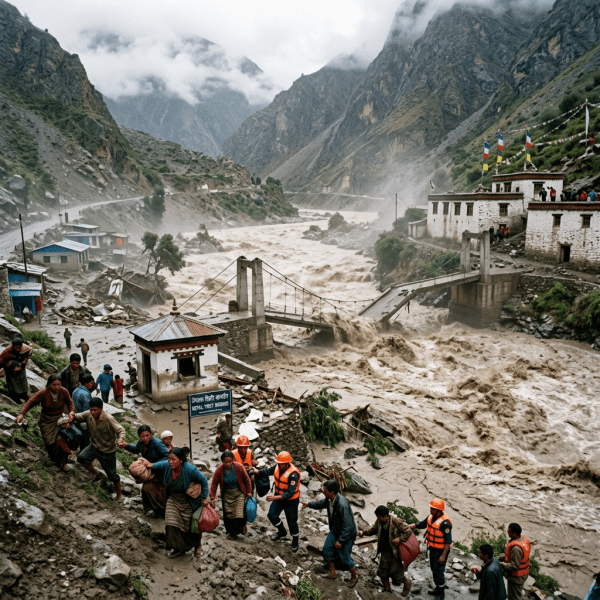
A catastrophic disaster has unfolded along the Himalayan border corridor separating Nepal’s Rasuwa district and China’s Tibet region. A sudden wall of water, mud, and heavy debris tore down the Bhote Koshi river system, obliterating key infrastructure, engulfing entire border settlements, and leaving communities on both sides of the frontier in crisis.
What Triggered the Disaster?
Early scientific and governmental assessments indicate that a 4.4-magnitude earthquake struck the region around 8:37 AM.The tremor is believed to have triggered a massive ice and rock avalanche into the Lhende Khola river.
The resulting debris temporarily dammed the waterway before giving way, unleashing a massive flash flood down the Bhote Koshi and Trishuli rivers.Experts from the International Centre for Integrated Mountain Development (ICIMOD) are actively monitoring the site to confirm whether a Glacial Lake Outburst Flood (GLOF) or a secondary landslide-dam burst was the main driver.
The Human Toll and Missing Foreign Travelers
The disaster struck during peak travel and pilgrimage season, resulting in heavy casualties among locals, workers, and international visitors:
- Confirmed Casualties:At least 98 people have been confirmed dead, with search efforts ongoing as emergency crews dig through meters of thick sediment.
- Unaccounted For:Over 380 to 480 people are currently listed as missing.
- International Visitors:The affected area serves as a major gateway for tourists and Kailash Manasarovar pilgrims.The missing include over 100 Indian nationals, along with tourists and workers from the US, UK, South Korea, Malaysia, and Nepal.
Infrastructure Overwhelmed
The flood destroyed critical trade, transit, and power facilities across the border region:
- Gyirong Port (Tibet):The primary overland land crossing between China and Nepal was inundated with thick sediment and floodwaters, cutting off local communications, power, and transit routes.
- Cross-Border Transit:The Friendship Bridge near Rasuwagadhi and multiple downstream bridges along the Trishuli River were swept away, severing vital supply routes.
- Power Grid Impact:Over 430 MW of hydroelectric capacity—representing more than 12% of Nepal’s entire national power generation—was knocked offline as plant sites were engulfed by the torrent.
Ongoing Emergency Efforts & Warnings
Rescue crews, military units, and medical teams have been deployed on both sides of the border.Helicopters and heavy excavators are attempting to clear roads and evacuate survivors, but efforts are severely hindered by damaged access routes and high water levels.
Disaster management authorities have issued emergency alerts for communities downstream along the Trishuli and Narayani river systems.Residents in low-lying areas are being advised to move to higher ground due to the ongoing threat of secondary flooding caused by lingering upstream blockages.


